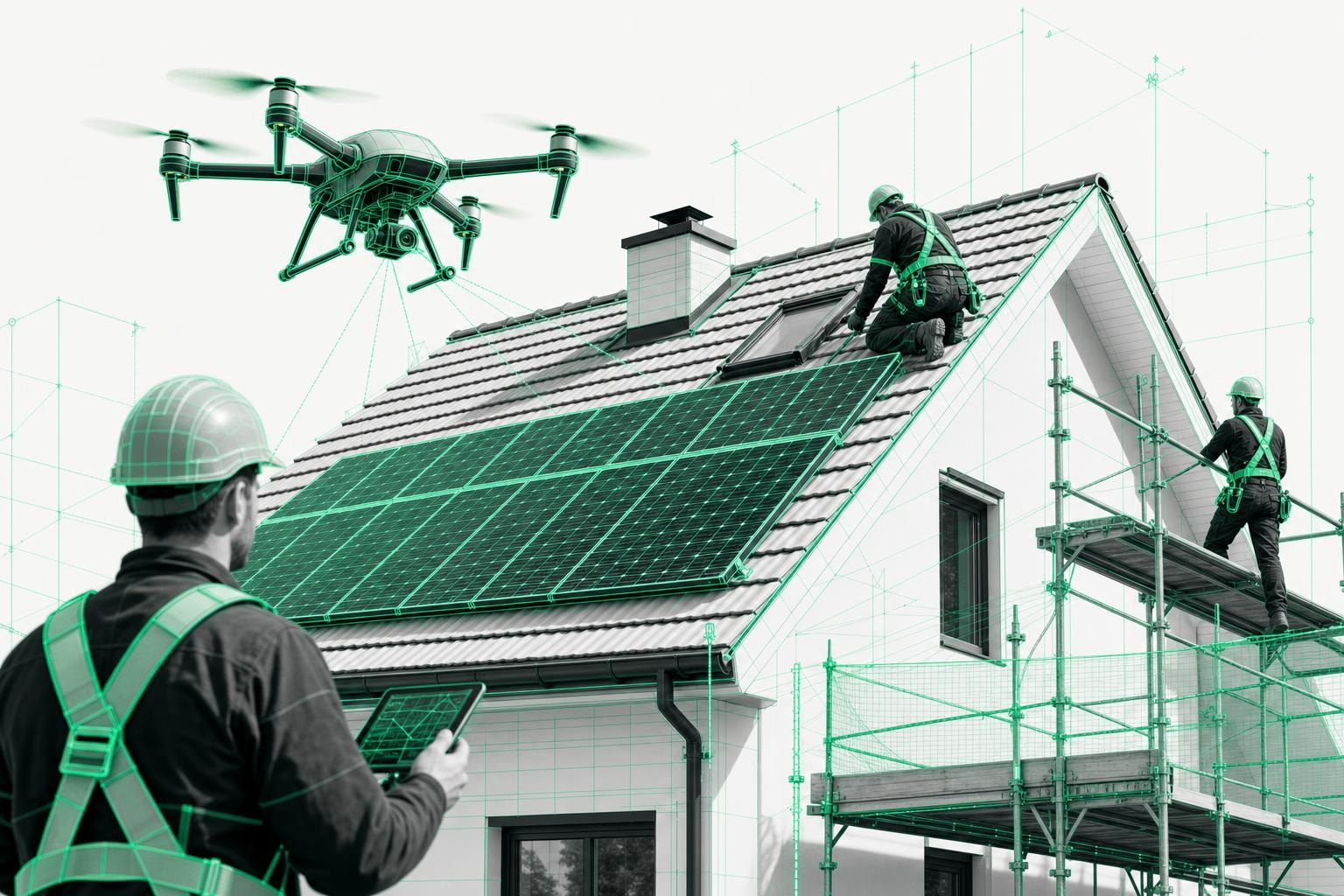
Every working day, an average of 20 people fall from height on German construction sites. Not during high-risk specialist jobs - but often during routine tasks like taking measurements, first inspections and roof checks. The figures that BG BAU and ZVDH are publishing for 2025/2026 are a clear warning signal for every business owner in roofing, solar installation, carpentry and scaffolding.
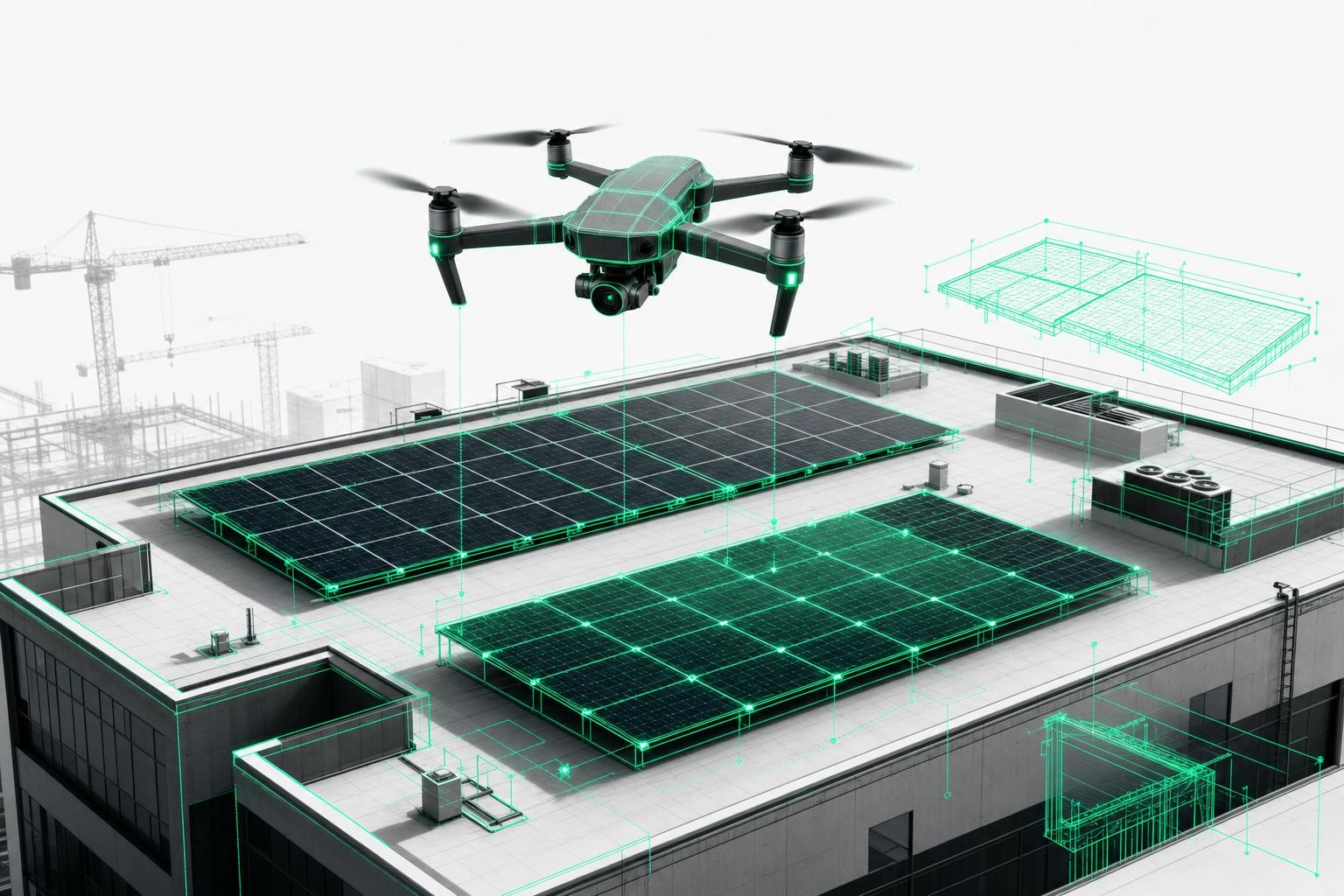
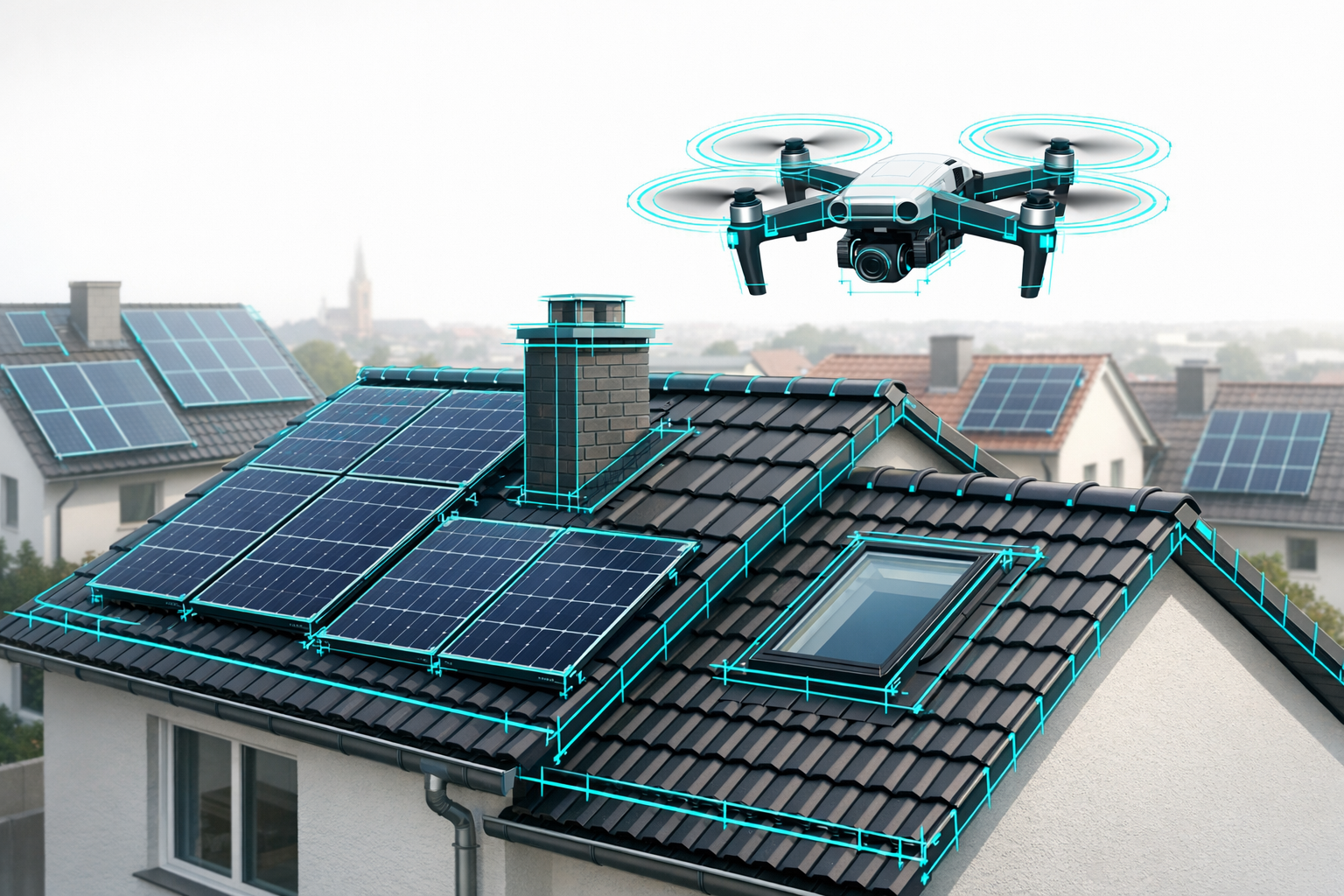
The good news: many of these risks are now completely avoidable. Modern drone surveying delivers more precise measurement data than traditional methods - without anyone having to step onto the roof. This makes drone roof inspection an important part of modern roofing safety.
The hard numbers: What the 2025 BG BAU statistics really mean
| Indicator | Number / Fact | Source |
|---|---|---|
| Falls from height accidents Jan-Oct 2025 | 6.178 notifiable | BG BAU (preliminary) |
| Of which fatal (Jan-Oct 2025) | 26 deaths | BG BAU (preliminary) |
| Fatal falls from roofs 2024 | 14 (12 outside, at least 10 inside) | BG BAU |
| Falls-from-height accidents total 2024 | 7.231 notifiable, 26 fatal | BG BAU |
| Share of falls in fatal construction accidents | approx. 36% | BG BAU 2024 |
| Most common accident triggers | Ladders, scaffolds, roofs / roof trusses | BG BAU |
| BG BAU Fall Premium (contribution-independent) | 50% of the acquisition costs | BG BAU Premium Catalog |
| PV-related fatal falls 2025 | 3 (assembly, maintenance, cleaning) | BG BAU |
In the first ten months of 2025, BG BAU received reports of 6,178 fall accidents, 26 of them fatal. And the year is not even over yet - by comparison: in the whole of 2024, BG BAU recorded 7,231 fall accidents, again 26 of them fatal.
What is particularly alarming is the distribution: around 36% of all fatal workplace accidents in construction are fall accidents - by far the largest single category. Fourteen people fell from a roof within one year.
On top of that: 50% of fatal fall accidents happen from heights of less than 5 meters. A fall from a single-family house can be just as deadly as a fall from an industrial hall.
The solar boom is making the problem worse
With the solar boom in Germany, the number of roof jobs is rising - and so is the risk of falls. Three fatal fall accidents in 2025 were directly linked to PV work - installation, maintenance or cleaning.
"Almost all fatal fall accidents occurred inward," BG BAU notes. The main problem is not falling over the roof edge, but breaking through decayed roof elements on the surface itself. Old corrugated asbestos sheets, brittle skylights, rotten substructures - what held for decades can become a death trap the moment someone puts their full weight on it.
The "Safe on the Roof" initiative
This is why ZVDH and BG BAU have launched the joint initiative "Safe on the Roof". The goal: to raise awareness among companies and workers for safe work on roofs and to support them with practical materials for implementing occupational safety measures and construction site safety regulations. A training calendar with twelve safety topics guides you through the year 2026 and can be used directly for your company's health and safety briefings.
Liability risks for business owners: What many underestimate
Legal obligation for business owners: In accordance with the Occupational Safety Act (ArbSchG) and DGUV Regulation 1, employers are required to perform a risk assessment before every hazardous task. Anyone who sends employees onto roofs without fall protection - even just for a measurement - can be personally liable in the event of an accident. BG BAU explicitly requires: No work on the roof without a prior risk assessment.
As a business owner, you carry personal responsibility for every employee you send up on a roof - even for a "quick measurement". BG BAU's core requirement is clear: no work on a roof without a prior risk assessment.
What does that mean in practice?
- Regulatory offences and fines if there is no risk assessment or if fall protection is inadequate
- Personal liability of management if a workplace accident is caused by demonstrably insufficient safety measures
- Higher BG contributions due to a worse accident record (the BG BAU bonus system works both ways)
- Loss of contracts due to reputational damage after an accident
Missing or poor-quality risk assessments are among the main causes of fatal roof accidents - especially for retrofitted PV installations on older buildings.
BG BAU occupational safety bonuses: What you need to know
The positive side: if you invest in occupational safety, BG BAU will support you financially. This pays off twice - more safety in your company and attractive grants for purchases such as safety equipment, additional gear or the organisation of health and safety.
Especially relevant for fall prevention: every eligible measure in the "fall" category is subsidised under the contribution-independent funding scheme with 50% of the acquisition costs. This new funding can be combined with the existing contribution-dependent funding - so you benefit twice.
Why roof walkdowns for measurements are no longer necessary
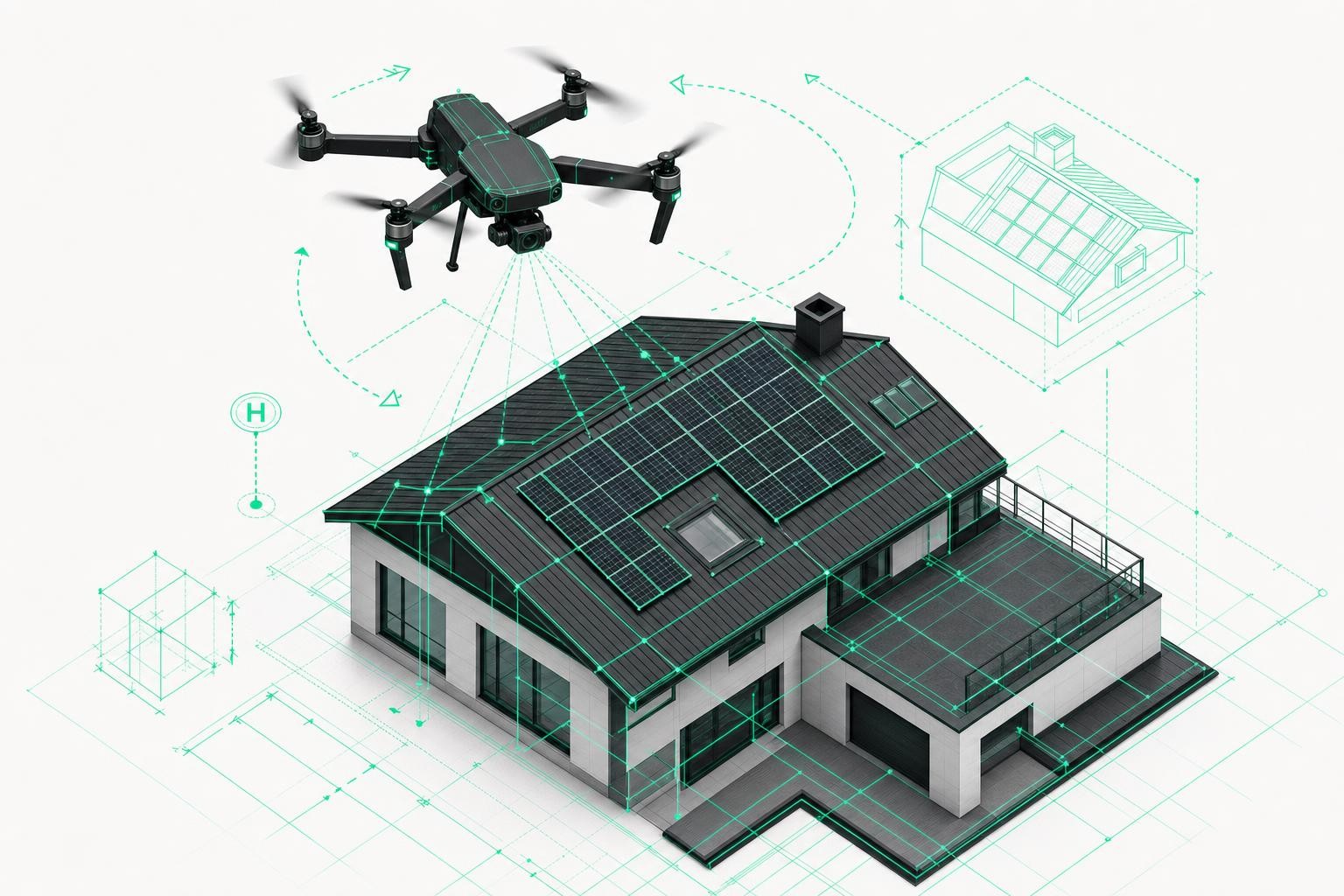
This is where a crucial shift in thinking starts: not every roof walkdown is unavoidable. Measurements, initial inspections and planning data can now be created reliably and in a compliant way from the ground - using a drone and AI.
The Airteam Fusion platform makes exactly this possible: a single drone flight around the building is enough. The AI processes the images fully automatically and delivers within 24 hours DIN-certified 3D models with accuracy of up to 99.9% and a tolerance of 1-3 cm at a flight height of 40 m.
What drone surveying delivers in comparison
| Traditional roof measurement | Airteam drone surveying | |
|---|---|---|
| Safety risk | High (risk of falling) | Zero (from the ground) |
| Measurement accuracy | Varies, prone to error | 99.9%, DIN-certified |
| Time required | Several hours | Drone flight + 24 h data |
| Roof walkdown needed? | Yes | No |
| Data export | Manual, error-prone | 15+ formats, ready to use |
| Risk assessment | Complex, manual | Data automatically provides a basis |
Companies that switch to Airteam report time savings of up to 90% for measurements. No ladders, no scaffolding, no fall risk - and more precise data than ever before. For many businesses, this is now the standard for safe, efficient drone roof inspection.
This is not a theoretical promise: Dachdeckerei Mann GmbH now measures 6,000 m² of roof area with over 100 dormers in just 2 days - instead of weeks. And master roofer Benjamin Harnack achieves a complete 3D roof model via drone flight, saves 90% of his time and prepares quotes directly based on the drone data.
Which trades is this relevant for?
Drone surveying is not a niche topic just for roofers. The risk of falls affects all trades that regularly inspect or measure buildings and need to take roofing safety seriously:
Roofers
Measurements, damage assessment, quote planning - all classic use cases where nobody needs to set foot on the roof anymore. More on 3D roof measurement for roofers
Solar installers and PV planners
Especially for PV planning on existing buildings, installers are often the first to step on the roof - onto structures they do not know. Drone surveying provides roof geometry, slopes, shade analysis and all planning data before anyone goes up there. More on PV planning with drones
Carpenters
For roof extensions, refurbishments and timber structures, precise building data is essential. Drone surveying for carpenters
Scaffolders
Facade and roof measurements for scaffolding planning can be created from the ground by drone - with exact 3D facade data that can be exported directly to Scaffmax and similar tools. Drone surveying for scaffolders
How to integrate drone surveying into your safety workflow
Getting started is easier than many think. Here is how you can establish drone surveying as a fixed part of your occupational safety strategy and align it with modern construction site safety regulations:
1. Replace measurement walkdowns with drone flights For all initial inspections, measurements and checks: fly the drone, upload the images, done. No employee steps onto the roof for measurement purposes.
2. Use the 3D model as the basis for your risk assessment The finished model highlights hazards like skylights, brittle roof areas or access problems - before anyone sets foot on the roof. This makes the risk assessment much easier and fully documentable.
3. Integrate the data into your planning software Airteam data is directly compatible with PV*SOL, AutoCAD, SEMA, Scaffmax, MF Dach, Eturnity and over 15 other formats. No media breaks, no manual data transfer.
4. Adapt your annual safety briefing Document the use of drone surveying as a preventive occupational safety measure in your annual briefing. The BG BAU training materials from the "Safe on the Roof" initiative provide suitable templates.
5. Check BG BAU funding Check whether the purchase of your drone or drone starter set can be subsidised through BG BAU occupational safety bonuses[1]. The combination of contribution-dependent and contribution-independent funding can cover up to 50% of your acquisition costs.
Conclusion: Less risk, more precision - and you can start right away
The BG BAU figures are clear: "Every day, 20 people fall from height on German construction sites: from scaffolding, ladders, platforms, elevated workplaces, from or through roofs and roof surfaces."
Many of these accidents happen during tasks that no longer require a roof walkdown. This is not a vision of the future - it is everyday practice in thousands of construction and trade businesses that already rely on drone surveying and drone roof inspection.
Switching to drone surveying is not a complex IT project. With an Airteam Starter Set, you are ready to go within a few days - including training, hardware, software and support. If you prefer to try it first: the Airteam Fusion platform is available free of charge and without risk for 14 days.
Protect your team. Increase your precision. Work safer than ever before.
Frequently asked questions
Is a drone flight for a survey legally safe — do I need permission?
For commercial drone flights in Germany you need an EU drone license (A1/A3 or A2, depending on drone weight and use). Airteam offers training and full support for this. Alternatively you can hire an Airteam pilot who will handle the flight for you - easy, compliant with regulations, and with no effort on your part.
Can drone surveying really replace all roof inspections?
For surveys, inspections and planning of PV, roof, or scaffolding projects: yes, in most cases completely. The Airteam Fusion platform provides centimeter-accurate 3D models with DIN-certified precision. For specific installation work that requires physical access, the roof understandably still needs to be walked on - but then with a safety plan clearly derived from the 3D data.
How accurate are Airteam's measurement data?
Airteam delivers DIN-certified accuracy of up to 99.9%, with a tolerance of 1-3 cm at 40 m altitude. This is significantly more precise than manual measurement methods and eight times more accurate than satellite data.
How quickly will I receive the 3D data after the drone flight?
Airteam's AI processes your drone images automatically in the cloud. Typically you will have the finished 3D models and planning data available within 24 hours - exportable in over 15 formats for PV*SOL, AutoCAD, SEMA, Scaffmax, MF Dach and many more.
Can my company receive funding from BG BAU for the purchase of a drone?
BG BAU offers occupational safety grants for investments in fall protection. Check BG BAU's grant catalog to see which devices and measures are eligible for funding. In addition to contribution-based funding, there are non-contributory fall-protection subsidies that can cover up to 50% of the purchase costs.
Further articles on the Airteam blog: