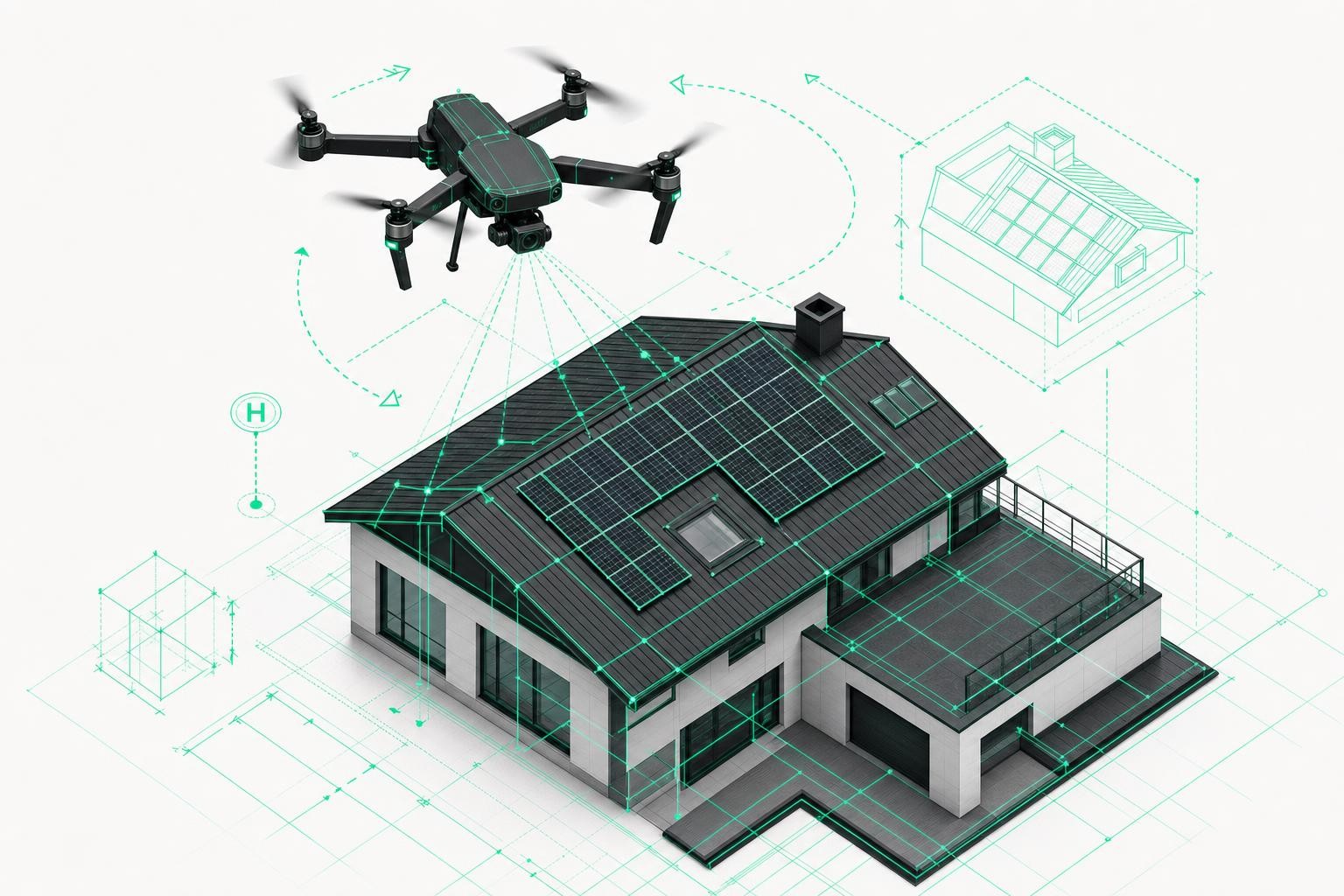
If you're a roofer, carpenter, or construction contractor flying a drone for commercial purposes, you need more than just a good piece of equipment - you need the right license. Since the EU Drone Regulation came into effect, a unified system applies across all participating countries. And as of July 2026, the BG BAU (the German statutory accident insurance for the construction industry) is even offering financial support to help cover the cost. This guide explains which license is required for typical construction use cases, what it costs, and how the funding works.
The EU Drone License System: Two Certificates, One Clear Framework
In the open category, there are two drone licenses recognized across all participating countries: the EU Competency Certificate A1/A3 (the "basic drone license") and the EU Remote Pilot Certificate A2 (the "advanced drone license").
Both certificates are valid for 5 years and must be renewed through refresher exams or recurrent training courses.
Basic Drone License: EU Competency Certificate A1/A3
For all classified drones other than C0, at minimum the EU Competency Certificate A1/A3 is required - this applies primarily to the common drone classes C1, C2, C3, and C4 (classified drones weighing more than 250 grams).
Drones in classes C2 and C3 may only be operated with the basic license under subcategory OPEN A3 - meaning well away from uninvolved persons and with a minimum horizontal distance of 150 meters from residential or commercial areas.
For typical construction applications - roof surveys over occupied buildings, facade inspections, or monitoring on active job sites - the A1/A3 certificate alone is usually not sufficient.
Advanced Drone License: EU Remote Pilot Certificate A2
The A2 certificate significantly expands what you're permitted to do: it allows you to fly drones weighing up to four kilograms in subcategory A2 - and considerably closer to people. In standard mode, a minimum horizontal distance of 30 meters from uninvolved persons must be maintained.
For roofers and construction companies operating C1 or C2 class drones over or near occupied buildings, the EU Remote Pilot Certificate A2 is the essential license. Only with this certificate are flights in subcategory OPEN A2 legal - which is precisely where most commercial construction operations take place.
| Merkmal | A1/A3 Kompetenznachweis | A2 Fernpilotenzeugnis |
|---|---|---|
| Bezeichnung | Kleiner Drohnenführerschein | Großer Drohnenführerschein |
| Drohnenklassen | C1, C2, C3, C4 | C2 (Kategorie OPEN A2) |
| Flug nahe Gebäude / Personen | Nur mit 150 m Abstand zu Wohngebieten (A3) | 30 m Mindestabstand zu Personen (A2) |
| Prüfungsformat | Online-Test beim LBA | Zusätzliche Theorieprüfung bei Prüfstelle |
| LBA-Gebühr | 25 € | 30 € |
| Gesamtkosten (Richtwert) | ca. 25–100 € | ca. 200–300 € |
| Gültigkeit | 5 Jahre | 5 Jahre |
| BG-BAU-förderfähig | Ja (im Paket) | Ja |
Cost Overview
A1/A3 Competency Certificate
The EU Competency Certificate A1/A3 carries an issuance fee of €25.00. To obtain it, candidates must complete an online training course and pass an online exam consisting of 40 multiple-choice questions across 9 subject areas.
Online course providers typically charge between €25 and €99, including the exam and study materials.
A2 Remote Pilot Certificate
The EU Remote Pilot Certificate A2 carries an issuance fee of €30.00. The certificate can be applied for through the Federal Aviation Office (Luftfahrt-Bundesamt, LBA) after successfully passing an additional theory exam at a designated testing center.
Designated testing centers charge their own fees for administering the exam, which is often offered as part of a combined training course. As a general benchmark, total costs for the course, exam, and LBA fee typically run around €200-€300, depending on the provider.
Tip for businesses: Anyone who obtains the A2 license automatically has the A1/A3 covered as well — both credentials appear on a single combined certificate. When renewing after 5 years, it is sufficient to renew only the higher-level A2 credential.
Step by Step: How the Licensing Process Works
First, the company must register as a UAS operator with the Luftfahrt-Bundesamt (LBA). Registration is completed online via the portal uas-registration.lba-openuav.de. Once the identity documents have been successfully verified, the operator receives an electronic registration number (e-ID) that must be affixed to every drone. Cost: €20 (natural person) or €50 (legal entity).
The online training and exam for the basic drone pilot license are taken directly in the LBA portal. The exam consists of 40 multiple-choice questions; a score of 75% correct answers is required to pass. Cost: €25 (LBA fee).
Prerequisites are a passed A1/A3 competency certificate and a declaration confirming completed practical self-study. The theory exam is taken at an LBA-approved testing center — since 2024 also available as a supervised online exam. After passing, the remote pilot certificate is applied for through the LBA. Cost: €30 LBA fee + course and exam costs (estimated total: €200–€300).
After purchasing the drone and obtaining the license, the invoice and supporting documents are submitted to BG BAU. The subsidy covers the drone, the license, and the LBA registration together — up to €2,000 per business per year.
BG-BAU Funding 2026: What Construction Companies Need to Know Now
Starting July 1, 2026, the BG BAU will for the first time fund the use of drones as a workplace safety measure. The BG BAU has added drones to its funding catalog because drones can serve as an effective safety solution in construction trades: they take over hazardous inspection and cleaning tasks, improving worker safety in situations such as work on roofs and facades, inside shafts and ducts, or in contaminated areas.
What Is Covered?
The funding covers not just the drone itself, but also the required EU drone license and the drone's registration with the Federal Aviation Office (LBA).
The new workplace safety subsidy includes several funding components: the purchase of eligible drones in EU classes C1 and C2, as well as the acquisition of the EU Remote Pilot Certificate A2 (which includes A1/A3).
How Much Funding Is Available?
The BG BAU covers up to 50 percent of total net costs, with a maximum of €2,000 per member company per year. The subsidy is independent of contribution levels and amounts to up to €2,000 per member company per year.
For detailed information on how the BG BAU funds the drone license, including current eligibility conditions and approved models, the resource site drohnenfoerderung.de is a comprehensive reference.
Who Is Eligible?
Based on current information, companies are eligible if they are a BG BAU member, employ at least one person, have paid at least one BG BAU contribution, and are using the drone as a workplace safety measure.
The purchase date must be on or after January 1, 2026 - meaning drones already purchased this year may also qualify for the subsidy.
How Does the Application Process Work?
Based on current information, the funding application is submitted after the drone has been purchased. Applicants submit the invoice and required documentation to the BG BAU. Once reviewed and approved, the subsidy is granted and the reimbursement is paid out. Processing typically takes only a few weeks.
Practical Guidance: Which License for Which Use Case?
For roofers, carpenters, and construction contractors, the answer is generally straightforward:
- Roof surveys over occupied buildings, facade inspections, job site documentation -> EU Remote Pilot Certificate A2 required (subcategory OPEN A2, drone class C2)
- Operations on open terrain, well away from residential areas -> A1/A3 Competency Certificate may be sufficient (subcategory OPEN A3)
In practice, commercial operators are best served by going straight for the A2 certificate: it covers all relevant use cases, qualifies for BG-BAU funding, and automatically includes the A1/A3 certificate.
For those looking to efficiently analyze drone footage afterward, software like the Airteam Fusion Platform can automatically convert drone images into precise 3D measurements - no dangerous roof access required.
Frequently Asked Questions
Do I absolutely need the A2 license as a roofer?
For most commercial construction applications — especially roof surveying and facade inspection near occupied buildings using a Class C2 drone — the EU A2 remote pilot certificate is required. With the A1/A3 competency certificate alone, C2 drones may only be operated under the OPEN A3 category, meaning a minimum distance of 150 meters from residential areas must be maintained.
Can I complete the drone license entirely online?
The A1/A3 competency certificate can be completed entirely online through the LBA. For the A2 remote pilot certificate, an additional theory exam at an approved testing center is required — since 2024, some testing centers have also offered supervised online exams.
How long is the drone license valid?
Both the EU A1/A3 competency certificate and the A2 remote pilot certificate are each valid for 5 years. Renewing the A2 license automatically renews the A1/A3 certificate as well.
When can I apply for the BG BAU subsidy?
The new occupational safety bonus takes effect on July 1, 2026. Purchases made from January 1, 2026 onward are eligible retroactively. The application is submitted after purchase, along with the invoice and supporting documents, to BG BAU.
Which drone models are eligible for the BG BAU subsidy?
Professional drones in EU Classes C1 and C2 that are used as an occupational safety measure are eligible for funding. The official BG BAU subsidy list is updated regularly and can be found at bgbau.de/praemien.