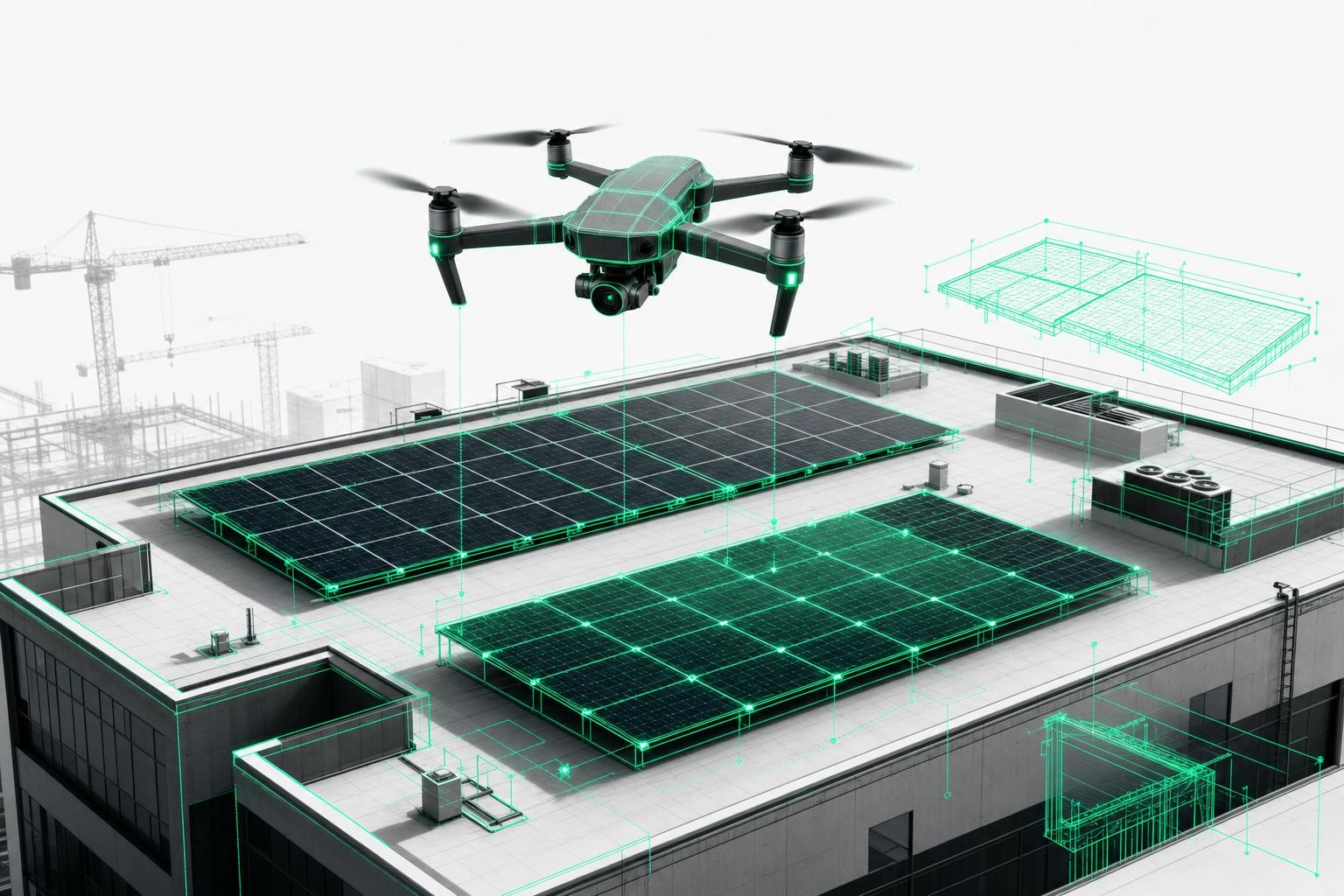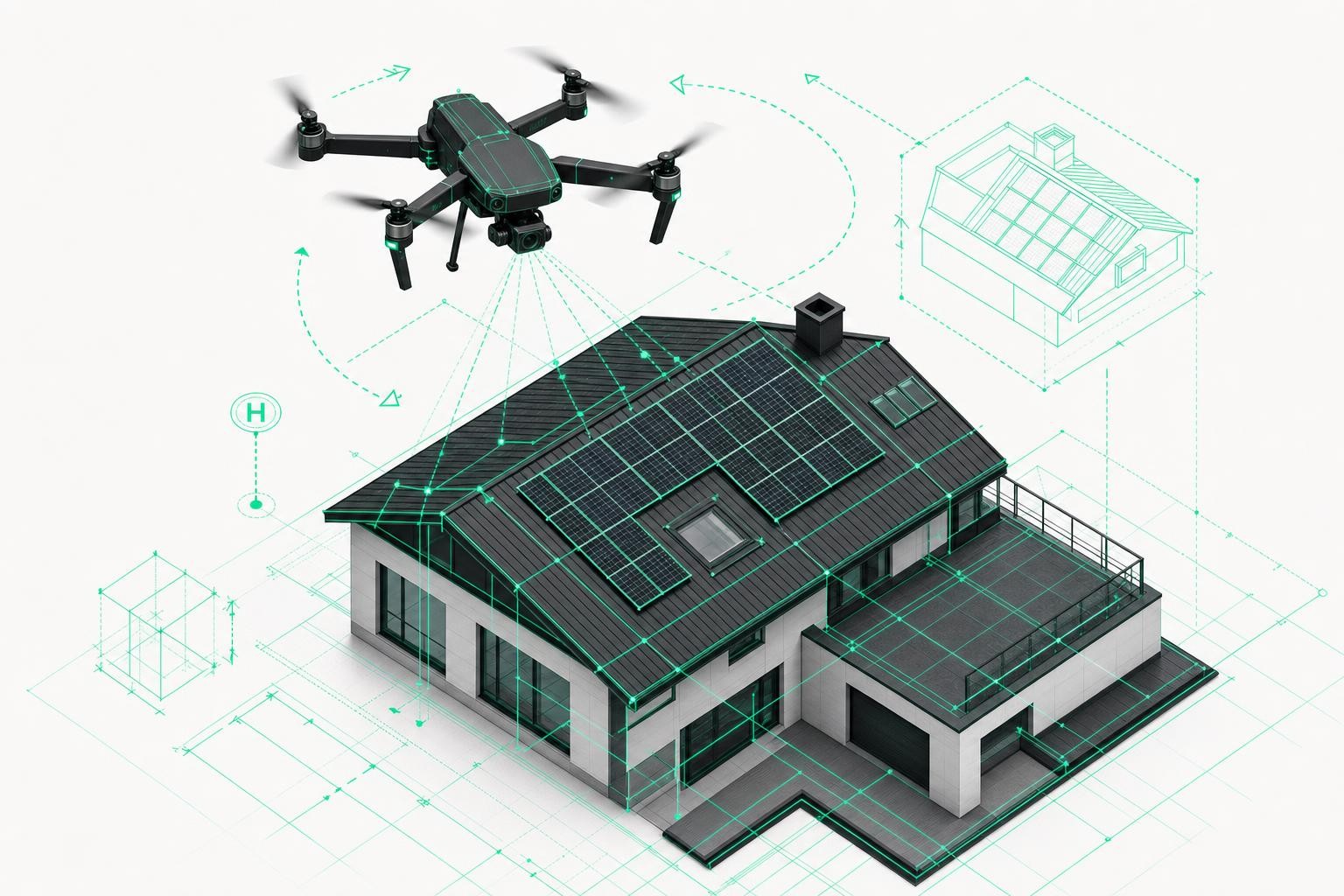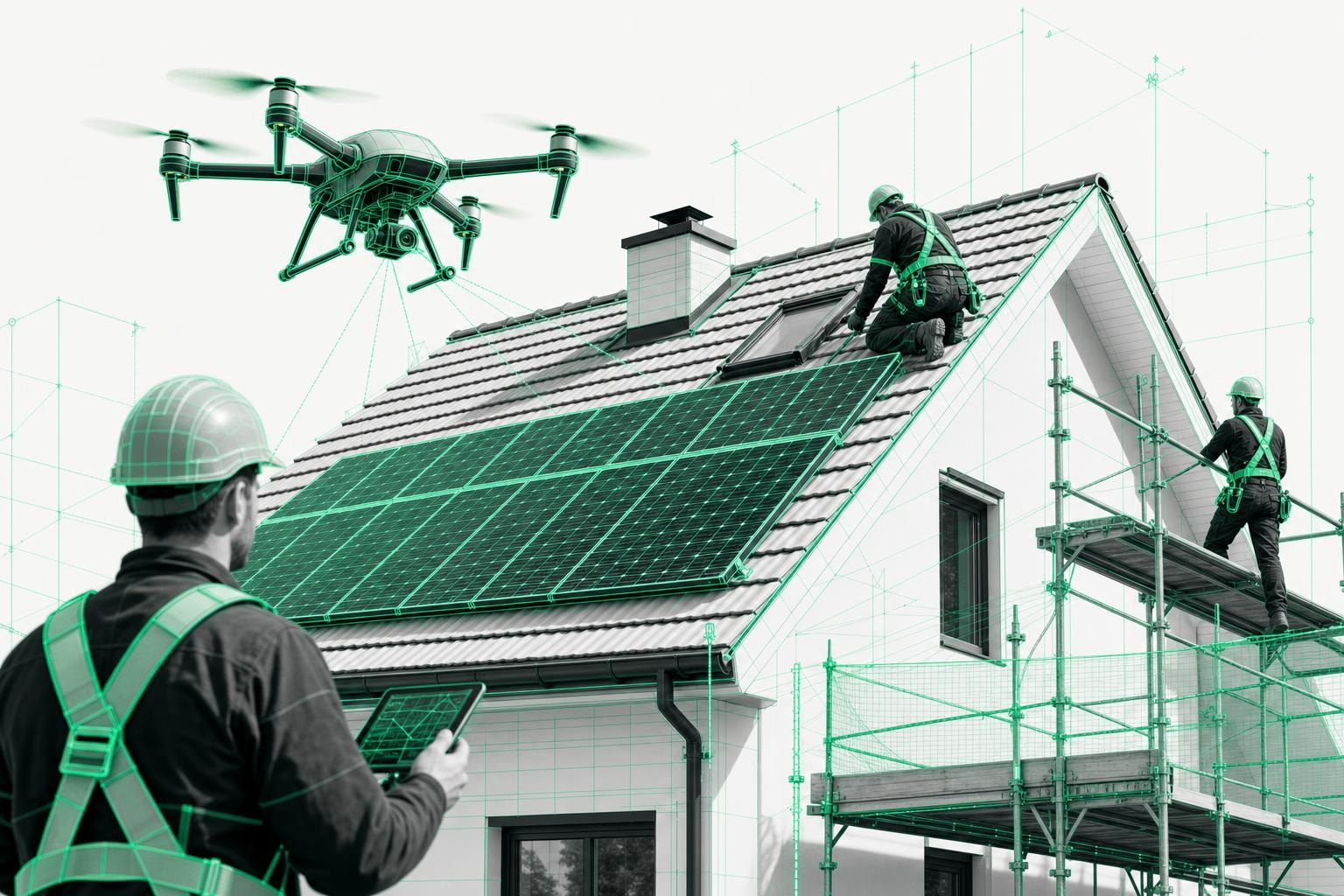
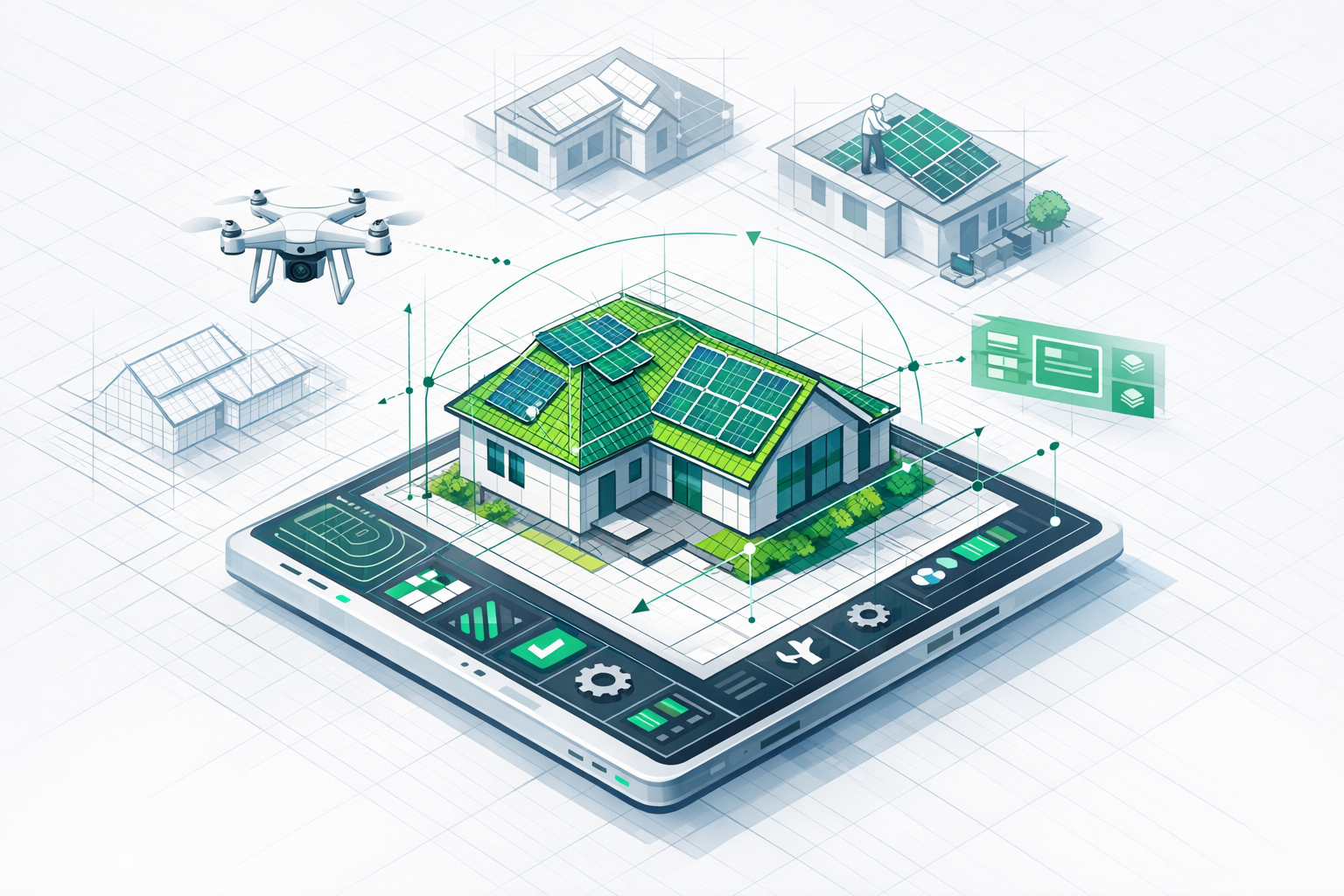
In practice, many solar installers use drone surveys primarily for creating proposals. The biggest lever for saving time, improving safety, and increasing margin, however, lies in using the 3D roof model across the entire project lifecycle-from the first inquiry through to ongoing maintenance.
This article shows how you can use a single 3D building model in all five project phases, what measurable impact that has on efficiency, error rates, and legal certainty, and how the Airteam Fusion Platform supports you.
Why 3D roof surveys are becoming the standard in the solar industry
The PV market remains under intense pressure: In 2024 alone, around 1.1 million new photovoltaic systems with an additional capacity of approximately 16.2 GW were connected to the grid in Germany[1]-solar power now covers roughly one-seventh of German electricity consumption.[2]
For solar installers, this means:
- More inquiries in less time
- Growing price pressure and rising customer expectations
- More complex roof geometries and mixed portfolios (existing buildings, commercial properties, homeowners' associations)
Traditional surveying methods are a bottleneck: Manual roof measurement typically takes 2-4 hours per building, and even longer for complex roofs. More than 20,000 ladder accidents are recorded in Germany every year, with a significant share occurring in construction and roofing. Measurement errors of 5-10% lead to rework, incorrect material orders, and lost margin.
Digital drone-based surveying changes the game: With the Airteam Fusion Platform, you can save up to 90% of the time-one drone flight of just a few minutes is enough, and the 3D model is available within 24 hours. Depending on the drone technology, accuracy reaches up to 99.9%, with a tolerance of only 1-3 cm at a height of 40 m, and complies with DIN SPEC 5452-5.
What really matters is how long you continue to use the result. That is where the long-term value of 3D roof surveys lies.
Five phases of the PV project chain - one roof model
Solar projects can be divided into five phases:
- Proposal phase
- Project preparation
- Construction phase
- Acceptance & billing
- Maintenance & inspection
With a single AI-powered 3D building model, you benefit in every one of these phases.
1. Proposal phase: faster, more accurate, more persuasive
Your contract is won or lost in the proposal phase-speed and data quality are critical.
Advantages of a 3D roof survey:
- Fast, accurate measurements: One drone flight is enough. Airteam's AI automatically detects all roof structures such as roof surfaces, dormers, valleys, and chimneys and generates a complete model.
- Complete capture of all rooftop elements: Complex roofs with extensions or penetrations are documented without gaps.
- Reliable basis for calculation: You work with measurements and angles that comply with DIN standards.
- Direct export into PV design software: Data export in over 15 formats, with direct integration into tools such as PV*SOL, Eturnity, AutoCAD, or SketchUp.
The result: You send proposals earlier, document them professionally, and win customers over with transparent, verifiable information.
2. Project preparation: better coordination, fewer buffers
Once the contract is signed, preparation determines how smoothly things run on site.
How to use the model in preparation:
- Material ordering: Precise areas, slopes, and distances enable targeted quantity planning and fewer incorrect orders.
- Scaffolding & logistics: Scaffolders receive reports with exact heights and dimensions, often without needing their own site visit. Crane locations and storage areas can be planned using panoramas and orthophotos.
- Planning with architects & specialist planners: CAD data instead of sketches; changes are documented directly in the model.
Airteam supplies standard-compliant reports and the right export formats for this-from MF roof exports through to Scaffmax data.
3. Construction phase: everyone works from the same data
Large screens in the warehouse and meeting rooms ensure the 3D model delivers its full value.
Your advantages during the construction phase:
- Visualization with the 3D model: Installers see the actual roof with all details before they ever arrive on site.
- Fewer queries: Many questions can be answered directly using the model, reducing phone calls and extra trips.
- Efficient collaboration: Electricians, scaffolders, and roofers all access the same, reliable data.
Experience from Airteam projects shows: This reduces planning time, optimizes module layout, and improves financial performance.
4. Acceptance & billing: legal certainty through documentation
For final acceptance, contractual billing, or disputes, documentation is crucial.
How drone surveys help:
- Documented initial condition: High-resolution images and 3D data record the state of the building before work begins.
- Objectivity in claims: Damage or shading issues can be clearly proven.
- Second survey at acceptance: A follow-up drone flight provides clean end-of-project documentation.
Especially for larger or shared properties, this transparency reduces disputes and strengthens your position.
5. Maintenance & inspection: sustainable service
With a digital "roof twin," you unlock a future-proof service segment.
How to use the model for maintenance:
- Portfolio capture: Multiple roofs can be flown in a single day.
- Analysis in the office: You can assess critical areas directly in the model.
- Targeted prioritization: You immediately see what is urgent-and what can wait.
This means fewer site visits, more accurate maintenance proposals, and predictable growth in service revenue.
Business impact: long-term ROI from a one-time survey
Many companies still see drone surveys as "extra costs" for proposals. In reality, a single 3D model pays off much faster when used across the entire project chain.
More than 5,000 companies have already completed over 70,000 projects with Airteam using drone and AI-based surveying. The pattern is clear:
- Fewer trips (initial measurement and rework)
- Stable proposal margins thanks to precise quantities
- Fewer disputes at acceptance and under warranty
- Scalable processes-especially for repeat projects or large portfolios
Comparison: traditional surveying vs. 3D roof model with Airteam
| Phase | Traditional approach | 3D roof survey with Airteam | Direct benefit for you |
|---|---|---|---|
| Proposal phase | Site visit, ladder, manual measurement | Drone flight, automatic 3D model | Faster proposals, better hit rate |
| Project preparation | Multiple appointments with scaffolder/architect | Digital reports & CAD exports from a single model | Less coordination effort |
| Construction phase | Sketches, different information levels | Shared view of the 3D model | Fewer questions & fewer extra trips |
| Acceptance & billing | Photos, notes, manual lists | Before/after drone imagery + structured reports | Greater legal certainty, clear evidence |
| Maintenance & inspection | Individual appointments on the roof | Periodic drone flights, evaluation in the office | Scalable maintenance, predictable service revenue |
Integrating 3D roof surveys across the project chain
To ensure the 3D model does not just sit in a proposal folder, a structured approach is recommended:
1. Clear rules: from when do you measure?
Define project sizes or customer types for which a drone survey becomes the standard-for example, from 10 kWp upwards, for commercial projects, or for homeowners' associations.
2. Clarify roles and responsibilities
Specify who flies, who creates the project in the Airteam Fusion Platform, and who exports which data. A short checklist is often enough.
3. Use integrations consistently
Connect the model to your existing tools:
- PV design: Import into PV*SOL, Eturnity, or similar
- Costing: Transfer quantities into your quoting software (e.g., MF roof)
- Scaffolding and timber construction: Export to Scaffmax, SEMA, and others
This avoids media breaks and manual data entry.
4. Combine flat rates and credits
With Airteam flat rates (Fast, Pro, Max, Ultra Fusion), you cover typical project sizes. For large roofs or additional data, you can use flexible credits-without bringing in new providers or tools.
5. Adapt your external communication
Actively use "digital surveying" in sales: showcase 3D visualizations, explain your precise, standards-compliant planning, and offer optional maintenance packages based on the digital roof twin.
Conclusion: From one-time survey to digital roof twin
A drone survey is more than just a modern replacement for a tape measure. Used correctly, the 3D building model becomes the guiding thread throughout your PV project chain-from the initial proposal calculation through to recurring maintenance.
You benefit from:
- Time savings - consistent, complete data in every phase
- Safety - improved safety on site and legally robust documentation
- Precision - technically and economically optimized systems
- Predictability - thanks to scalable, clearly documented workflows
If you establish 3D roof surveys not just as a proposal tool, but as the backbone of your processes, every drone flight becomes a long-term investment in efficiency and competitiveness.
Frequently Asked Questions
Does a 3D roof survey help me even if the customer does not accept the proposal?
Yes-especially for recurring customer types or existing properties. The model remains stored in your Airteam Fusion Platform and can be reused for later requests (for example, system expansion, battery storage, or roof renovation). For building portfolios, the model creates a data foundation for future projects.
Is one drone flight really enough for all project phases?
In most cases, yes. A carefully planned flight captures all relevant data for proposals, preparation, construction, and billing. For maintenance and inspection, it is advisable to conduct additional flights at longer intervals to document changes such as damage. The initial flight remains the central data source.
How much effort is involved in getting started with drone- and AI-based surveying?
Getting started is easier than many expect. Airteam provides starter kits including drone, training, and support, plus cloud software that can be used without CAD expertise. The key is clear internal workflows: who flies, who creates projects, who exports data. Many companies have their team aligned with the new standard process within a few weeks.
How secure and legally reliable is the data?
By complying with DIN SPEC 5452-5 and achieving high geometric accuracy, Airteam data is suitable for contract-compliant billing and technical documentation. Combined with photographic evidence, you gain a solid evidential basis in the event of disputes. It is important to archive and document the data for each project in a traceable way.
Is 3D roof surveying worthwhile for small roofs and single-family homes?
Yes-this is where time savings and increased safety really pay off. Instead of 2-4 hours of measuring, you complete the survey in a few minutes and send the proposal more quickly. The effect is particularly strong when inquiry volumes are high. With flat rates like Fast or Pro Fusion, small projects can be handled profitably; for larger projects, you can flexibly add credits.