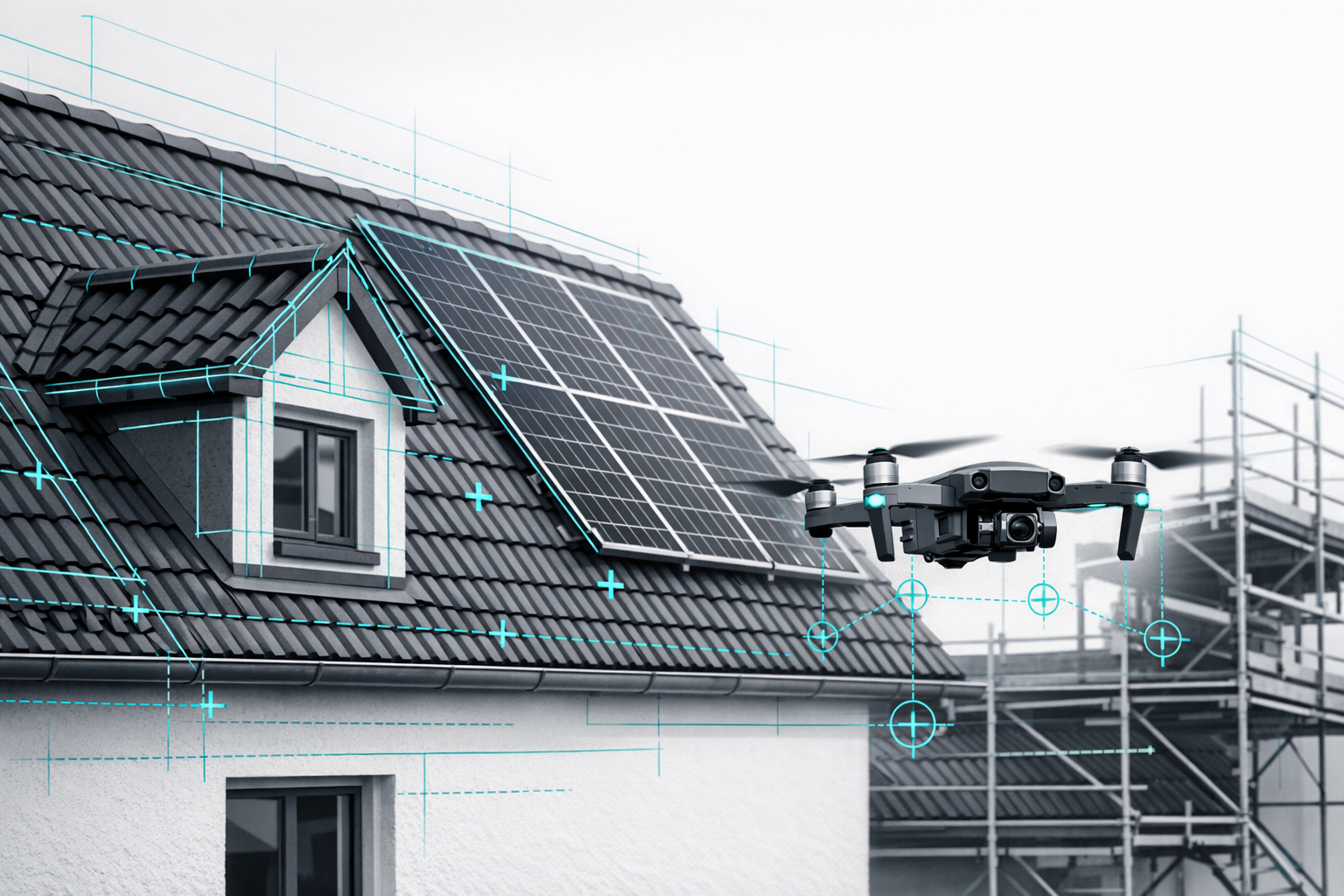
Digitalization is transforming the skilled trades sector. Drone-based photogrammetry can speed up site measurements by up to 90% (according to industry figures) and is making traditional measurements with ladders and tape measures increasingly obsolete. While a growing number of roofing companies are interested in using drones, many businesses still face a crucial question: Which photogrammetry software is right for my company?
This in-depth comparison looks at the key providers, from Pix4D to Airteam, and shows which solution is best suited for roofers, carpenters, solar installers, and scaffolders. You'll learn what DIN-compliant surveying really means and how you can achieve significant cost savings in your first year.
What is photogrammetry software and why do tradespeople need it?
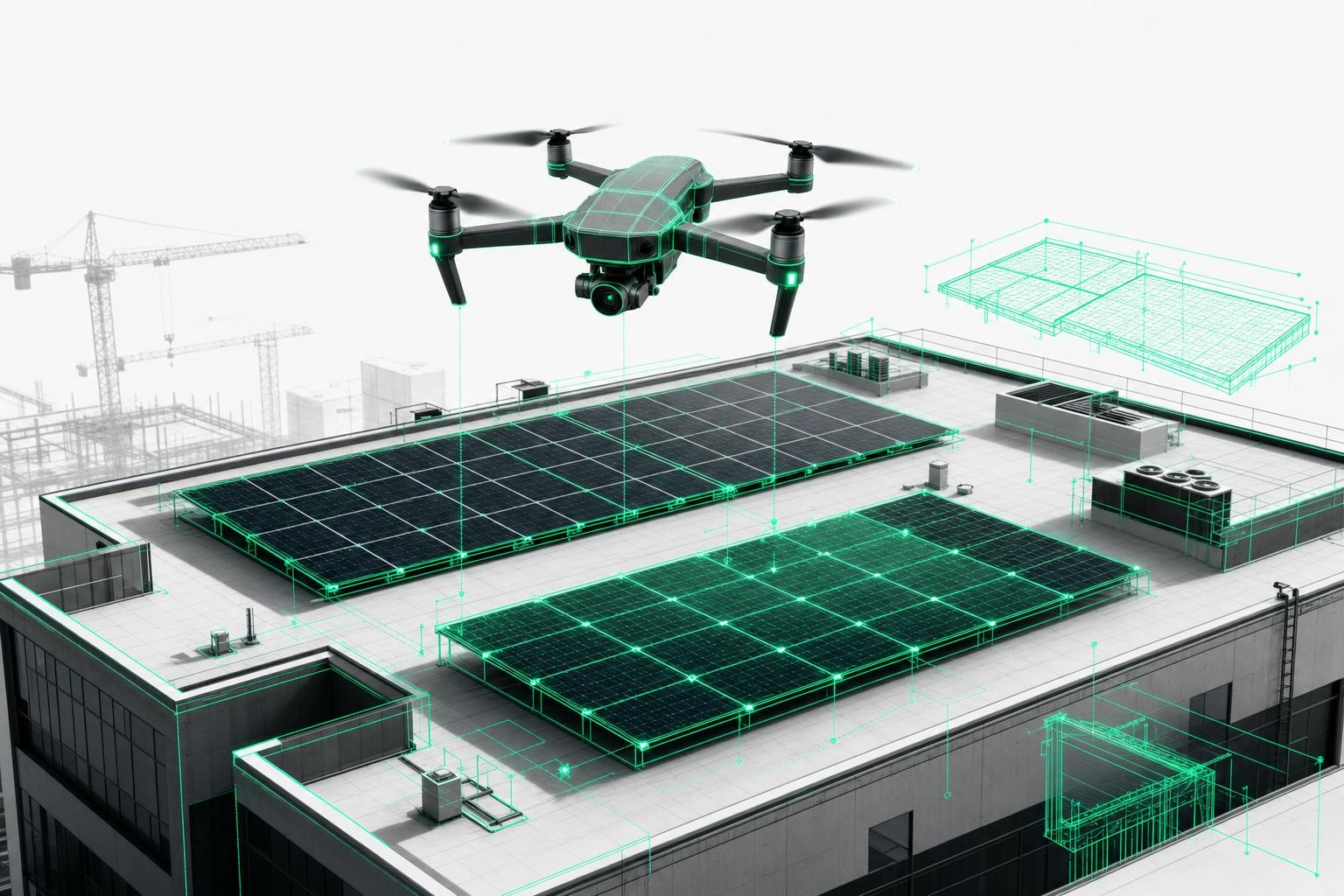
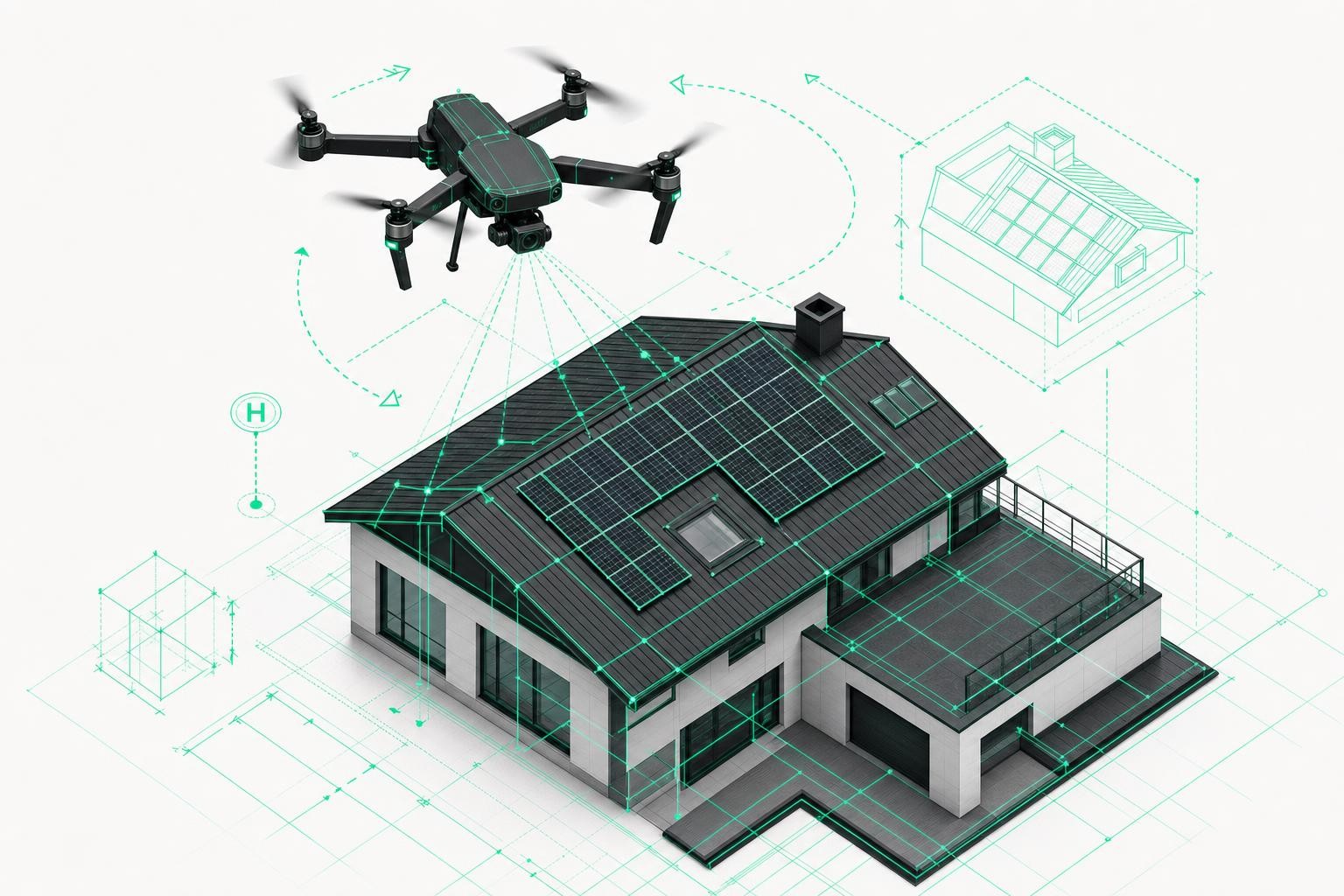
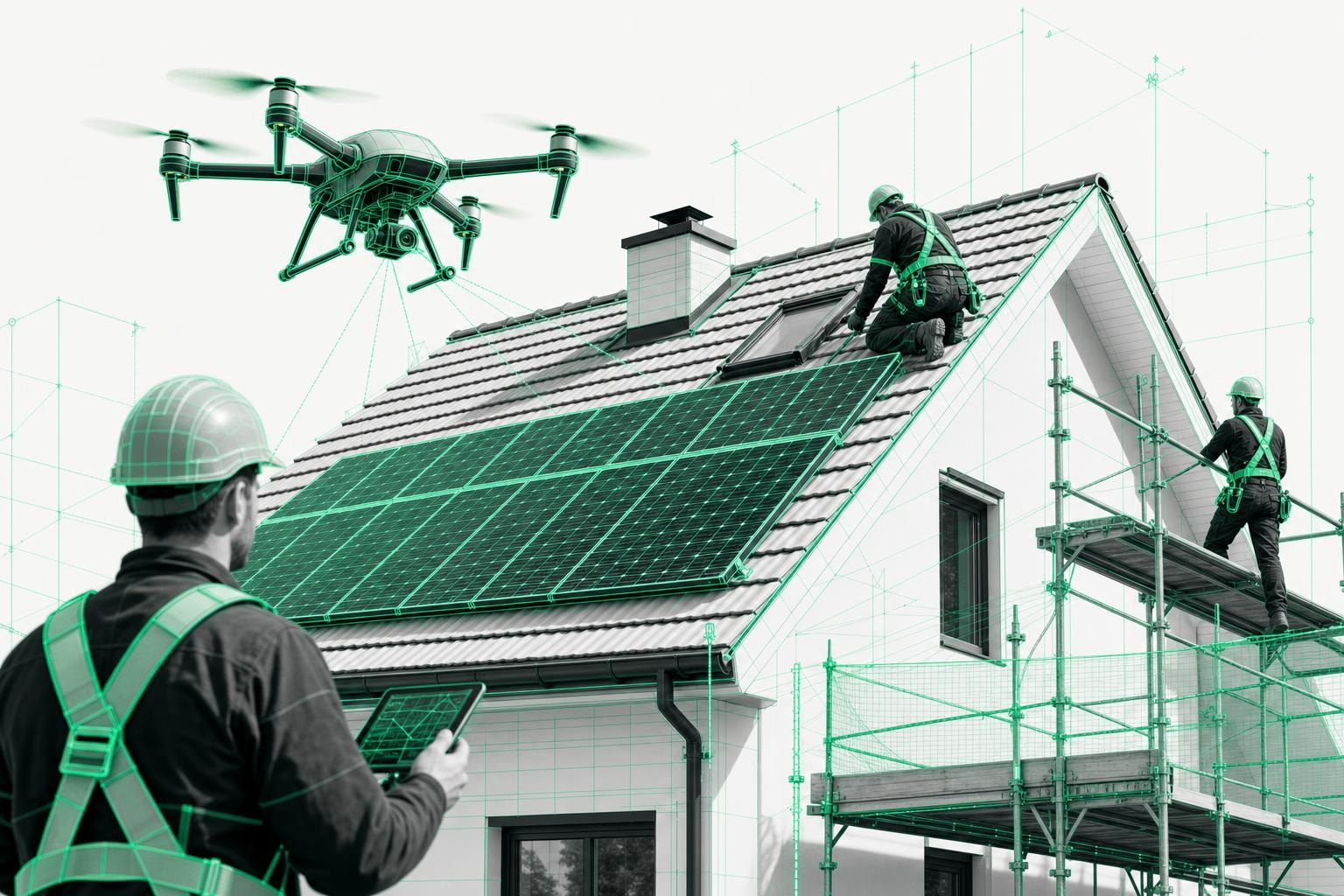
Photogrammetry software converts drone images into precise 3D models and planning data. You can measure roofs, facades, and buildings from the ground with centimeter-level accuracy - without ladders, without risk, and without hours of manual measuring.
A game changer for trades businesses:
- Safety: No more dangerous roof walks
- Speed: Significantly faster measurements and quote preparation
- Accuracy: Centimeter-precise measurements with digital documentation
- Professionalism: 3D visualizations can dramatically improve your close rate
Backed by data: According to a DroneDeploy study, 86% of surveyed companies saved at least 5,000 USD in their first year using reality capture technology.
The 5 most important evaluation criteria for trades businesses
Ease of use: Do you need CAD skills or not?
Fully automated solutions like Airteam convert drone imagery into ready-to-use planning data without requiring CAD skills. Manual photogrammetry tools like Pix4D demand extensive post-processing and CAD expertise.
Decision guide: Do you have a CAD specialist on your team? If not, fully automated solutions are 3-5 times faster to get productive with.
Accuracy and standards: Focus on DIN compliance
Only a few providers deliver DIN-compliant results that can be used in court or with insurers. International solutions often do not meet German standards out of the box.
With professional providers, centimeter-level accuracy typically means tolerances of ±1-3 cm over a distance of 40 meters - sufficient for quantity takeoffs in line with VOB requirements.
Export options: Seamless integration into existing workflows
Critical interfaces for trades:
- Roofers: MF Dach, GAEB, CSV export for estimating software
- Solar installers: PV*SOL, Eturnity, SolarEdge Designer, Sunny Design
- Carpenters: SEMA, SketchUp, AutoCAD, DXF format
- Scaffolders: Scaffmax, direct facade measurement
Price-performance: Understanding total cost of ownership
Consider hidden costs:
- Software licenses (monthly/annual)
- Hardware investment (drone €800-3,000, PC upgrade)
- Training costs (€500-5,000 depending on complexity)
- Support and maintenance
Support and service: German-language support vs. international providers
German providers like Airteam offer phone support during business hours. International solutions often rely on ticket systems and English-only documentation.
Detailed software comparison: The key providers
Pix4D: The heavyweight for professional users
Pix4Dmapper is considered a market standard for professional photogrammetry, offering high flexibility and precise results.
Strengths:
- High accuracy and versatility across many applications
- Strong integration with DJI drones and RTK systems
- Various specialized products (Survey, Mapper, Cloud) available
- Established market position with a large user community
Weaknesses:
- Complex to use; requires multi-day training
- High hardware requirements (16+ GB RAM, dedicated GPU)
- Manual post-processing needed to create trade-specific outputs
- No German-language support
Price: €260/month or €2,600/year (annual subscription)
Target group: Larger companies with CAD expertise and in-house IT resources
DIN compliance: No, manual post-processing required
RealityCapture: Built for speed
RealityCapture stands out for having the fastest processing on the market and became free in 2023 for companies with annual revenue under €1 million.
Strengths:
- Fastest processing speed currently available
- High-quality 3D reconstruction
- Free for smaller companies (under €1M annual revenue)
- Supports a wide range of camera and drone models
Weaknesses:
- Requires a powerful GPU (NVIDIA recommended)
- User interface is English-only
- No trade-specific export templates
- Steep learning curve for photogrammetry beginners
Price: Free (under €1M annual revenue), otherwise €1,250/year per seat
Target group: Tech-savvy users with high-performance hardware
DroneDeploy: Cloud-based all-in-one platform
DroneDeploy offers a fully cloud-based platform with simple operation and collaboration features.
Strengths:
- Intuitive, browser-based interface
- Fully cloud-based - no heavy local hardware needed
- Strong collaboration features for teams
- Automated flight planning and execution
Weaknesses:
- High monthly costs by German market standards
- Limited customization for trade-specific workflows
- No DIN standards or German planning formats
- Servers located in the USA (potential data privacy concerns)
Price: €329/month (Individual Plan, billed annually)
Target group: Larger companies with multiple users and an international footprint
Airteam: The specialist solution for trades
Airteam was developed specifically for German trades businesses and offers fully automated, DIN-compliant evaluation.
Strengths:
- Fully automated conversion into DIN-compliant planning data
- No CAD skills required - browser-based
- German-language support and documentation
- Direct integration with more than 15 industry tools (MF Dach, PV*SOL, etc.)
- Starter kits including drone, training, and software from €1,950
Weaknesses:
- Focused exclusively on building measurement
- Less flexible for niche applications outside construction/trades
- Newer provider (founded in 2018) compared to long-established players
Price: From €125/month (Fast Fusion), starter kits from €1,950
Target group: Roofers, carpenters, solar installers, scaffolders without CAD expertise
DIN compliance: Yes, generated automatically
Practical use cases: Which software suits which trade?
Roofers: From damage documentation to quote preparation
Scenario: Measuring storm damage for insurance billing and quote creation.
Step-by-step with a fully automated solution:
- Plan the drone flight: 5-10 minutes flight time, automatic image capture
- Upload and processing: Upload images; 3D model ready after about 24 hours
- Generate planning data: Another 2-7 days for DIN-compliant measurement
- Export: Direct export to MF Dach, GAEB, or CSV for estimating software
Software recommendation: Airteam for fast, DIN-compliant results without CAD post-processing.
ROI example: With 10 projects per month, a roofer can save 20-40 hours of work - that's €1,300-2,600 at an hourly rate of €65.
Carpenters: Precisely measuring complex roof structures
Scenario: Measuring an existing roof structure for renovation, including dormers and complex geometry.
Special requirements:
- Precise rafter spacing and eave heights
- 3D models for fabrication software such as SEMA
- Coordination between design office and workshop
Software integration: Export as DXF/DWG for seamless CAD import, or fully automated integration into SEMA.
Recommendation: Airteam for automated workflows, or Pix4D where CAD expertise is already available.
Solar installers: Better PV design through precise data
Scenario: Residential PV system including shading analysis and yield forecast.
Workflow optimization:
- Drone flight during the initial site visit
- 24 hours later: 3D model ready for customer visualization
- Direct export into PV*SOL, Eturnity, or SolarEdge Designer
- Quote with precise yield forecast within 1-2 days
ROI calculation: 3D visualizations can significantly improve close rates while sharply reducing planning time.
Export formats: PV*SOL, SolarEdge Designer, Sunny Design, Eturnity, PVcase
Cost-benefit analysis: What does photogrammetry really cost?
One-time costs vs. ongoing costs
Typical cost estimate for a trades business:
One-time costs:
- Drone (DJI Mini 3 to Phantom): €800-3,000
- PC upgrade (if needed): €1,000-2,500
- Training and implementation: €500-5,000
- A2 drone license: €300-500
Ongoing costs:
- Software licenses: €125-330/month
- Maintenance and updates: €200-500/year
- Insurance (drone): €200-400/year
ROI calculation for trades businesses
Example calculation for roofers:
- Time savings per project: 2-4 hours
- Hourly rate: €65
- Projects per month: 10-15
- Monthly savings: €1,300-3,900
- Break-even: 4-8 months
Additional benefits:
- Fewer queries and change orders
- More accurate quotes reduce pricing risk
- More professional appearance to customers
Frequently asked questions and expert tips
Which photogrammetry software is easiest for tradespeople without CAD skills?
Fully automated solutions like Airteam are designed specifically for trades. They automatically convert drone imagery into DIN-compliant plans without requiring CAD knowledge. The browser-based interface can usually be mastered after 1-2 hours of onboarding.
Are photogrammetry software measurements legally valid?
That depends heavily on the provider. Only a few, such as Airteam, deliver DIN-compliant results that can be used in court or with insurers. Most international solutions like Pix4D or DroneDeploy do not automatically meet German standards and require manual post-processing to achieve VOB-compliant quantity takeoffs.
What hardware do I need for photogrammetry software?
Cloud-based solutions such as Airteam or DroneDeploy only require a standard PC with an internet connection. Desktop programs like Pix4D need powerful computers with at least 16 GB RAM and a dedicated graphics card (NVIDIA GTX 1060 or better). You'll also need a suitable drone - for most trades, DJI Mini or Air models are sufficient.
How long does it take to get up to speed with photogrammetry software?
With specialized trade-focused solutions, you can usually get started productively after 1-2 hours. Professional programs like Pix4D require 1-2 weeks of full-time learning and often additional training courses that can cost several thousand euros. For more complex tools, you should expect 2-4 weeks before they can be used productively.
Is photogrammetry worthwhile for small trades businesses?
From as few as 5-8 projects per month, the investment typically pays off through time savings and higher accuracy. Smaller businesses should focus on all-in-one packages that include both hardware and software to keep barriers to entry low. Starter kits from €1,950 make the investment predictable and low-risk.
Our recommendations: Choosing the right software for your business
Small businesses (1-5 employees)
Recommendation: Airteam Drone Starter Set or similar fully automated solutions
Reasoning:
- Easy to use with no prior CAD knowledge
- German-language support during business hours
- Moderate costs with a predictable ROI
- DIN-compliant results without post-processing
Investment: €1,950-3,450 for a starter kit, then €125/month
Medium-sized businesses (5-20 employees)
Recommendation: Pix4D or specialized industry solutions, depending on in-house expertise
Reasoning:
- More flexibility for different applications
- Better integration into existing CAD workflows
- Scalable licenses for multiple users
- Easier to justify more extensive training programs
Investment: €2,600-4,000/year plus hardware and training
Large businesses (20+ employees)
Recommendation: Enterprise solutions with tailored configuration
Reasoning:
- Scalable across multiple locations
- Advanced features such as API integration
- Multi-user licensing with centralized administration
- Customized training and support contracts
Investment: From €10,000/year for software plus extensive IT integration
Outlook: Photogrammetry trends for the trades
AI is accelerating automation: Artificial intelligence is increasingly eliminating the need for manual post-processing. Semantic recognition can automatically distinguish between roof tiles, dormers, chimneys, and solar panels.
BIM integration is becoming standard: Building Information Modeling links photogrammetry with rich building data models. By 2025, we expect the first fully automated BIM exports generated directly from drone imagery.
5G enables near real-time processing: Ultra-fast mobile networks will accelerate cloud processing. On-site processing could deliver finished 3D models during the customer appointment itself.
Market forecast: Market analysts expect the German construction photogrammetry market to grow by 25-30% annually. By 2027, an estimated 60% of roofing companies could be using drone technology.
Conclusion: Your path to the right photogrammetry software
There is no single perfect solution - but there is a solution that fits your business.
Smaller trades companies are usually best served by fully automated, German-language solutions. DIN compliance and ease of use save both time and stress.
Larger companies with IT resources benefit from the flexibility of established tools like Pix4D, but need to factor in training time and complexity.
Three factors are crucial:
- Your CAD expertise: If you have it, manual tools are an option.
- Your project volume: From around 8-10 projects per month, almost any solution pays off.
- Your quality requirements: DIN compliance is indispensable for German trades.
Our advice: Start with a cost-effective, fully automated solution and gain hands-on experience. You can always move to more complex tools later - going the other way around is much harder.
Digitalization in the trades is no longer something for the future; it is already here. Those who get started now will secure a competitive edge for the years ahead.
Disclaimer: Market statistics and ROI figures can vary depending on company size, project complexity, and specific use cases. The construction and photogrammetry markets are evolving rapidly, so you should always obtain up-to-date information directly from the providers.
Sources & data used:
[S] Drone Industry Insights - Construction Drone Market Report (2024). https://droneii.com/construction-drone-market-report
[S] PwC - Clarity from Above: Commercial Applications of Drone Technology (2024). https://pwc.com/clarity-from-above
[S] Hexagon - Reality Capture ROI Study: Enterprise Survey Results (2023). https://hexagon.com/reality-capture-roi
[S] ZVDH - Digitalization in the Roofing Trade: Opportunities and Challenges (2024). https://zvdh.de/digitalisierung
[S] Pix4D - Pricing and Plans Overview (2024). https://pix4d.com/pricing
[S] DroneDeploy - Construction Industry Plans and Pricing (2024). https://dronedeploy.com/pricing
[S] RealityCapture - Software Licensing and Free Access Policy (2024). https://capturingreality.com/pricing
[S] Airteam - Product Overview and Pricing Structure (2024). https://airteam.ai/pricing
[S] Journal of Building Engineering - UAS-based Photogrammetry Accuracy Assessment (2023). Volume 76, Article 107342
[S] Applied Sciences - Centimeter-level Accuracy in Construction Surveying (2024). Volume 14, Issue 3