In the first ten months of 2025, BG BAU received reports of 6,178 fall accidents - 26 of them were fatal, according to preliminary figures. More than a third of these serious incidents happened during work on roofs[1], many of them caused by non-load-bearing areas. These are not abstract statistics - they affect real people, real businesses, and real liability risks.
In response to this alarming situation, the Zentralverband des Deutschen Dachdeckerhandwerks (ZVDH) and the Berufsgenossenschaft der Bauwirtschaft (BG BAU) launched the joint initiative "Sicher auf dem Dach" (Safe on the Roof). The core demand: No work on the roof without a prior risk assessment (Gefährdungsbeurteilung).
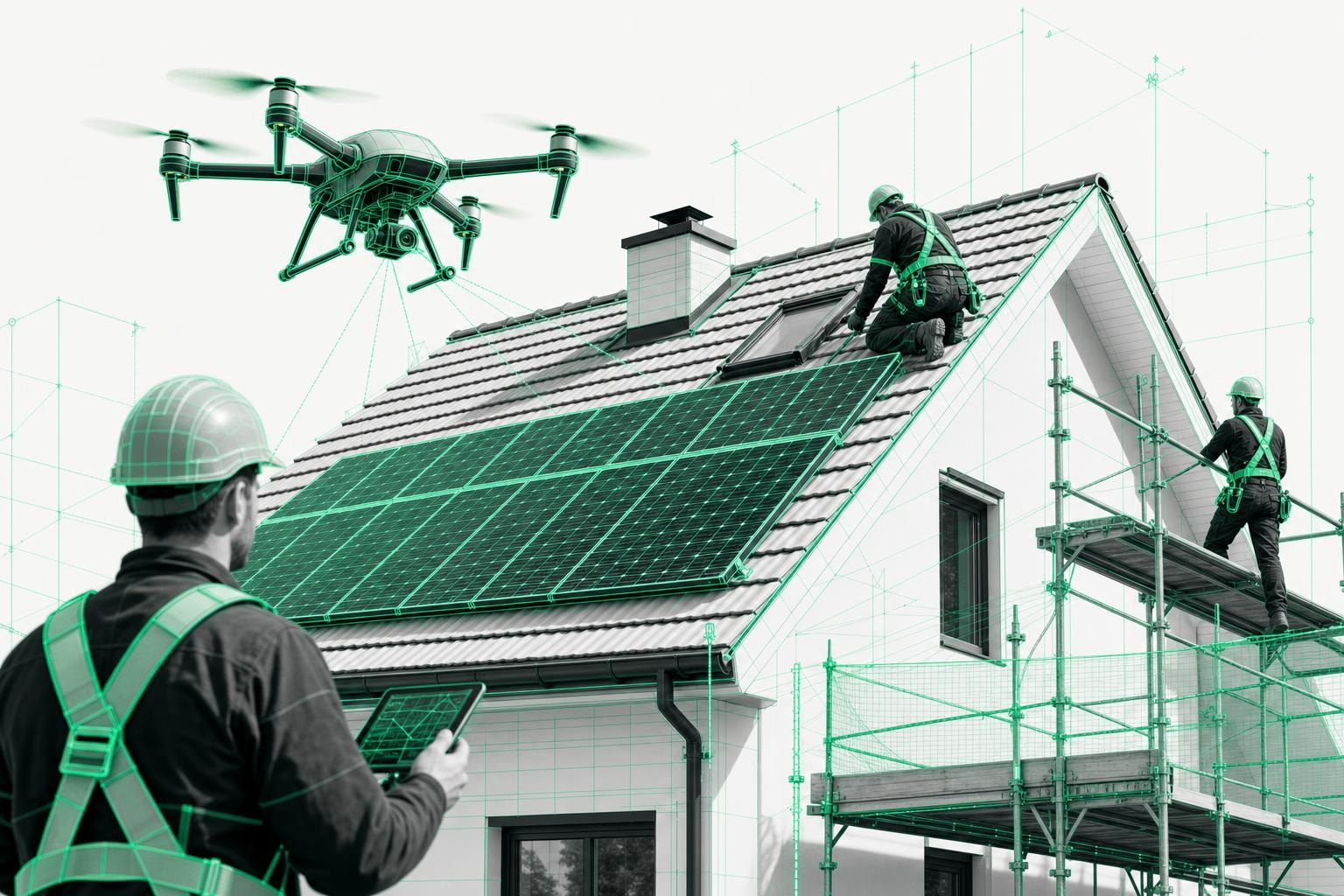
For you as the owner or site manager of a roofing or solar company, this means: occupational safety is not a tedious formality, but a legal obligation - and an entrepreneurial responsibility. The good news: drone-based measurement makes this obligation much easier to fulfil - and at the same time reduces the risk for your team to an absolute minimum, improving overall construction site safety.
What a risk assessment really means - and why you are personally liable
The Gefährdungsbeurteilung (risk assessment) is the key instrument of German occupational health and safety law. Its legal basis is Sections 5 and 6 of the Occupational Health and Safety Act (ArbSchG)[2]: employers must identify and assess all work-related hazards and define appropriate protective measures.
Attention: Personal liability of the business owner
Under the Occupational Safety Act (ArbSchG), the employer is personally responsible for ensuring that risk assessments are carried out and documented. Whoever neglects this duty acts unlawfully — and may even be punishable by law in the event of damage. This applies to every business that has at least one employee.
What the risk assessment must cover:
- Systematic identification of all potential hazards in the workplace
- Assessment of the risks based on probability of occurrence and severity of damage
- Definition of specific protective measures
- Written documentation of results and measures
- Regular updates - especially after changes in work processes or after accidents
According to Section 5 ArbSchG, all employers in Germany are required to carry out a risk assessment for every workplace - regardless of industry or company size, starting with the very first employee.
The construction sector has ranked first in accident statistics for years and faces particular challenges in roof work safety. Craft businesses in particular often struggle with documentation - a study shows that only just under one in five micro and small enterprises can provide a documented risk assessment[3].
Fall hazards: the main risk in roof work - and what you need to document
Fall accidents, at 36 %, are the most common cause of fatal occupational accidents in the construction industry. They rank ahead of falling components (26 %) and accidents involving construction machinery (15 %), which makes them a central topic in any roofing risk assessment.
What makes them especially dangerous: almost all fatal fall accidents were caused by falling through the roof - not over the edge, but through non-load-bearing materials such as corrugated asbestos sheets, old skylight strips or brittle light panels[4]. With the PV boom, the risk continues to rise: three of the 26 fatal accidents in the first ten months of 2025 were directly related to photovoltaic work.
What must be included in a risk assessment for roof work?
As soon as work on roofs is planned, a precise risk assessment is mandatory.[5] The following questions must be answered clearly to ensure proper roof work safety and roof fall protection:
- What work will be carried out on the roof, in concrete terms?
- Who will work on the roof, and what qualifications do these people have?
- Which hazard zones exist (e.g. non-load-bearing areas, structures, openings)?
- Which protective measures are required for each specific activity?
- How are access routes to the roof secured?
- Are external companies involved, and are their protective measures coordinated?
Traditionally, this means that someone has to go up on the roof to be able to answer these questions based on direct inspection. With drone surveys, this becomes much safer and more efficient.
How drone surveys simplify the risk assessment - and reduce risk
The principle is simple: when all measurement is carried out from the ground, the fall risk in this critical project phase is completely eliminated.
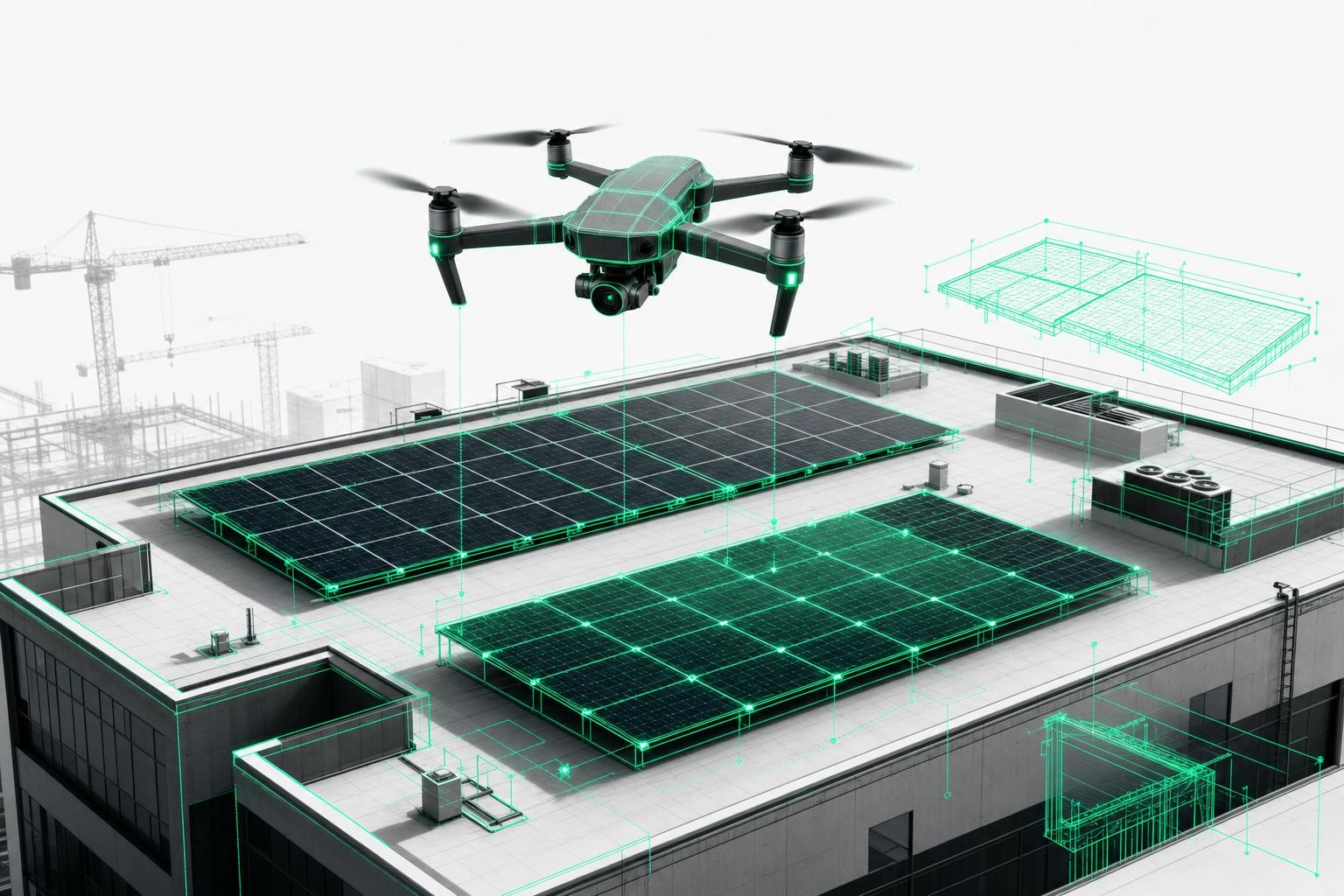
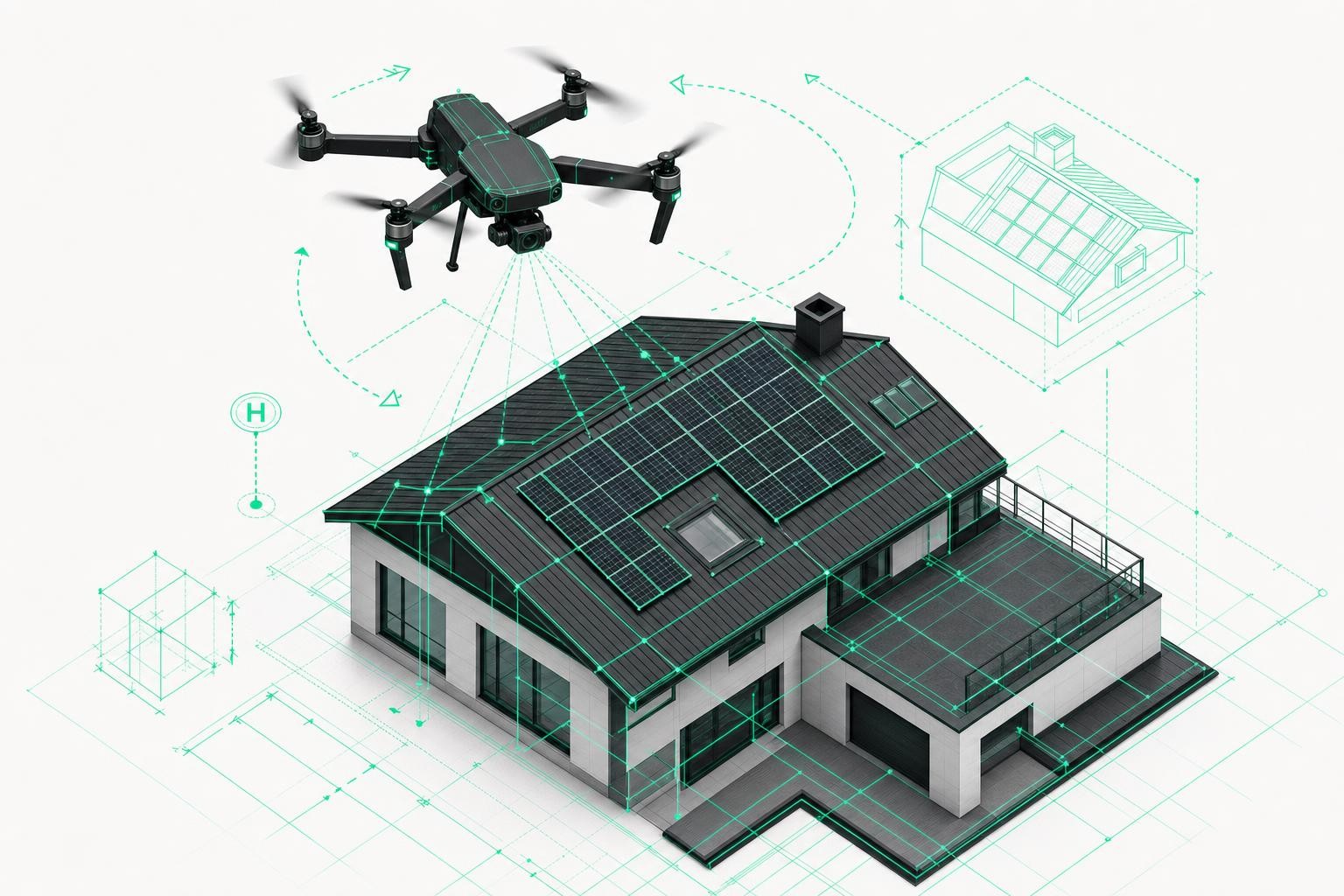
The Airteam Fusion Plattform automatically converts drone imagery into precise, DIN-compliant 3D building models. The result: centimetre-accurate data for the entire roof - without anyone having to step onto the surface.
Concrete benefits for the risk assessment
1. Hazard zones become visible before anyone steps onto the roof
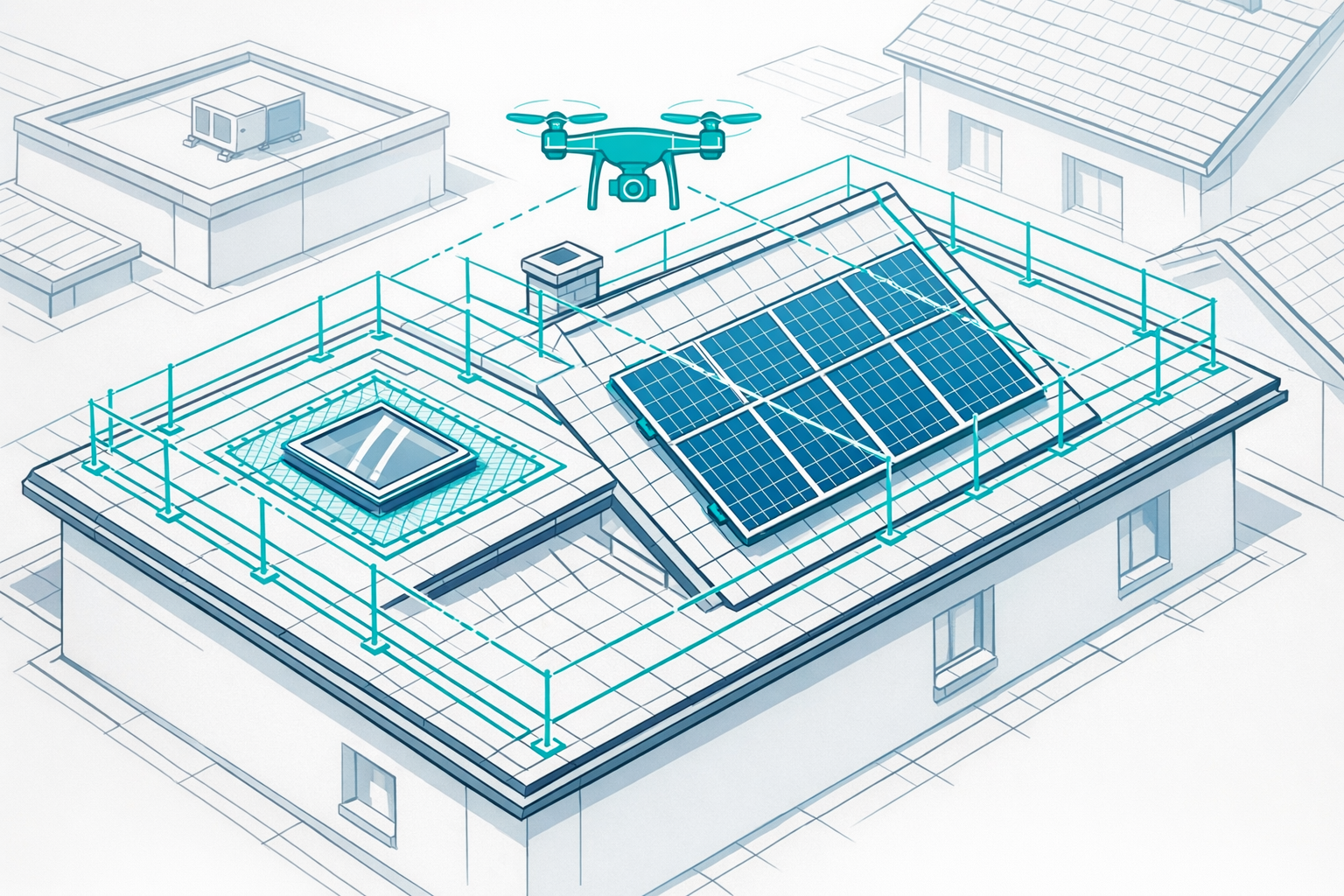
In the 3D model, all safety-relevant areas are documented: light panels, skylight strips, non-load-bearing surfaces, chimneys, roof openings. You can mark these hazard zones directly in the model and transfer them into your risk assessment - as an objective, transparent basis for construction site safety.
2. Documentation effort is greatly reduced
Instead of handwriting notes on the roof, you have a complete digital twin of the building after the drone flight. You can incorporate this directly into the written documentation required by Section 6 ArbSchG - with exact dimensions, layout plans and visual evidence.
3. You have robust evidence for BG BAU
In the event of an accident or an inspection by the Berufsgenossenschaft, you can demonstrate that you systematically identified hazards and derived protective measures. A DIN-compliant 3D model as part of the roofing risk assessment is a strong argument.
4. Planning reliability for the actual roof work
Based on the drone data, you can plan the entire construction project - whether roof refurbishment, PV installation or scaffolding - with high precision. The data can be exported into more than 15 formats, including PV*SOL, MF Dach, AutoCAD, SEMA and Scaffmax.
How this works in practice is shown by companies such as Dachdeckerei Mann, which used Airteam to survey 6,000 m² of roof area with more than 100 dormers in just 2 days - instead of several weeks.
Step by step: Integrating drone surveys into your risk assessment
Instead of sending an employee onto the roof, the drone is launched from the ground. In a few minutes, high-resolution images of the entire roof are created — including all structures, hazard zones, and component conditions. No risk of falling, no scaffolding, no PPE required.
The images are uploaded to the Airteam Fusion platform. The AI automatically processes them into a DIN-compliant 3D model with all dimensions, inclinations, surfaces and components - usually within 24 hours.
In the 3D model, all safety-relevant areas are visible: skylight panels, skylight bands, light bands, non-penetrable surfaces, chimneys, roof hatches. These are marked in the model and feed directly into the risk assessment.
Based on the 3D model, you document all relevant hazards and protective measures for the actual roof work (e.g., PV installation, roof renovation). The model provides objective, traceable data - ideal for legally compliant documentation under § 6 ArbSchG.
The Airteam data can be exported to planning tools such as PV*SOL, MF Dach, AutoCAD or SEMA. At the same time, screenshots and 3D views can be embedded directly into the annual safety training - as a visual basis for employees.
BG BAU training calendar 2026: Drone surveys as part of safety training
In parallel with the "Sicher auf dem Dach" initiative, BG BAU has developed a training calendar specifically for the roofing trade. It guides you through 2026 with twelve safety topics and can be used directly for monthly safety briefings for your employees. In addition, BG BAU offers the 2026 wall calendar "Sicherheit ganz oben"[6] with monthly safety tips.
The topic of drone surveys can be easily integrated as an extension of existing safety topics - for example, in the month when fall protection or roof access is on the agenda.
How to integrate drone surveys into your annual safety training
Possible training session on the topic "Safe measurement and risk assessment":
- Before: Roof access for measurement requires full PPE, scaffolding or anchor points -> high effort, high risk
- After with a drone: The measurement phase takes place entirely from the ground -> fall risk in this phase = zero
- What employees learn: Why the company switched to drone surveys, how the images are captured and processed, and which work phases still take place on the roof (and how these are secured with appropriate roof fall protection)
This type of training combines an understanding of technology with a tangible safety benefit - and shows your team that you are investing in their safety and in professional roof work safety.
What you can do right now as a business owner
Roof safety and legally compliant documentation do not conflict with efficiency - with the right tools, both go hand in hand. Here are the most important steps at a glance:
- Check your risk assessment: Is your risk assessment for roof work up to date? Does it document fall risks and hazard zones specifically for each project?
- Introduce drone surveys: Replace risky measurement visits on the roof with drone flights. Airteam offers an easy way to get started - with single projects, flat rates or starter kits including training.
- Use the 3D model as the basis for your risk assessment: Document hazard zones directly in the model and link them to your written risk assessment.
- Adapt your training: Integrate the BG BAU training calendar 2026 and add the topic of drone use to your annual occupational safety training.
- Secure your evidence: Store drone data, 3D models and risk assessment documents digitally - in case of an inspection by BG BAU or the labour inspectorate.
A look at the Airteam success stories shows how other companies - from roofers to solar installers - are already successfully taking this path to stronger construction site safety.
If you want to dive deeper: the article Safe on the roof: How digital roof measurement makes solar installations professional and accident-free looks specifically at the PV perspective. And in the Drone survey vs. manual measurement comparison you will find a detailed cost-benefit analysis.
Conclusion: Risk assessment and drone surveys - a powerful combination
The message from BG BAU and ZVDH is clear: anyone working on roofs must do so safely - and that starts with a thorough risk assessment. This is not optional, but a legal obligation with personal liability.
Drone-based roof measurement is not a luxury, but a practical safety tool: it eliminates the fall risk completely during the measurement phase, provides objective data for the risk assessment and at the same time saves up to 90 % of the time. Safety and efficiency do not exclude each other - on the contrary.
With the right mix of drone technology, structured roofing risk assessment and consistent roof fall protection, you create a high level of roof work safety for your team and your projects.
Frequently asked questions (FAQ)
Is a risk assessment for roof work really mandatory?
Yes, absolutely. Under Sections 5 and 6 of the Occupational Safety Act (ArbSchG), every employer — regardless of company size — must create and document in writing a risk assessment for all activities. For roof work, this is especially important due to the high fall hazard. Violations can be punished as an administrative offense; with intent, there may even be criminal liability.
Can I really use the drone survey as part of my risk assessment?
Yes. The risk assessment must be based on a real analysis of the working conditions. A 3D model from drone surveying provides objective, DIN-compliant data on roof geometry, components, and potential hazard zones — and is thus an excellent basis for the documentation under § 6 ArbSchG. Additionally, you can use the model to prove that you systematically identified the hazard points before the work starts.
Do I need to have a drone pilot license myself to carry out the drone survey?
Not necessarily. Airteam offers, in addition to its own Starter sets including training also a pilot service: You book a certified Airteam pilot to perform the flight for you. This way you can immediately benefit from the advantages without having to fly yourself.
How often must the risk assessment be updated?
The risk assessment is not a one-time document; it must be updated on a case-by-case basis—for example, when work processes change, after accidents, or when new technologies (such as drones) are introduced. An annual check as part of the occupational safety training—as supported by the BG BAU Training Calendar 2026—is recommended.
Does the drone survey also apply to solar installers and carpenters, not just roofers?
Yes. The obligation to perform a risk assessment and the fall hazard apply to all trades that work on roofs or at height — including solar installers, carpenters, and scaffolders. Airteam is explicitly designed for all these trades and offers suitable data formats and export options for industry-specific planning tools.