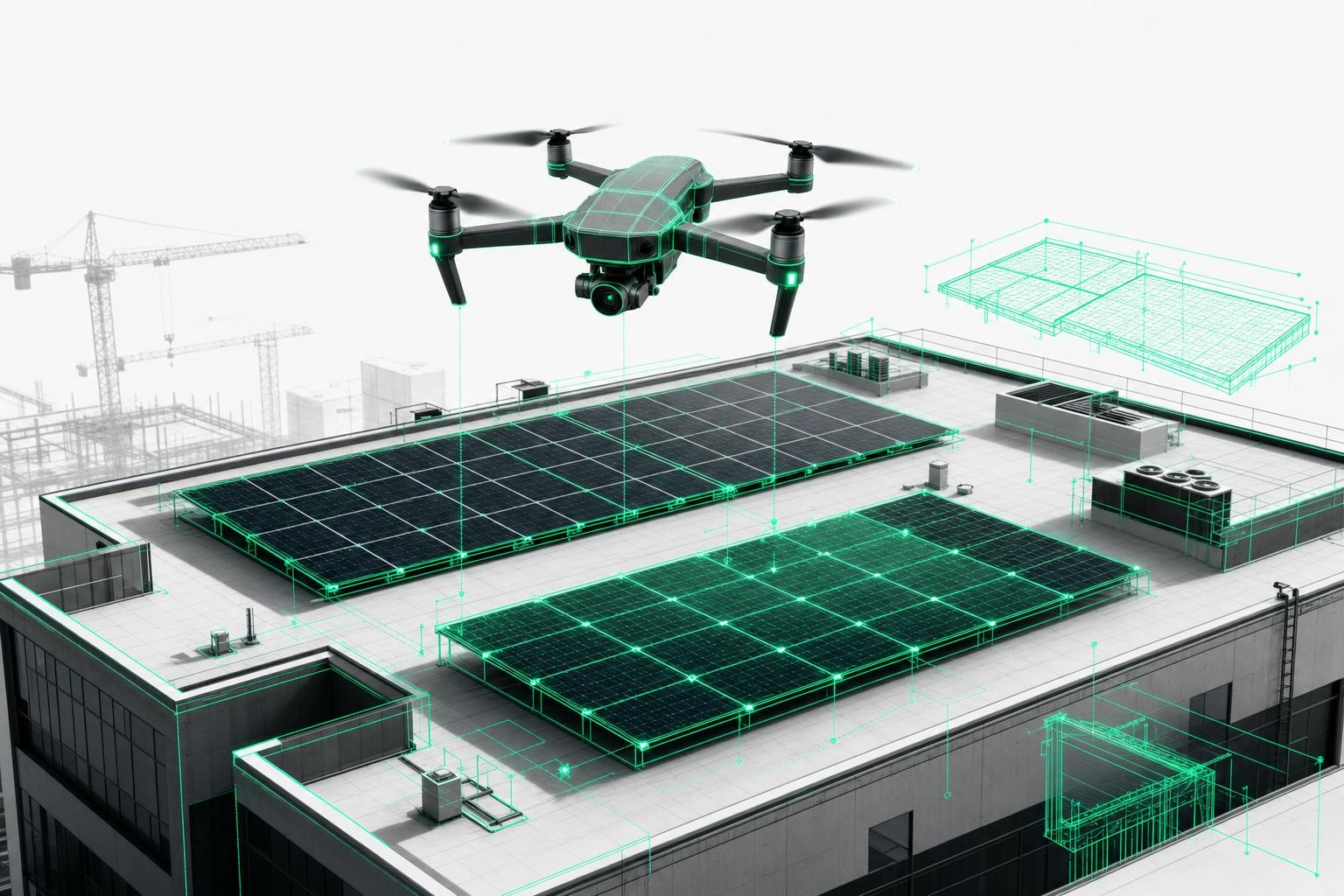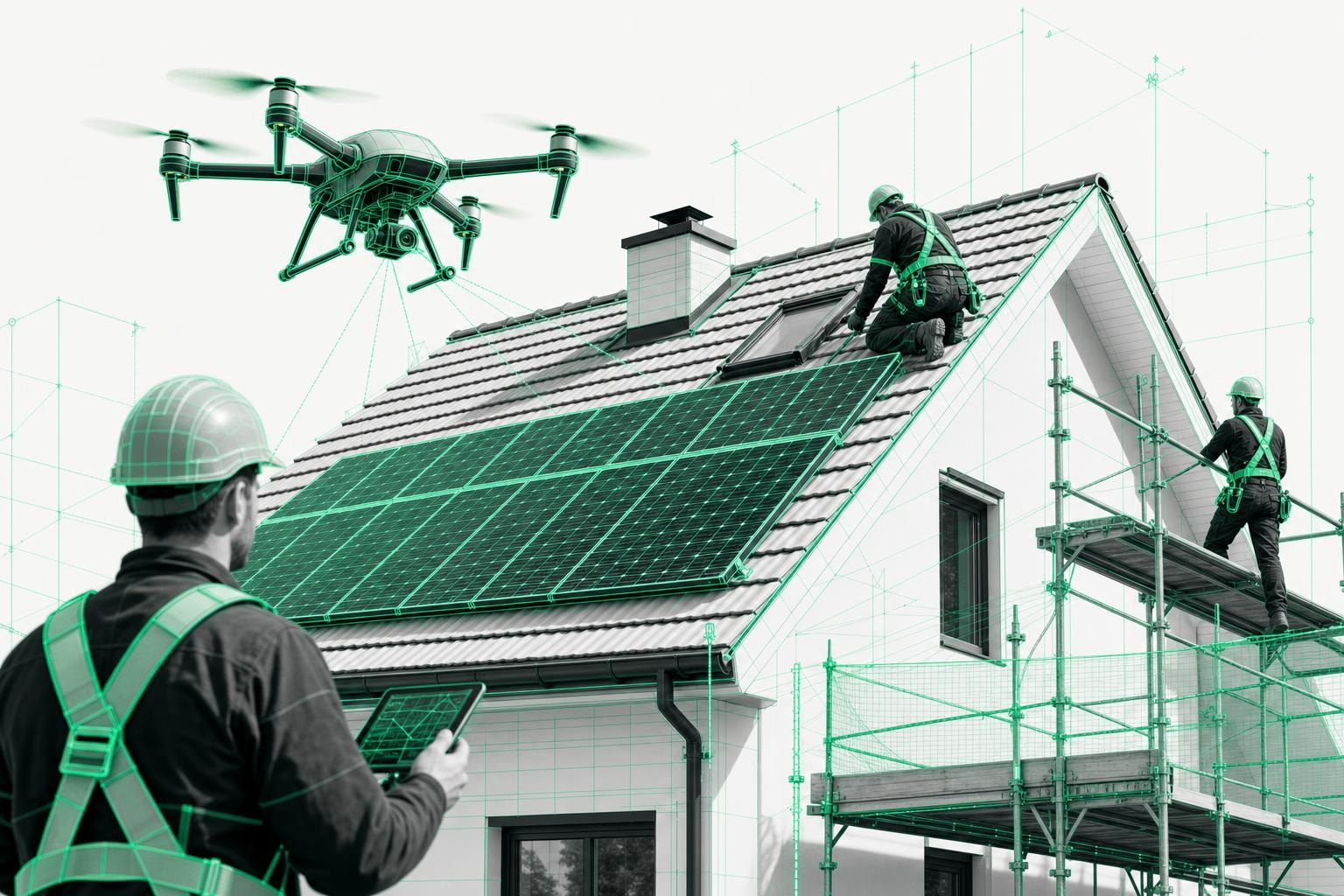
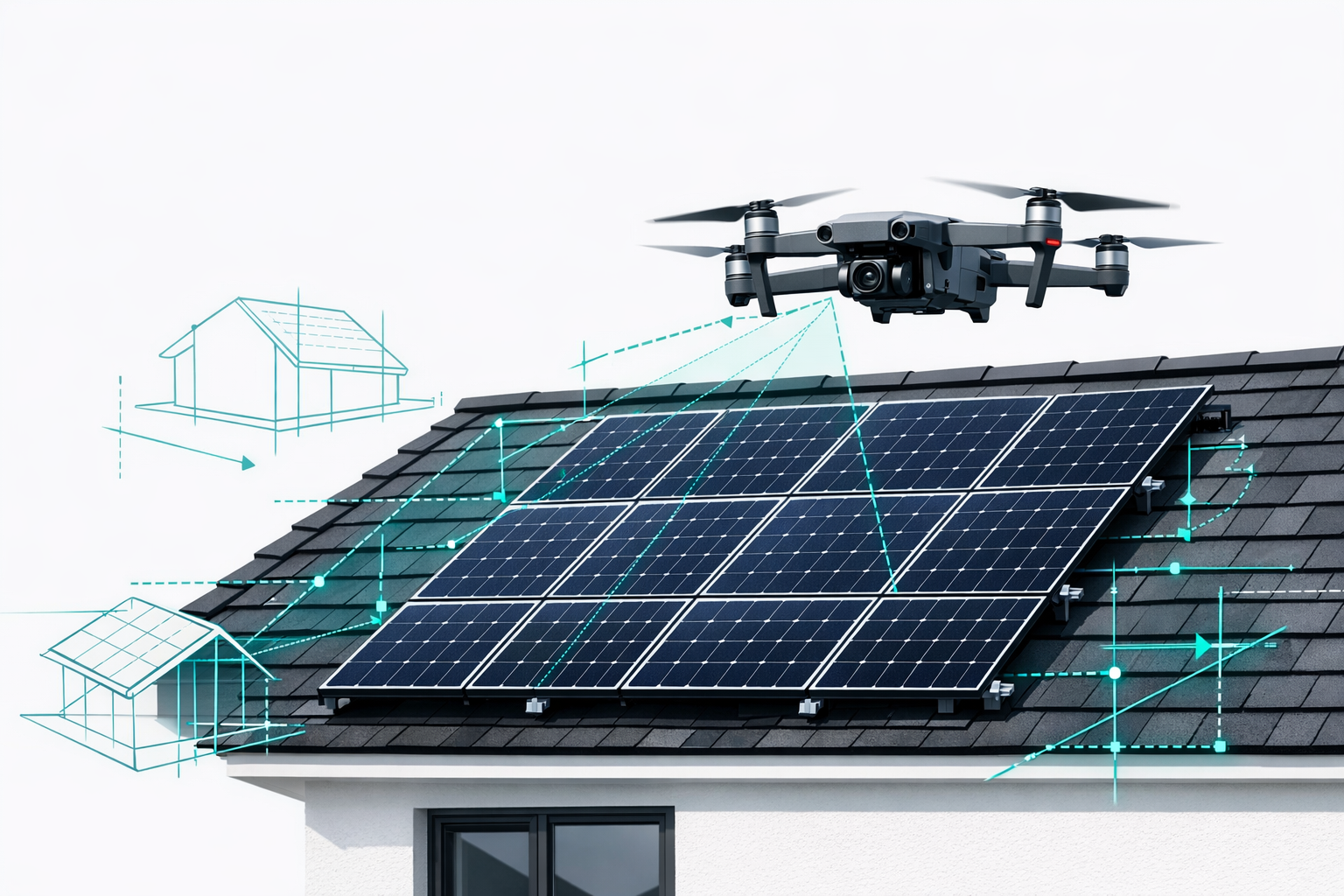
Roof survey done, laptop open, quote ready - what sounds like a vision of the future is already everyday reality for Strombauer. In the joint webinar from Airteam, Eturnity, and Strombauer, the speakers showed very concretely how drone surveying and planning software work together to massively accelerate PV planning.
This article summarizes the key insights and quotes from the webinar and explains what the "Next-Level Solar Design" workflow looks like in practice for installation companies.
From Measuring Tape to Drone - Why PV Planning Has to Change
At the start of every re-roofing project or PV installation, the same challenge appears: reliable building data. Until now, that has typically meant:
- setting up a ladder
- climbing onto the roof
- measuring with tape or laser
- counting tiles
- sketching on-site and redrawing later in the office
Airteam moderator Jos summed it up in the webinar:
The tools themselves are exciting. But at the end of the day, it's all about implementation. With the drone as a tool, access to technology and software becomes incredibly easy for trades businesses.
Marius Wegener, Managing Director of Strombauer, knows the pain from hands-on experience. Five or six years ago, he started out in a very traditional way:
We worked with measuring tape and folding rule, put the ladder up to the roof, took measurements, and did the first designs on paper.
As project volumes increased, it quickly became obvious: this approach is neither efficient nor scalable - especially in the era of the energy transition, where speed and quality are critical.
Airteam: Digital Surveying as the Foundation for Precise Solar Design
Airteam tackles this exact problem: drone-based surveying instead of walking the roof.
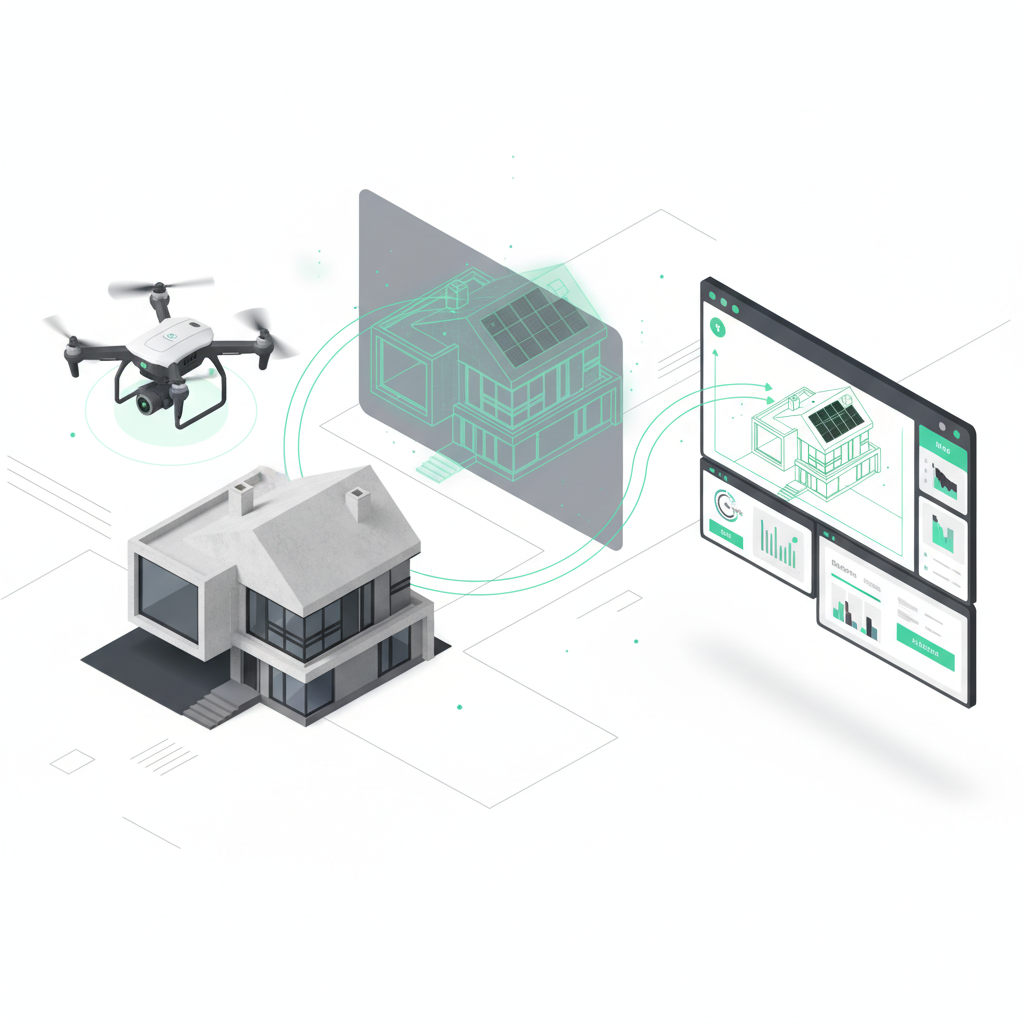
The process at a glance:
- On-site visit as usual - but without a ladder.
- Drone flight around the building, often just 2-3 minutes for a single-family home.
- Upload the images to the Airteam Fusion platform.
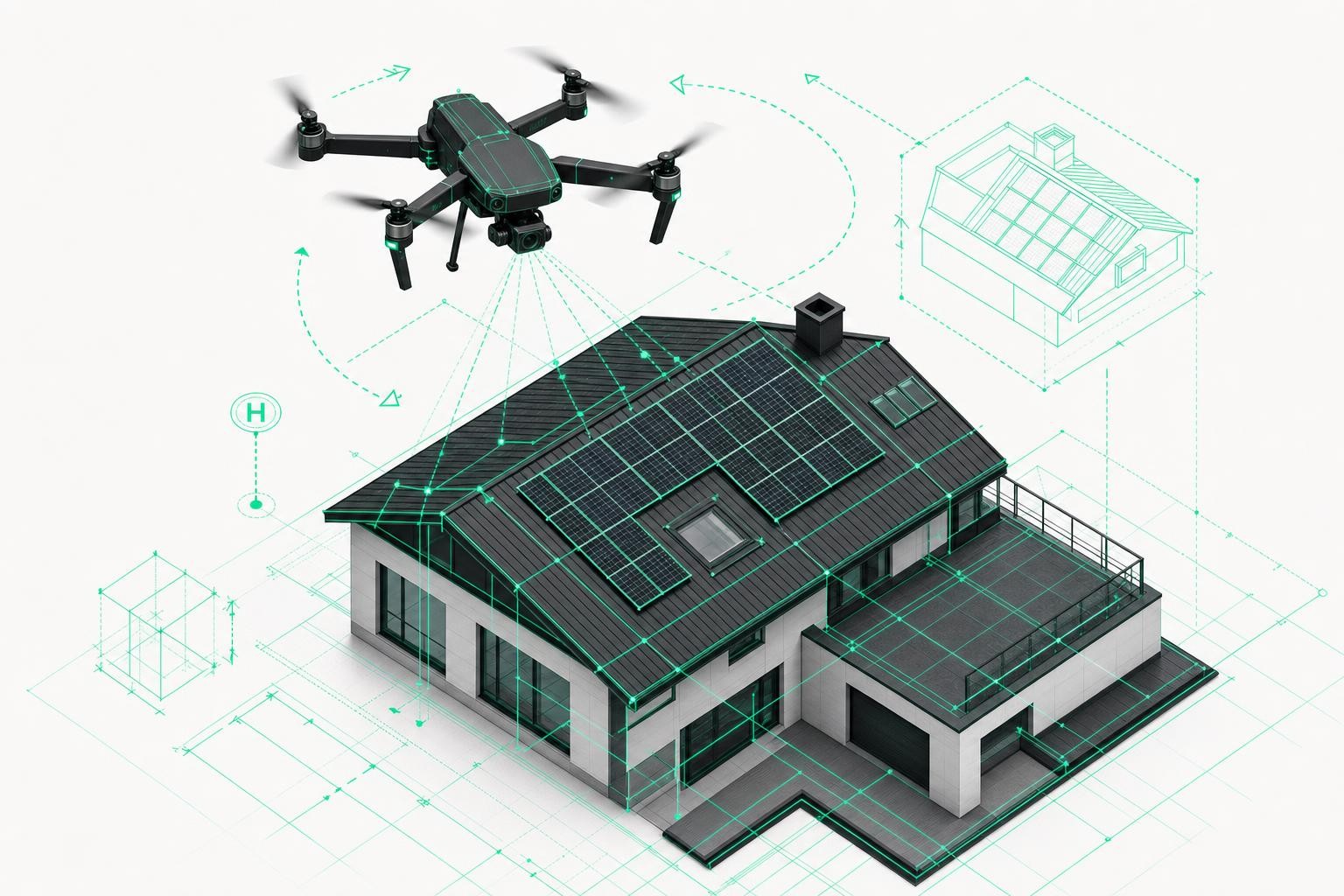
- AI evaluation: creation of a centimeter-accurate 3D twin of roof and facade.
- Export of the planning data - including a dedicated format for Eturnity.
Jos summarizes the impact as follows:
You save up to 90% of the time on-site for the survey and just as much time afterward processing the data. It's very safe - nobody has to go on the roof anymore - and, above all, it's standardized.
Key advantages for PV planning:
- Current, high-resolution data instead of outdated, pixelated satellite images
- Obstacles such as roof windows, vents, and chimneys are automatically detected and incorporated into the model
- Surroundings and vegetation are visible - essential for realistic shading analysis
- Web-based platform: no installation needed, data is centrally accessible for the entire team
For Eturnity, Airteam provides a GLB file that includes roof, facade, and surroundings as well as semantically classified roof areas - the basis for the next step: the actual solar design.
Eturnity: From 3D Model to Ready-to-Sign Proposal
Eturnity Solar Expert is PV design and sales software that covers the entire process from system sizing to proposal - web-based and vendor-neutral.
Felix Köhler from Eturnity describes their mission like this:
Our mission is to radically simplify your planning and proposal processes, increase your close rates, and give your customers a consistently positive experience from start to finish.
A typical workflow with Eturnity:
- Create a project (address, template, components)
- Import the 3D model from Airteam as an Eturnity file
- View the roof surfaces in the 3D viewer - including all obstacles
- Create the module layout with just a few clicks (double-click on the roof surface)
- Add consumption data, tariffs, storage, EV chargers, heat pumps
- Automatically generate profitability calculations and self-consumption ratios
- Generate bills of materials, contribution margins, and a proposal PDF at the push of a button
The real game changer is the combination with Airteam:
Eturnity on its own is already great - but with Airteam it's even better. We can upload the 3D models directly, obstacles are already drawn in, which makes planning even more accurate and even easier.
Felix emphasizes.
From the customer's perspective, the proposal is particularly impressive: on-brand, clearly written, and compact - not a 70-page PDF no one reads, but a visual, easy-to-understand document that enables quick decisions.
Real-World Example: Strombauer's End-to-End Workflow
Strombauer is a PV installer in the Dortmund area and at the same time a wholesaler with its own warehouse and logistics center in Bielefeld. In the webinar, Managing Director Marius Wegener showed in very concrete terms how their planning workflow has evolved:
-
Phase 1 - Manual:
Measuring tape, ladder, paper, counting tiles. -
Phase 2 - Drone photos + tile counting:
The drone takes photos, tiles are counted on-screen, dimensions are manually transferred into K2 Base, and the module layout is created there. Everything is then redrawn in Eturnity to generate a professional proposal. -
Phase 3 - Airteam + K2 Base + Eturnity:
Airteam creates a 3D model that is measured in the viewer. The measurements are transferred into K2 Base and from there into Eturnity. -
Phase 4 - Airteam + Eturnity (today):
Since Intersolar, Strombauer has been using Airteam's new GLB format directly in Eturnity.
We fly the roof with the drone, get the measured 3D model, which we always check with a measuring rod - usually 99 or 100% accuracy. Then we upload the file into Eturnity and can complete the planning there in a very short time.
In the live demo section, Marius shows:
- around 75 drone photos as the basis for one project
- import of the GLB model into Eturnity, precise alignment on the map
- automatic module placement via double-click, manual fine-tuning like a game of Tetris
- entry of load profile, electricity price, storage
- automatic simulation including self-sufficiency and self-consumption ratios
- bill of materials with contribution margin in euros and percent, based on stored purchase prices
- generation of a finished proposal PDF in just a few minutes
Before switching, a thorough system design could easily take up to two hours. Today, Felix talks about "5 to a maximum of 20 minutes in the residential sector", depending on complexity - including the proposal document.
Why is Strombauer so committed to this setup? According to Markus:
I'm mainly here because things are moving forward. The software keeps getting better, requests like the collaboration with Airteam are heard and implemented. And: the support works - if something doesn't run smoothly, someone usually takes care of it within a day so that we can keep working.
What Does This Mean Tangibly for Trades Businesses?
The webinar reveals five key learnings for roofers, solar installers, and carpenters:
-
Massive time savings
Drone surveying plus direct import into Eturnity drastically reduces on-site and planning time. More inquiries can be handled with the same team size. -
Higher data quality & fewer errors
Centimeter-accurate 3D models and automatically detected obstacles minimize design errors, rework, and expensive material corrections. -
Improved safety
No one needs to climb onto the roof anymore - reducing the risk of accidents and insurance claims, especially for steep or hard-to-access roofs. -
Stronger customer experience & higher close rates
Visual 3D views and clear proposals build trust. Those who can present a fully calculated proposal at the first appointment are more likely to win the job. -
Scalability across the team
Thanks to the intuitive interface, even new team members or trainees can quickly produce high-quality designs - specialized knowledge is supported and embedded in the software.
How to Get Started with the Next-Level Workflow
If you want to establish a workflow similar to Strombauer's, you can get started in three steps:
-
Pilot project with drone surveying
Choose a typical single-family home, survey it with a drone (or book an Airteam pilot), and have your first 3D model created. -
Test the Eturnity integration
Export the Airteam model in Eturnity format, import it into Eturnity, and run through a complete design including the proposal. -
Train the team & standardize processes
Define clear checklists for drone flights, data transfer, and proposal approval. Airteam and Eturnity provide training and support to make onboarding easier.
Conclusion:
"Next-Level Solar Design" is not a buzzword, but a very concrete workflow: launch the drone, generate the 3D model, design in Eturnity, send the proposal - safer, faster, and more accurate than any ladder and measuring tape. For companies that want to be at the forefront of the energy transition, now is the right time to take this step.