In the first ten months of 2025 alone, BG BAU reported 6,178 fall accidents on construction sites in Germany - 26 of them were fatal. More than one third of these fatal accidents happened on roofs[1] - and the numbers are continuing to rise with the solar boom.
The response from BG BAU and ZVDH is clear: Their joint initiative "Sicher auf dem Dach" (Safe on the Roof) was launched at the end of 2025, and BG BAU has developed a dedicated safety training calendar for roofers for 2026, guiding you through the year with twelve monthly safety topics.
As a business owner or safety officer, this development gives you a real opportunity: The annual safety training you are required to provide anyway becomes the ideal starting point to introduce drone-based surveying as a safer way of working. This way you meet your legal duty - and at the same time gain an edge over your competitors.
Why your annual safety training is the right moment now
According to Section 12 of the German Occupational Health and Safety Act (ArbSchG), every employer must train employees at least once a year on workplace safety and health protection. DGUV Regulation 1 adds another requirement: When new tools or technologies are introduced, staff must be trained before they start using them.
Drone surveying is a new technology. This means you are not only allowed to include its introduction in your annual health and safety training - you are actually required to do so if your team will be working with it in the future.
The BG BAU safety training calendar 2026 provides the ideal framework: Use the monthly safety topics around fall protection as your foundation and add the practical benefits of drone-based surveying. This turns your annual safety training from a mere obligation into a session that creates real value.
Tip: The BG BAU wall calendar "Sicherheit ganz oben" (Safety at the Top) in DIN A2 format is ideal for hanging permanently in your workshop or office - it reminds your team of key safety aspects throughout the year.
The core argument: Ground-based surveying replaces dangerous roof access
Before you dive into planning the details of your health and safety training, it is worth focusing on the core argument - because it convinces both your team and your clients:
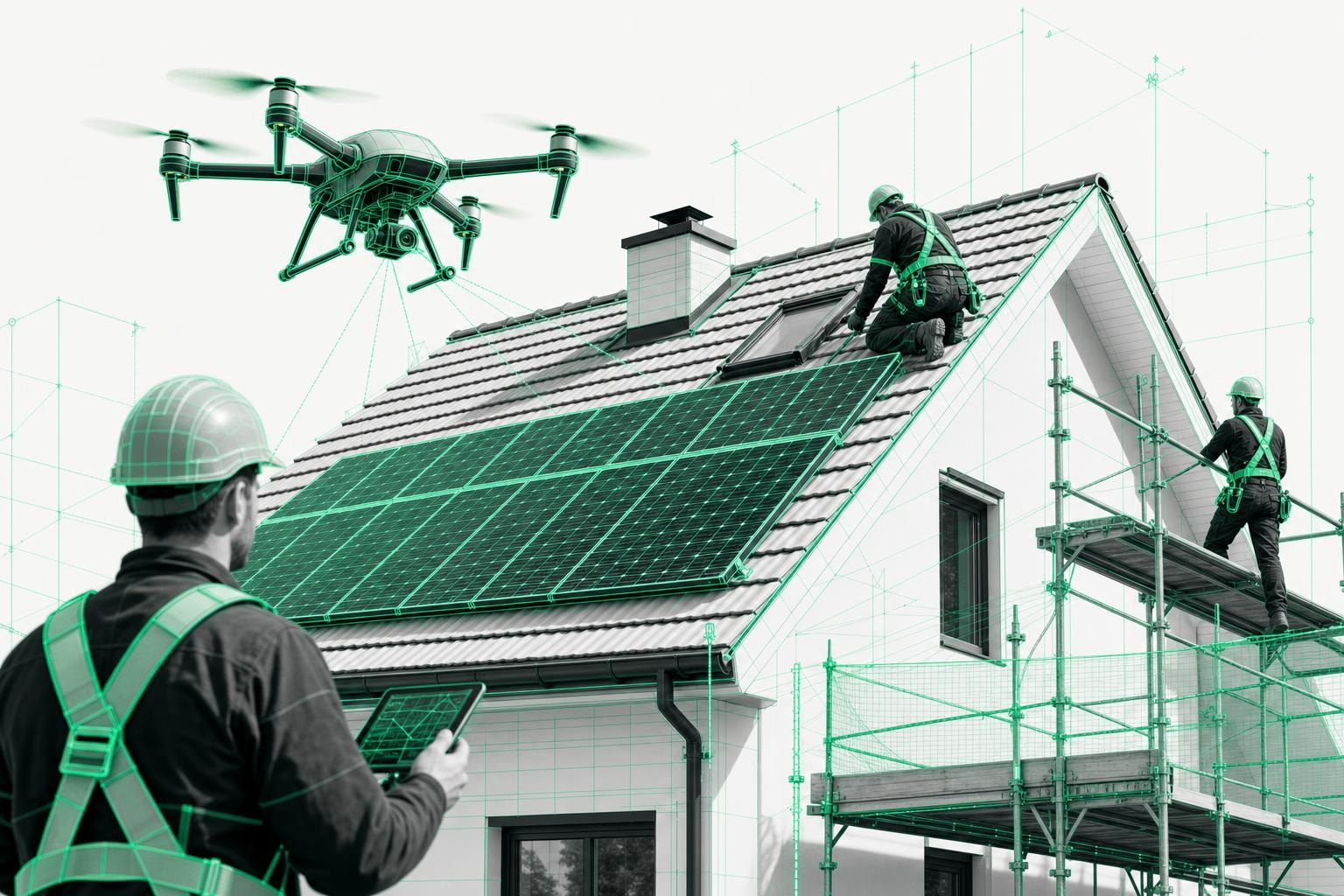
If you work with the Airteam Fusion platform, nobody has to step onto the roof just to take measurements. The entire measuring process happens from the ground - the drone does the work at height. The result:
- Zero fall risk during the surveying process
- DIN-certified accuracy of up to 99.9% with a tolerance of just 1-3 cm at 40 m altitude
- Up to 90% time savings compared to traditional manual measuring
- Fully compatible export formats for PV-Sol, AutoCAD, SEMA, Scaffmax, and more
Once your team understands in the safety training that climbing onto the roof is no longer necessary for measuring, acceptance and motivation increase significantly. This is not a theoretical safety topic - it is an immediate, tangible improvement in their day-to-day work.
Step by step: How to integrate drone surveying into your training
Inform your team in writing before the training that roof inspections for measurements will be replaced by drone flights. Briefly explain the background: less risk, more efficiency. This announcement reduces resistance and increases willingness to actively participate in the training.
Show in the training how the Airteam Fusion Platform works - from drone capture to the finished 3D model. A live demo or a short video conveys the principle clearly. Important: emphasize that no CAD skills are required and the operation is quick to learn.
Clearly define which employees will be deployed as drone pilots in the future. These individuals require the EU Drone Competence Certificate A1/A3 (for drones over 250 g). All other employees will receive an introduction to the Airteam Fusion Platform for further processing of the data.
Instruct the entire team in operational safety during drone flights: minimum distances to people and buildings, weather check before flight (no operation in storms/heavy rain), behavior in case of signal loss and an emergency plan. These topics nicely complement the BG BAU training calendar 2026.
Document the training fully in the training certificate: date, topic (e.g., "Introduction to drone surveying / fall protection"), list of participants with signatures and the name of the trainer. Keep the document for at least 2 years (in accordance with DGUV Regulation 1).
Who needs which qualification?
A common misconception: Not every employee needs a drone license. The required qualifications depend on each person's role in the company.
| Role in the operation | Required qualification | Effort / Cost | Applies to |
|---|---|---|---|
| Drone pilot (flies the drone) | EU competence certificate A1/A3 (required for drones over 250 g) | Online training + exam, approx. 3-6 hrs, €25 at the LBA | 1-2 employees per operation |
| Planner / Estimator (processes the data) | Introduction to the Airteam Fusion platform | One-time training including onboarding by Airteam | All data-handling employees |
| Site manager / Foreman | Basic drone operation knowledge + safety rules | Part of the annual safety briefing | All site-based managers on the construction site |
| All other employees | Instruction: Drone in operation - Behavioral rules | Part of the annual training (approx. 15-30 min.) | Entire team (roofers, carpenters, scaffolders, solar installers) |
The EU A1/A3 certificate of competency in detail
The EU A1/A3 certificate of competency is obtained fully online via the German Federal Aviation Office (LBA) and costs 25 euros. The exam consists of 40 multiple-choice questions, of which at least 75% must be answered correctly[2]. The certificate of competency is valid for 5 years.
For C1 class drones (common craftsperson drones over 250 g), the EU A1/A3 certificate of competency is the minimum requirement. Anyone who frequently flies near people (for example in commercial areas with pedestrian traffic) should additionally aim for the EU A2 remote pilot certificate.
You will find a detailed guide to the drone license for trades businesses in our blog post Drone License for Roofers & Carpenters 2025.
Training certificate: What you need to document
Your annual safety training is only as legally secure as the documentation behind it. DGUV Regulation 1 requires written documentation of all safety trainings. The training certificate (Unterweisungsnachweis) must include at least the following information:
- Date of the training
- Topic/content (for example: "Introduction to drone surveying - fall protection and occupational safety when using drones")
- Participant list with first and last name plus signature
- Name and signature of the trainer
- Where applicable, reference to materials used (BG BAU safety training calendar, Airteam demo)
Employers who fail to meet their health and safety training obligations risk fines of up to 30,000 euros[3]. Keep each training certificate for at least 2 years - digital storage is just as valid as paper.
Training certificate checklist: Date ✓ | Topic ✓ | Participants + signatures ✓ | Trainer ✓ | Retention period at least 2 years ✓
A clear structure like this works as a practical safety training template that you can reuse for every annual safety training session.
The motivation effect: When your team understands the benefits
Annual health and safety trainings are often seen as a box-ticking exercise. That changes the moment you present drone surveying as a concrete solution - because it answers a question many employees ask themselves every day: "How can I work more safely and more quickly?"
Experience from real projects shows: When a company introduces the principle of drone surveying during the annual safety training [/drohnenvermessung-vorteile-dachaufmass-solaranlagen], the willingness to use it is significantly higher than with a later, stand-alone introduction. Staff ask questions, the demo sparks interest - and on the very next project, many are keen to try the drone themselves.
This applies across trades: Roofers, carpenters, solar installers, and scaffolders all benefit from ground-based digital measurements. To see how different companies use Airteam in practice, take a look at our success stories.
FAQ: Safety training and drone surveying
Is the annual safety briefing really legally required?
Yes. According to § 12 of the Occupational Safety and Health Act (ArbSchG), every employer is required to instruct their employees at least once a year. DGUV Regulation 1 complements this and requires written documentation (training record). In case of violations, fines of up to €30,000 may be imposed.
Can I integrate the introduction of drone surveying directly into the existing annual training?
Yes, that's even advisable. According to § 12 ArbSchG, an instruction must be given when introducing new work equipment or technologies. You can seamlessly integrate this mandatory module into your annual safety training—and at the same time follow BG BAU's Training Calendar 2026.
What drone license do my staff need?
For most surveying drones used in the trades (e.g., DJI models over 250 g), the EU Certificate of Competence A1/A3 is required. It is completed entirely online with the Federal Aviation Authority (LBA), takes about 3-6 hours and costs €25. It is valid for 5 years.
Who must conduct the training?
Basically, the employer themselves or a competent person appointed by them—for example the safety officer or the construction manager. The occupational safety specialist can assist. Important: The responsibility remains with the business owner/manager.
How long must I keep the training records?
At least 2 years according to DGUV Regulation 1. For legal reasons (e.g., in the case of accidents at work or occupational diseases) a longer retention period is advisable. Digital archiving is easily possible.
Conclusion: Turn a legal duty into an opportunity
Your annual health and safety training is not a burden - it is the ideal framework to drive real change in your business. The BG BAU safety training calendar 2026 guides you through the year with twelve safety topics and gives you relevant hooks every month to connect fall protection with digital ways of working like drone-based 3D measurements.
If you integrate drone surveying into your annual safety training now, you are sending a clear signal: Safety is non-negotiable - and efficiency is not either. With the right technology, you do not have to choose between them.
Ready for your first step? Test the Airteam Fusion platform for free and see for yourself how easy it is to get started - start your 14-day trial here.