An estimated several million existing roofs in Germany are in need of renovation - and from 2026 onwards, every full roof replacement in several federal states will automatically trigger a legal obligation to install solar. For solar installers, this means a huge pool of projects that has barely been tapped so far. If you position yourself now, you actively help shape a structural surge in demand instead of sleeping through it.
This guide shows you which rules apply in which federal states, which challenges existing roofs bring with them, and how you can already win projects faster and more safely today with a precise digital roof survey workflow based on drones and AI.
New Solar Panel Roof Mandate 2026: What You Need to Know as a Solar Installer
The solar panel roof mandate (Solardachpflicht) in Germany is regulated at state level - and the individual states are moving at different speeds. For solar installers, one point is crucial: it is no longer just about new builds. From 1 January 2026, North Rhine-Westphalia will introduce a solar panel mandate for any full roof renovation (complete renewal of the roof covering) for all residential and non-residential buildings. This is a turning point: every comprehensive roof renewal becomes a trigger for a PV system.
NRW is not an isolated case. Baden-Württemberg has already had this rule for existing buildings in place since 1 January 2023[1] - with a requirement to use at least 60 percent of the suitable roof area. And Schleswig-Holstein has introduced a solar panel mandate for new residential buildings from March 2026.
| Federal State | Roof renovation mandatory? | Minimum requirement | In force since / from |
|---|---|---|---|
| Baden-Württemberg | ✅ Yes (Residential & Non-residential buildings) | at least 60% of the suitable roof area | 01.01.2023 |
| Nordrhein-Westfalen | ✅ Yes (all building types) | 30% of the suitable roof area (existing buildings) | 01.01.2026 |
| Schleswig-Holstein | ⚠️ Non-residential buildings only during renovation | Entire eligible roof area; new residential buildings mandatory from March 2026 | New construction from March 29, 2026 |
| Berlin | ✅ Yes (substantial roof renovation) | at least 30% of the net roof area | 01.01.2023 |
| Hamburg | ✅ Yes (from 50 m² of roof area) | Proportionate eligible area | 01.01.2024 |
| Bremen | ✅ Yes (from 80% of the roof area renewed) | at least 50% of the gross roof area | 01.07.2024 |
Energy Sharing as an additional growth driver: From June 1, 2026, the new §42c EnWG will come into force and will enable for the first time the so-called Energy Sharing in Germany. PV system operators can share their solar power directly with neighbors or tenants via the public grid. This makes PV systems on multi-family houses and existing buildings even more attractive — and creates further demand for precise PV planning for these very buildings.
The Rules in Detail: Federal State by Federal State
North Rhine-Westphalia: Existing Roofs Become Mandatory Cases
In NRW, the solar panel roof mandate for existing buildings applies from 1 January 2026 whenever the entire roof skin is fully renewed - meaning that covering and waterproofing are completely replaced. This is set out in Section 42a of the state building code (Landesbauordnung NRW)[2].
The specific minimum requirements for existing buildings are:
- 30% of the suitable roof area must be fitted with PV
- Alternative: a minimum output of 3 to 8 kWp depending on building size (for buildings with up to 10 residential units)
- Exceptions only apply in the case of technical impossibility, listed-building protection or proven economic inefficiency (payback period longer than 25 years)
Important: The solar panel roof mandate in NRW applies from a usable building area of at least 50 square metres - smaller buildings are exempt.
Baden-Württemberg: A Pioneer With the 60 Percent Rule
Baden-Württemberg is the first federal state to extend the obligation to roof renovations. Since 1 January 2023, a solar panel mandate has applied in Baden-Württemberg for fundamental roof renovations: at least 60 percent of the suitable roof area must be used for solar. The rule applies to residential and non-residential buildings alike and will remain unchanged in 2026.
What many overlook: as an alternative to a PV system, a solar thermal system can also fulfil the obligation in Baden-Württemberg. In practice, however, most owners opt for photovoltaics - and hire a solar installer.
Schleswig-Holstein: New-Build Obligation for Residential Buildings From March 2026
With the amendment of the Energy Transition and Climate Protection Act (Energiewende- und Klimaschutzgesetz, EWKG), Schleswig-Holstein has introduced a solar panel mandate for private residential buildings. The obligation applies to new residential buildings if the building application is submitted on or after 29 March 2026. For roof renovations on residential buildings there is no mandate in Schleswig-Holstein - it only applies to non-residential buildings if more than 10 percent of the roof area is renovated.
For solar installers, this means: new-build projects in the private sector in the state between the seas will automatically be subject to the solar panel roof mandate.
If you look at it as a solar panel mandate by state, NRW, Baden-Württemberg and Schleswig-Holstein are currently setting the pace - and other states are likely to follow with their own solar panel mandate 2026 regulations.
The Real Challenge: Existing Roofs Are Complex
Even though the legal requirements are clearly formulated, in practice existing roofs present solar installers with significant challenges. This is exactly where it is decided whether a project runs smoothly or whether costly rework is required.
Three Typical Problems on Older Existing Roofs
1. Complex roof geometries
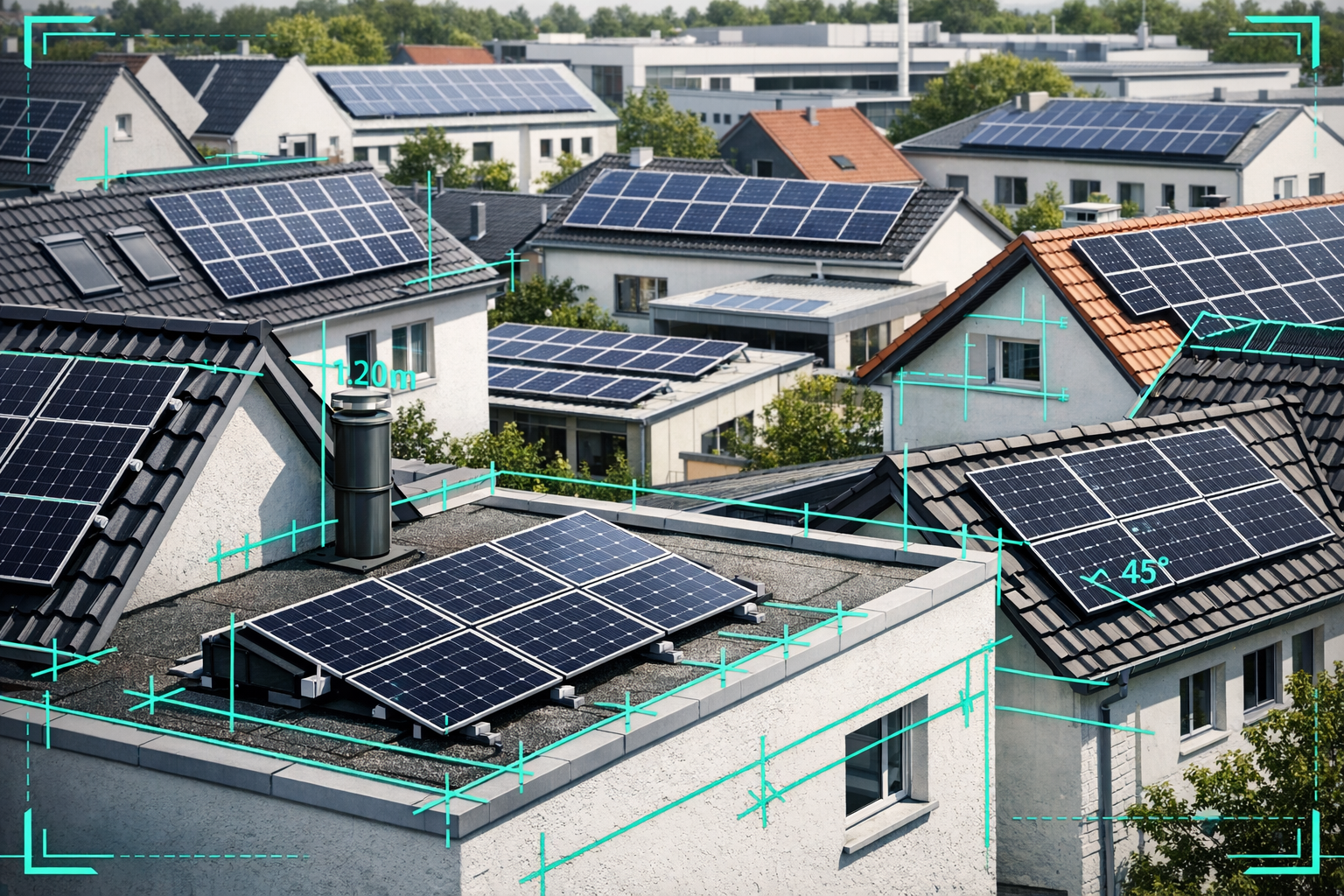
Multi-family houses and older buildings rarely have simple gable roofs. Dormers, extensions, hip and mansard roofs, ventilation shafts and roof terraces make the areas difficult to capture - with high time expenditure and a considerable risk of measurement errors.
2. Unknown shading conditions
For existing buildings - especially in multi-family housing estates - adjacent buildings, trees and roof structures must be accurately recorded for shading analysis. An imprecise analysis leads to overestimated yields and disappointed customers.
3. Unknown roof condition
Before PV planning, it must be clear whether the roof can bear the static load of the modules. Without precise documentation of the roof structure, there is no reliable basis for planning.
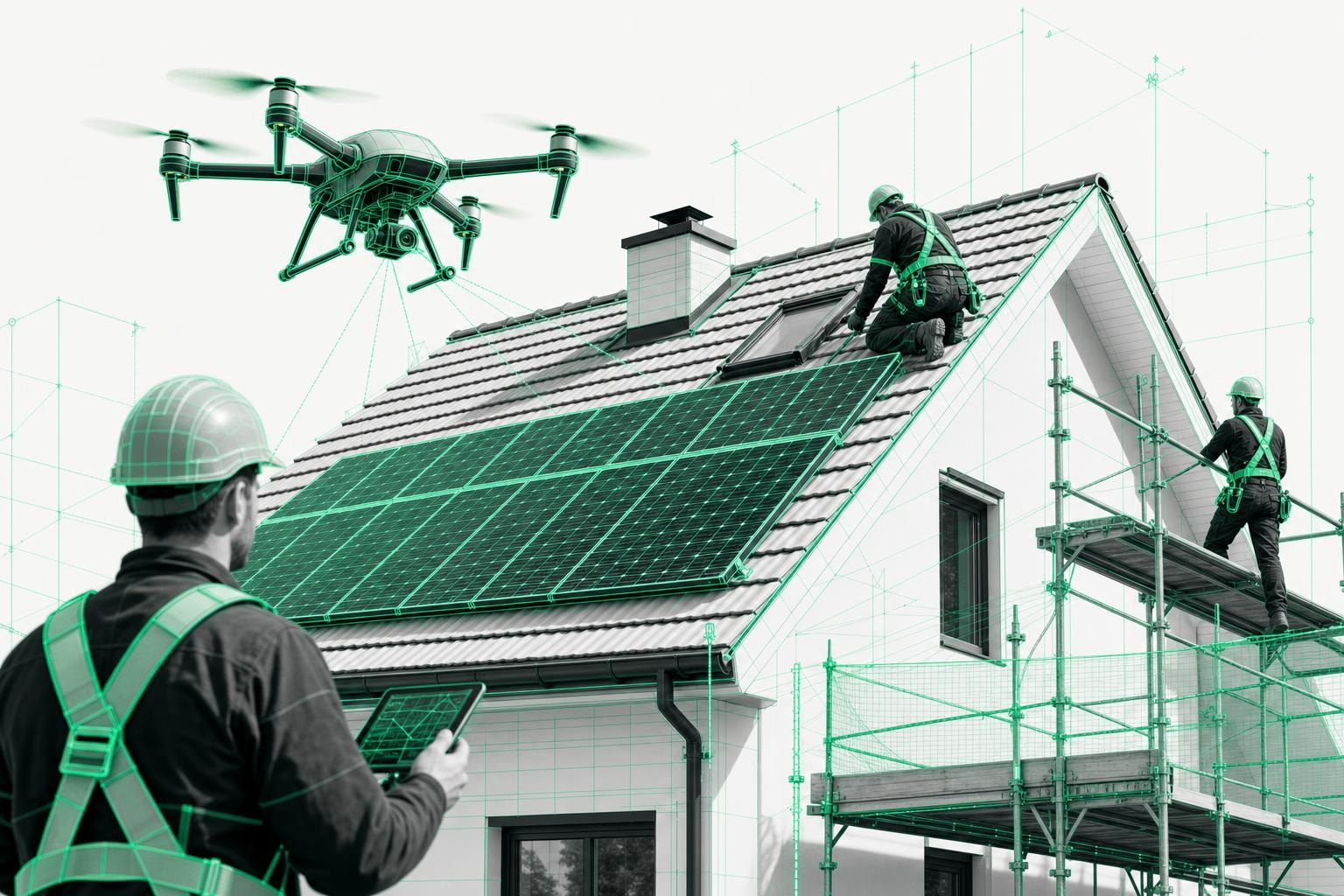
A traditional manual roof survey is particularly time-consuming, risky and prone to error on such buildings. Roof walks on complex geometries increase the risk of accidents - and incorrect measurements will hurt later in system design and installation.
How AI-Based 3D Drone Surveys Simplify Planning on Existing Roofs
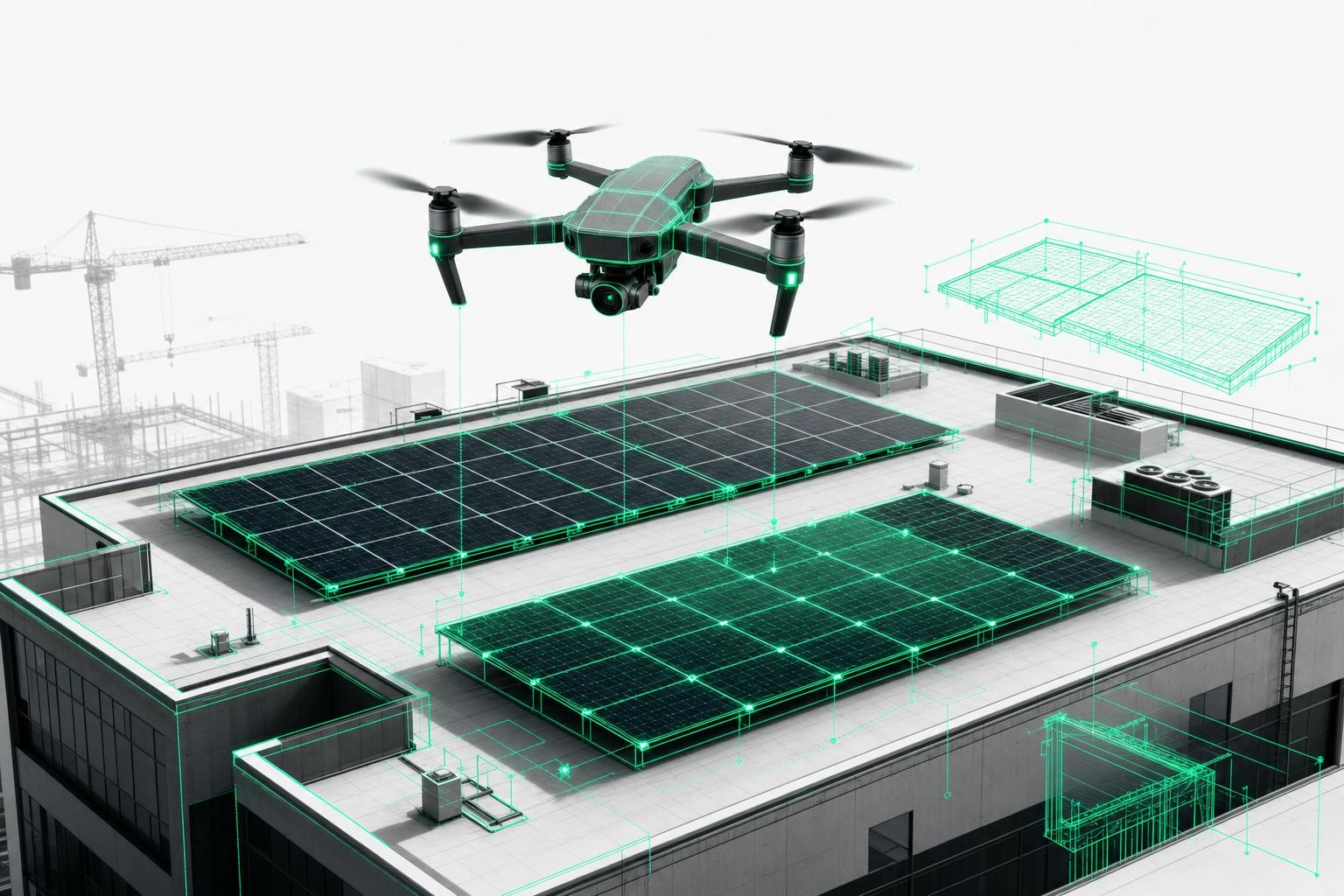
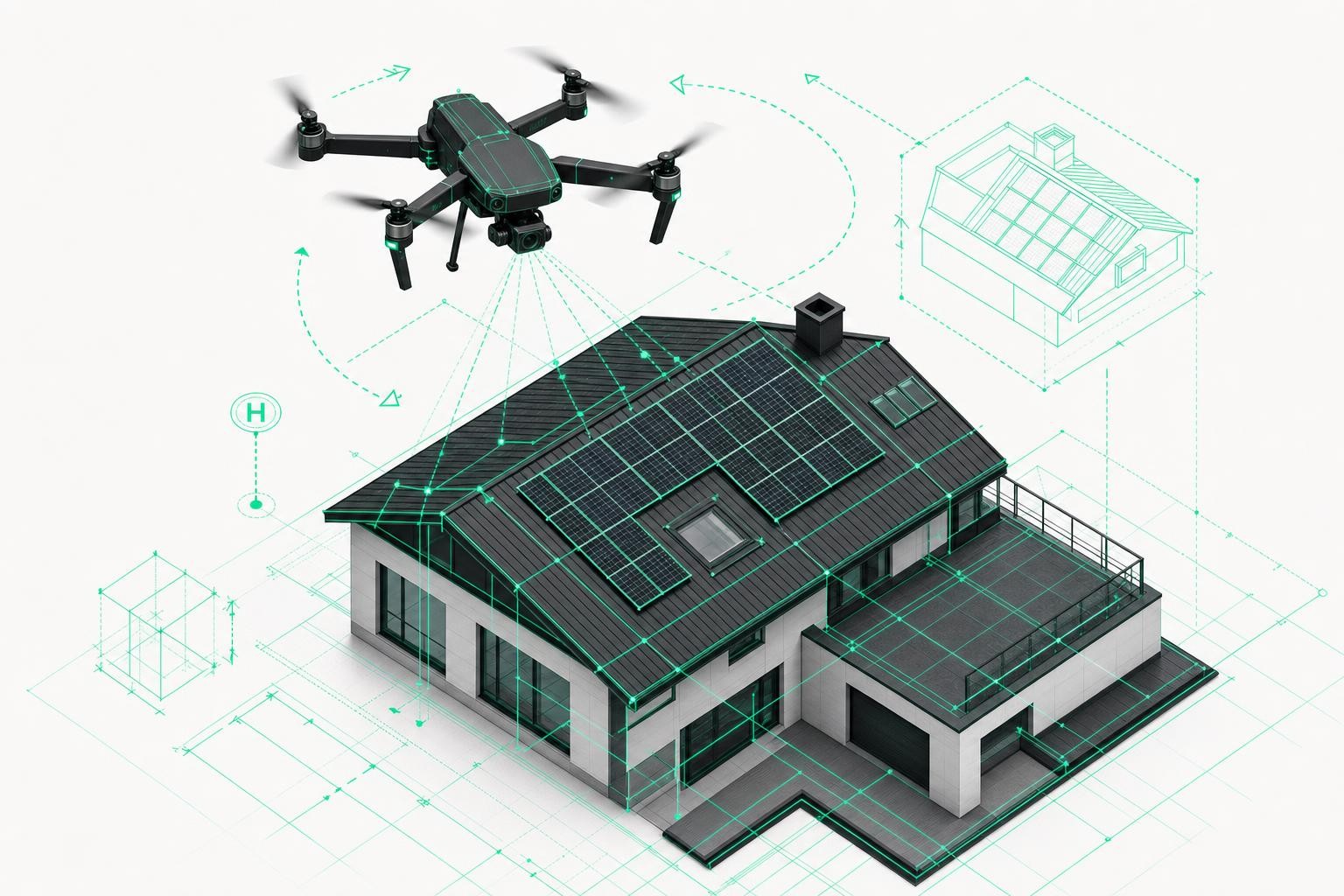
This is exactly where the Airteam Fusion Plattform comes in. Instead of time-consuming roof walks, a short drone flight is all you need - the AI takes care of everything else automatically.
Just a short drone flight is sufficient—from the ground, without any roof access. The camera captures all relevant roof areas, dormer windows, structures and shading objects in a single pass.
The Airteam Fusion platform automatically processes the drone images into a precise, DIN-certified 3D building model—typically within 24 hours.
The 3D model provides all data for precise shading analysis: roof slopes, orientations, structures, and neighboring buildings are captured to centimeter accuracy.
The data are exported directly to PV*SOL, Eturnity, SolarEdge Designer, or other common planning tools—ready for system design, with no manual transfer.
With precise, DIN-compliant planning data you create a legally sound proposal—faster than the competition and with significantly lower risk of errors.
The result is a DIN-certified 3D building model with an accuracy of up to 99.9% and a tolerance of just 1-3 cm at a flight altitude of 40 m - ready for direct use in your planning tools and pv system design software.
Seamless Integration Into PV Planning Tools
Airteam data can be exported directly into the most common PV planning programs - with no manual transfer and no media breaks:
- PV*SOL (LPM format or planarised data - ideal depending on project size, more in the Airteam guide to PV*SOL)
- Eturnity for fast quoting and customer presentations
- SolarEdge Designer for system-specific layout
- AutoCAD, SketchUp, SEMA and more than 15 other formats
This really pays off on complex existing roofs: users of the Airteam platform save up to 90% of the time compared with manual surveys - and receive far more precise data for shading analysis.
If you want to see what that looks like in practice, take a look at the Energieinsel success story: by using Airteam, the company was able to save several working days per project while significantly improving planning quality.
Energy Sharing From June 2026: Another Strong Argument for PV on Multi-Family Homes
The solar panel roof mandate is not the only topic that will shape the market in 2026. On 13 November 2025, the Bundestag introduced energy sharing into German law for the first time with the new Section 42c EnWG; it will come into force on 1 June 2026.
What this means in concrete terms: from June 2026, PV system operators will be able to share their solar power directly with neighbours, tenants or businesses via the public grid - instead of feeding it into the grid for low feed-in tariffs. This makes PV systems on multi-family houses and in residential quarters significantly more attractive.
For solar installers, this means:
- More arguments for owners who have been hesitant up to now
- Larger systems on multi-family roofs become far more attractive financially
- The need for precise roof measurement and optimal system design increases - because every additional kWp contributes directly to the financial outcome
- The smart meter obligation from 7 kW creates additional infrastructure work around PV projects
Especially on multi-family buildings - with their often complex roof geometries - a precise 3D survey is the essential foundation for optimal system design.
What This Means for Your Business: Three Scenarios
Scenario 1: Roofers Ask You to Be Their Partner
From 2026 onwards, roofers who carry out roof renovations in NRW or Baden-Württemberg must be able to propose or at least recommend a PV solution to their customers. Solar installers who cooperate with roofing companies and quickly prepare reliable offers will become preferred partners.
With a drone survey, you capture the roof during the very first site visit and deliver a complete planning proposal within 24 hours - with no roof walk and no delay.
Scenario 2: You Actively Target Renovation Projects
The solar panel mandate 2026 creates predictable demand: whenever a full roof renovation is planned in a state with a mandate, demand for PV arises automatically. Solar installers who proactively approach roofers, property managers or building owners and win them over with fast, DIN-compliant offers secure a clear competitive advantage.
How such a unique selling point works in sales is explained in our article on the competitive edge for solar companies through drones and AI.
Scenario 3: You Design Energy-Sharing-Ready Systems on Multi-Family Buildings
Multi-family houses will become a central growth segment in 2026 - due to the combination of the solar panel roof mandate for renovations and energy sharing. The challenge: these buildings have complex roofs, many households and high requirements for system design.
A precise 3D drone survey is the basic requirement if you want to plan reliably here and avoid wasting any kWp potential.
Conclusion: Position Yourself Now - Before Everyone Else Does
The solar panel roof mandate for roof renovations is not a bureaucratic detail. It is a structural demand accelerator that will take full effect in NRW from January 2026, has already been active in Baden-Württemberg since 2023 and will be gradually expanded in other states. Combined with the energy sharing law, this creates a wave of demand that particularly affects multi-family buildings and existing roofs.
For solar installers who position themselves well now, the rule is simple: whoever can plan quickly wins the contract. And whoever plans precisely avoids expensive corrections later on.
The AI-based 3D drone survey from Airteam is built exactly for this: capturing complex existing roofs quickly, safely and in a DIN-compliant way - and transferring the data directly into your pv system design software and other planning tools. No risk on the roof, no duplicate work, no media breaks.
Does the solar roof obligation apply to roof renovations for single-family homes as well?
Yes, in NRW from January 1, 2026 and in Baden-Württemberg since January 2023. The obligation applies to a full renewal of the roof covering - not for partial repairs, but when roofing and sealing are completely renewed.
What does the solar roof obligation mean in practical terms for solar installers?
Every comprehensive roof renovation automatically triggers the need for a PV system in the affected federal states. This opens up new assignments for solar installers directly within roof renovation projects - often in combination with roofing companies.
Why is surveying particularly important for existing buildings?
Existing buildings often have complex roof geometries, dormers, extensions, or roof projections, which make manual surveying prone to errors. Additionally, unknown roof conditions become visible only with precise 3D data. Errors in the surveying later lead to costly corrections.
From June 1, 2026, can PV system operators share their solar power with neighbors or tenants via the public grid? (Energy sharing) How does this relate to the solar roof obligation?
From June 1, 2026, PV system operators will be able to share their solar electricity with neighbors or tenants via the public grid (§42c EnWG). This makes PV systems on multi-family houses even more economically attractive - and increases planning pressure, since the systems must be designed optimally for each building.
How can I use Airteam to process the solar roof obligation projects more efficiently?
With the Airteam Fusion platform you generate from a single drone flight a precise 3D survey of the existing structure, which can be exported directly to PV*SOL, Eturnity and other planning tools - DIN-compliant, in less than 24 hours, without a roof inspection.