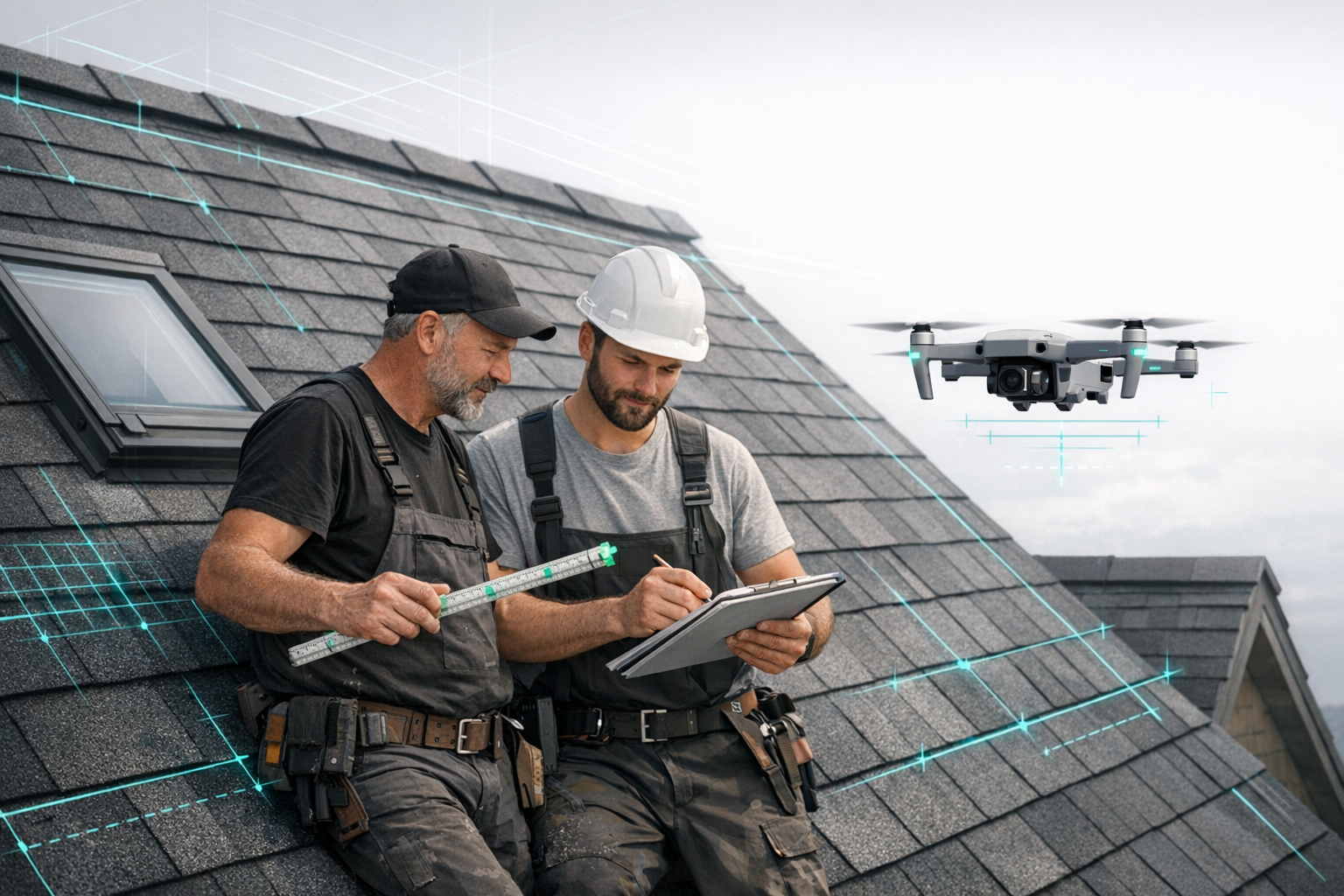
Imagine this: two tradespeople standing on a steep pitched roof, folding rule in hand, sketch pad balanced on their knees - just hoping the numbers will still be legible back at the office. For many roofing companies, that is still everyday reality. Yet construction surveying has fundamentally changed over the past few decades. From analogue tape measures to electronic total stations, all the way to AI-powered 3D surveying by drone: anyone who understands this evolution can leverage the opportunities of 2026 in a targeted way.
This overview explains how surveying methods have developed, where traditional approaches reach their limits - and why digital surveying is now the new standard in the roofing trade.
Era 1: Analogue craft - folding rule and paper
Traditional roof measurements are taken with a tape measure, folding rule and occasionally a caliper. For decades, this was the undisputed standard in the roofing trade. One or two roofers climb onto the roof, measure areas, slopes and edges, and transfer everything by hand onto paper.
The method worked - but came with familiar drawbacks:
- Measurement inaccuracies of 5-10 cm were common
- Illegible notes led to transcription errors in calculations
- Hazardous roof access with ladders or makeshift scaffolding
- Time required: 3-5 hours just to measure a single-family home
Errors in surveying can lead to design flaws, additional costs and delays. For roofing companies with a high project volume, these disadvantages quickly add up to a serious competitive disadvantage.
Era 2: Electronic total stations
From the 1990s onwards, electronic total stations began making their way into construction surveying. A total station combines electronic distance measurement and angle measurement in a single, highly precise instrument. The collected data could be stored digitally and imported directly into CAD software - a significant advance over pen and paper.
However, the technology had pitfalls:
- Acquisition costs in the five-figure range
- Complex operation requiring specialist expertise
- Roofs still had to be accessed in person
- Data evaluation still took hours, despite digitalisation
For professional surveying firms, total stations were a real gain. For a typical roofing company with 5 to 20 employees, the barrier remained high.
Era 3: 3D laser scanning - precise but complex
In the 2000s, 3D laser scanning arrived on the market and impressed with its precision. Laser scanners can capture all relevant data and store it as point clouds. Tolerances of ±1-3 cm became achievable.
The problem: for a long time, this technology remained the domain of specialised surveying service providers. For everyday roofing work, laser scanning was hardly practical:
- Investment costs running into tens of thousands of euros
- Evaluation required specialist software and expertise
- Setup time on site: up to several hours
- No direct workflows into common trade software
In short: laser scanning was a brilliant technology for large-scale projects - but not a tool for day-to-day operations in roofing companies.
Era 4: Satellite and aerial imagery - the first digital detour
With the availability of digital aerial and satellite imagery, many believed the roof measurement problem had been solved. No climbing onto roofs, no expensive equipment - it sounded ideal.
Reality turned out differently. Satellite data achieves an accuracy of only ±30-50 cm - a value that is simply insufficient for professional solar PV planning or scaffolding design. On top of that, the data is often months or years old, does not reflect current additions or structures on the roof, and is difficult to integrate into up-to-date planning workflows.
Anyone needing the actual roof pitch, the exact position of dormers or precise area calculations for an accurate quote hit a dead end with satellite images.
Era 5: Drone surveying - a turning point for the trades
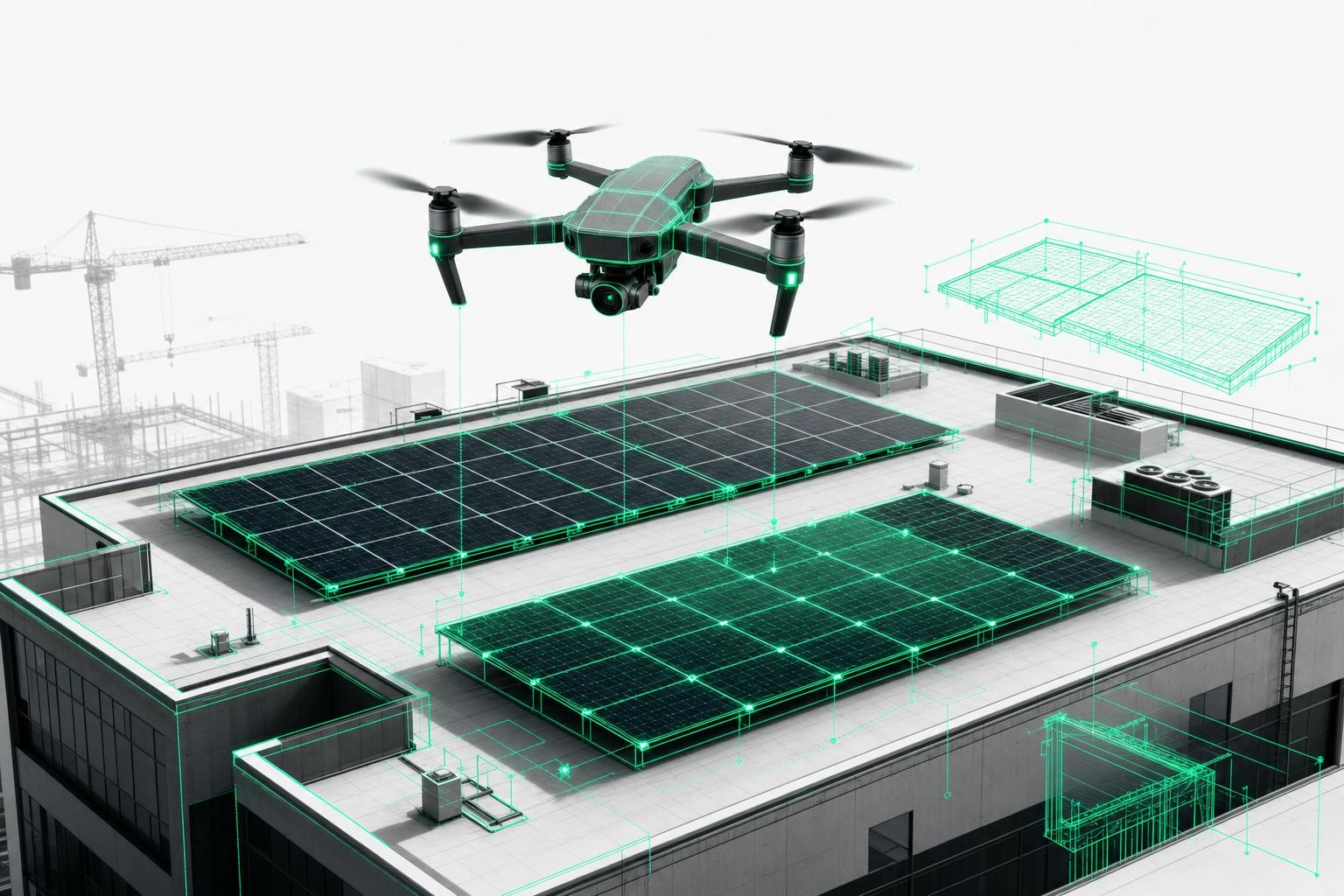
From around 2015 onwards, drone technology established itself for commercial use. Early pioneers in the roofing trade started using drones for aerial images and used photogrammetry software to generate the first 3D models. Drones can capture hazardous or hard-to-reach areas without putting staff at risk.
But one crucial step was still missing: evaluation was complex, the software was not designed for roofing companies, and transferring the results into calculation tools required a lot of manual work. The potential was obvious - but everyday practicality still had room for improvement.
Era 6: AI-powered 3D surveying - the standard in 2026
Today, in 2026, drone surveying is no longer experimental. AI-enabled cloud platforms such as the Airteam Fusion Platform have removed the last remaining barriers: evaluation is fully automated, results comply with DIN standards, and the finished data can be imported straight into planning software.
The process is simpler than ever:
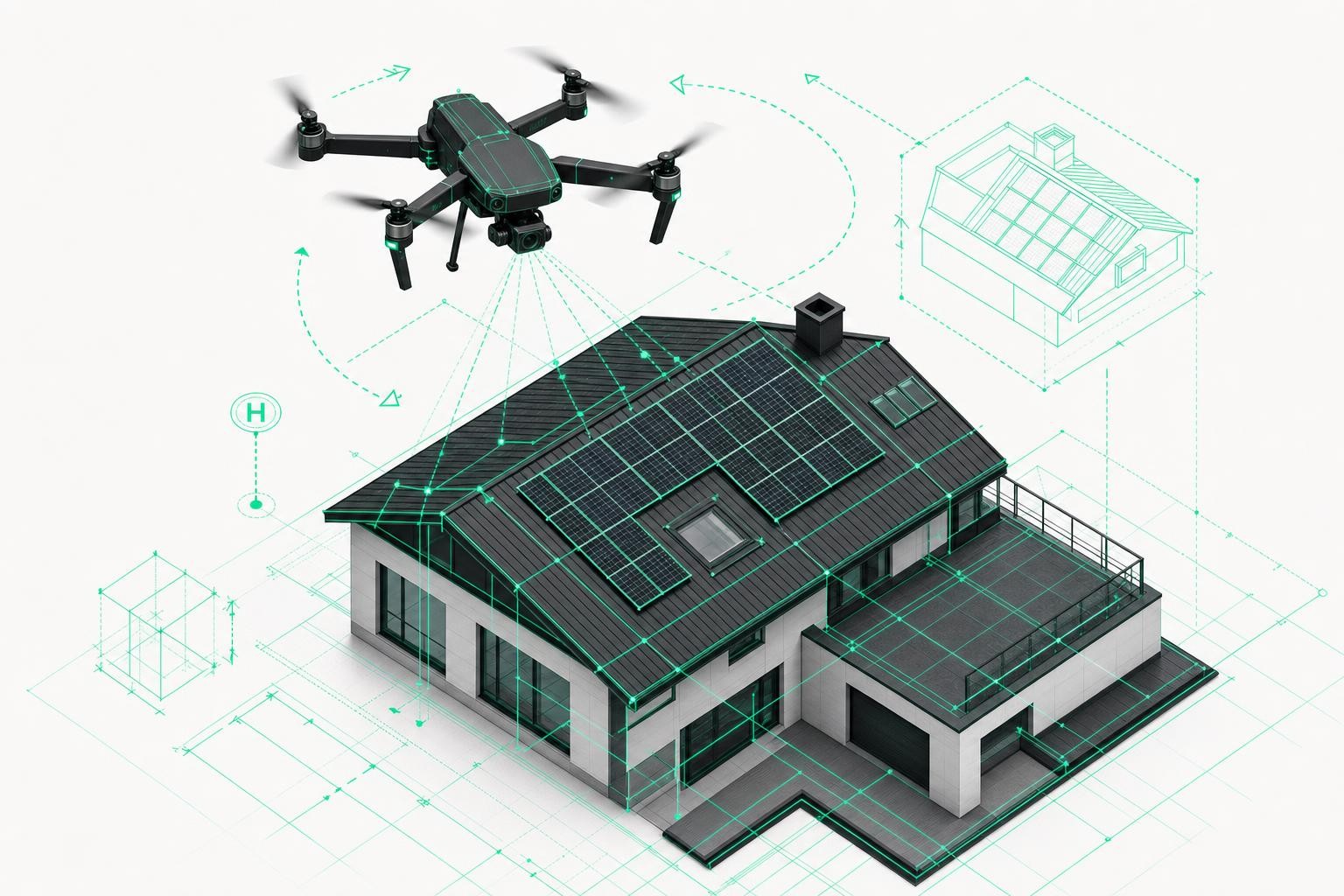
- Drone flight: Fly around the building once - about 15-30 minutes for a single-family home
- Upload to the cloud: Upload images, AI handles the evaluation
- 3D model ready: DIN-compliant 3D models are available within 24 hours
- Export: Send data directly to PV*SOL, MF Dach, AutoCAD, SEMA and more than 15 other formats
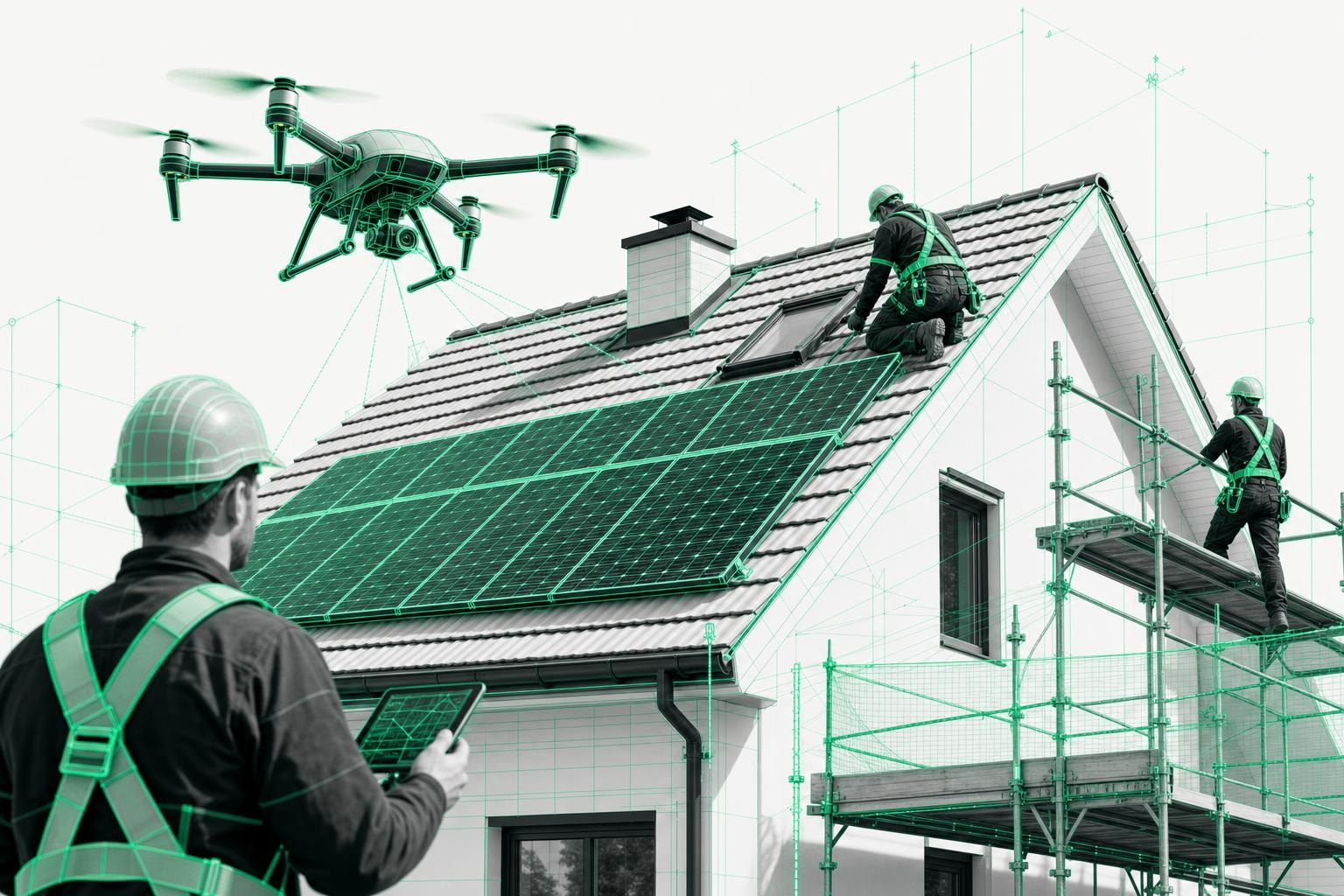
Using RTK drones, the Airteam Fusion Platform achieves 99.9% accuracy with a tolerance of only 1-3 cm at a height of 40 m. That is eight times more accurate than satellite data - and entirely ground-based. No climbing, no ladders, no safety risks.
The evolution at a glance
All methods in direct comparison
The comparison makes one thing clear: every era brought progress. But only the combination of drone technology and AI solves all three core challenges of construction surveying at once - speed, precision and safety - and makes the technology accessible to every roofing company.
What standardisation means for you
A milestone that is often underestimated in the industry: Airteam, together with the German Institute for Standardization (DIN), helped shape DIN SPEC 5452-5 - the first unified standard for digital roof measurements by drone.
For you as a roofer, this means:
- Legally reliable measurement data for quotes, invoicing and regulatory procedures
- Comparable, transparent results based on a unified standard
- Planning certainty for tenders and insurance claims
- Greater acceptance among architects, energy consultants and clients
Anyone working with data that complies with DIN SPEC 5452-5 today sends a clear signal to clients: this roofing company works precisely, digitally and professionally.
Why 2026 is the right time to switch
The evolution of construction surveying shows a clear pattern: no new method completely replaces the old one overnight - but roofing companies that switch early benefit the longest. Successful roofers are already using digital measurement solutions and reporting measurable benefits:
- Up to 90% time savings compared to manual measurement
- No more dangerous roof access
- Faster quote generation and thus more projects won
- Seamless integration into existing software environments
A real-world example underlines this: Dachdeckerei Mann GmbH surveyed 6,000 m² of roof area with more than 100 dormers in just 2 days - instead of several weeks. Roofing companies like this demonstrate that the technology is no longer a promise about the future, but part of everyday practice.
The difference between tomorrow's roofing companies and those stuck in the past is not the craft itself - it is the tools they use to measure.
Key takeaways for you
- Traditional methods such as folding rules and total stations have served roofers well for a long time, but they clearly hit limits in terms of precision, safety and efficiency
- Laser scanning and aerial imagery closed some gaps, but remained too complex or too inaccurate for day-to-day operations in most roofing companies
- AI-powered drone surveying solves all core problems at once in 2026: faster, safer, more precise - and directly integrable into your roofing workflows
- DIN SPEC 5452-5 provides a standardised basis for legally reliable, professional measurement data
- Those who switch today do not just save time and money - they gain a genuine competitive edge
You can learn more about how to practically implement digital surveying in your roofing company in our Guide to roof measurement with drones or in the direct comparison: Drone measurement vs. manual measurement.