
1. What is the Solar Initiative about?
On 10 December 2025, the Green Party of Switzerland submitted 134,000 signatures for its Solar Initiative to the Federal Chancellery. This makes it highly likely that the popular initiative "For a secure supply with renewable energies (Solar Initiative)" will be put to a nationwide vote. (srf.ch)
The core of the initiative:
- All suitable roofs and façades in Switzerland are to be equipped with solar panels. (nau.ch)
- There will be a mandatory installation requirement for solar systems, especially for new builds and major refurbishments - with exceptions where, for example, listed-building protection or other overriding interests apply, or where installation would be disproportionate. (nau.ch)
- The goal is a secure electricity supply from renewable energies, without new nuclear power plants and without relying on offsets abroad. (schweizerbauer.ch)
For you as a solar installer, roofer, timber construction specialist or general contractor, this means: If the initiative passes, demand for PV systems on virtually every suitable roof will explode - from single-family homes to large residential developments.
2. What does this mean in practice for solar and roofing companies?
A legal obligation to install solar on all suitable roofs and façades means:
- More projects at the same time: significantly more enquiries for new builds and refurbishments.
- More complex roofs: dormers, chimneys, superstructures, different roof pitches.
- More documentation requirements: clients, planners, insurers and authorities will all expect traceable, standards-compliant data.
- More pressure on your team: the skilled labour shortage remains, while time pressure increases.
The real bottleneck will not be the PV modules themselves, but rather:
- Fast, safe measurement of roofs and façades.
- Error-free planning data for PV design software, structural analysis and tendering.
- Standardised workflows that can be repeated dozens or hundreds of times.
This is exactly where Airteam comes in.
3. Why traditional site measurement reaches its limits under mandatory solar rules
If you are still measuring sites the traditional way, you will recognise these issues:
Roof measurement as a time sink
- Travel to site, set up ladders, access the roof, measure, sketch.
- Afterwards: type up the measurements and transfer them into planning or quotation software.
- End result: easily 2-3 hours per property, and more for complex roofs.
Safety risks for your team
- Every ladder, every steep roof, every wet roof tile increases accident risk.
- As project numbers grow, the risk potential rises automatically.
Error-prone data
- Hand sketches, missing measurements, unclear photos.
- Especially for PV projects, a deviation of just 5-10 cm quickly leads to extra work, change orders or reduced energy yield.
Now imagine these already stretched capacities suddenly have to cover many times more PV projects - that is exactly the scenario the Solar Initiative anticipates.
4. Drone-based 3D measurement as a key technology for the Solar Initiative
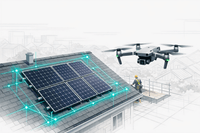
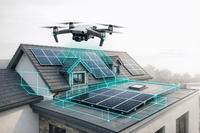
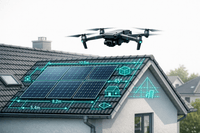
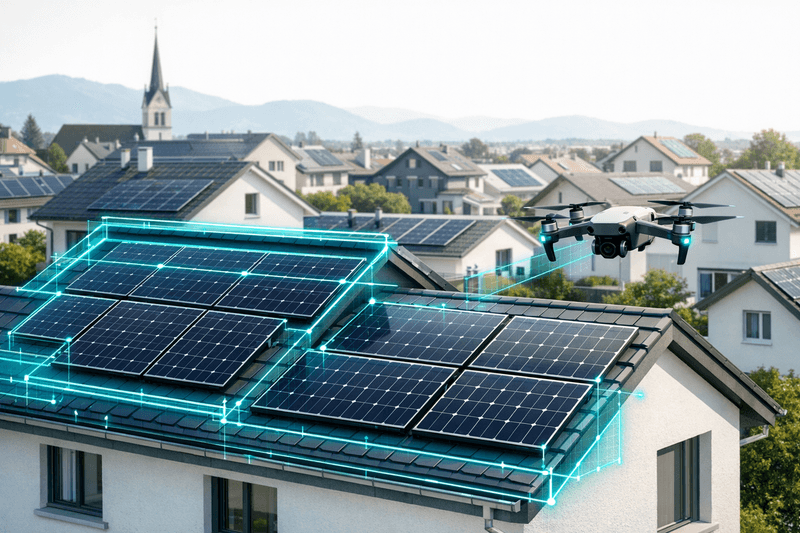
Airteam offers a cloud-based solution for drone-based 3D building and roof measurement, designed specifically for trades and construction companies.
The key facts:
- Up to 90% time savings compared to manual measurement.
- Centimetre-accurate, standards-compliant measurements - no return visits, no estimates.
- Safe from the ground: no climbing on roofs, no repeated ladder use.
- Direct exports into common solar and industry software such as PV*SOL, Eturnity, MF Dach, PVcase Roof and more.
- Over 5,000 companies and more than 70,000 projects have already been completed with Airteam.
This turns a political obligation for roofs into an organisational and technical opportunity for companies that consistently digitise their processes.
5. Real-world examples: How PV companies scale with digital measurement
Although the Solar Initiative is a Swiss proposal, the challenges are similar across the entire German-speaking region - and Airteam customers are already showing how to handle a solar boom in a controlled way.
Example: Svea Solar (commercial & industrial and residential PV)
- 48% less planning time per project.
- 15% higher energy yield thanks to more precise planning and better use of available area.
- 25% lower project costs thanks to fewer errors and less rework.
Example: Energieinsel (specialist PV installer)
- Previously: up to 2 days of measurement effort for larger sites with two employees.
- Today: a single drone flight, upload, automated 3D evaluation - measurements and 3D model are available within 24 hours.
- The measurement data flows directly into the PV planning software, with no manual tracing.
Applied to Switzerland: if mandatory solar rules come into force, scalable workflows like these will have to become standard so companies do not drown in projects.
6. What a solar project looks like with Airteam in day-to-day work
For you as a solar installer or roofer, the process with Airteam typically boils down to three steps:
Fly the drone - safely from the ground
- You or a trained pilot flies around the site in about 10-15 minutes.
- No roof access, no scaffolding just for measurement.
Upload & automatic 3D evaluation
- The photos are uploaded to the Airteam Cloud.
- Within a short time, a centimetre-accurate 3D model is generated, including all relevant areas, inclinations, heights and obstacles.
Direct export into your planning tools
- Export into PV*SOL, Eturnity, PVcase Roof, MF Dach, AutoCAD and others.
- You create your quotation in minutes instead of hours and can reliably calculate different options (east/west, mounting angles, layout scenarios).
Especially when, as envisaged in the Solar Initiative, it is about entire portfolios (for example residential estates or commercial sites), this digital workflow becomes crucial: You can capture dozens of roofs systematically in a short time, instead of climbing over each individual building.
7. Opportunities for Swiss companies: Turning obligation into competitive edge
If mandatory solar rules are introduced, everyone will be under the same pressure - but not everyone will have the same tools. That can become a real advantage for you if you act now:
Early switch to drone-based measurement
- You are ready when municipalities, cantons or housing cooperatives tender larger PV programmes.
- You can provide reliable, standards-compliant quantities - quotations without nasty surprises.
Higher conversion rates through professional 3D visualisation
- Clients see their roof or façade as a 3D model including module layout.
- This builds trust - a crucial factor when PV systems become the norm.
Better utilisation of your team
- Instead of two people measuring for a full day, one person spends just 10-20 minutes and the rest is handled digitally.
- Your skilled workers can focus on planning, installation and service.
8. What you can do right now
Regardless of whether the Solar Initiative is adopted exactly as proposed or in a modified form - the trend is clear: more PV on more roofs, faster.
Your next steps:
Review your internal processes
- How many hours per week are you currently spending on site measurement?
- How often do you have to remeasure or adjust projects?
Test drone-based measurement
- Start with a test project or a small flat-rate package for recurring sites.
- Learn how your quotation speed and error rate change.
Set up integration with your software
- Check which of your tools (PV*SOL, Eturnity, MF Dach, PVcase Roof, AutoCAD etc.) can already work directly with Airteam data.
Train your team - work safely from the ground
- One or two days of training are usually enough to get your team "flight-ready" - with no need for a CAD degree.
9. FAQ on the Solar Initiative and drone-based measurement
Is the Solar Initiative already in force?
Not yet. The Green Party has submitted 134,000 signatures, and the Federal Chancellery is now verifying their validity. Only after that will it be decided when and in what form the initiative will be put to a nationwide vote. (srf.ch)
Does this affect me as a company based in Germany?
Directly, the Solar Initiative only affects Switzerland. However, similar discussions about mandatory solar systems for new builds and refurbishments are taking place in Germany and Austria as well. Companies that digitise their processes today will be better prepared for future obligations and incentive programmes.
Do I need special permits for drone flights in Switzerland or the German-speaking region?
Yes, drone flights in Switzerland and in the EU are subject to clear regulations (CE classes, remote pilot certificates, minimum distances to people and so on). Airteam supports customers in flying in compliance with the law and selecting suitable flight profiles; in case of doubt, you should also consult local regulations and the rules of the Federal Office of Civil Aviation or the European Union Aviation Safety Agency.
Is Airteam worthwhile for smaller companies as well?
Yes. Airteam is explicitly designed for small to medium-sized trades businesses with 2-50 employees - with transparent flat-rate pricing, a pilot network and training. Even companies with only a few projects per month benefit from time savings, improved safety and error-free measurements.
Conclusion:
The Swiss Solar Initiative will massively accelerate the solar market in Switzerland - with or without a full obligation for every roof. Companies that adopt drone-based, standards-compliant measurement today will be able to handle more projects in less time and with lower risk tomorrow.
If you want to see what this could look like in your own company, now is the right time to start your first test project with Airteam.