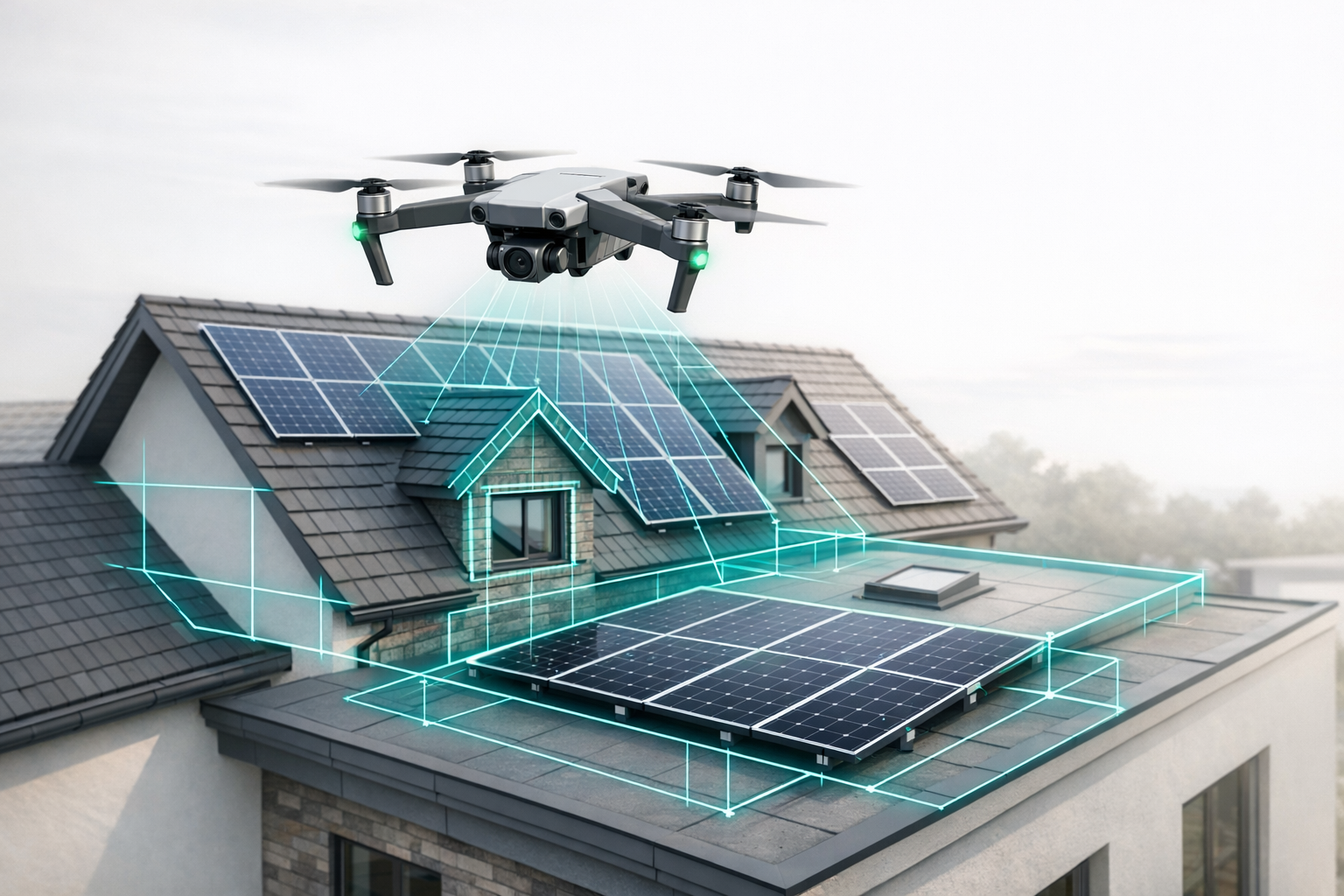
Digital roof surveys using drones and AI are no longer a vision of the future - today they already determine how quickly and profitably a company can prepare quotes and complete projects. In a webinar with Airteam, master roofer Nicolai Jährling from Frankfurt gave a very concrete look at how he has integrated the Airteam Fusion Platform into his daily workflow - and why he is convinced:
In three or four years, nobody will be standing in front of a house with a notepad counting tiles anymore.
This article summarizes the key insights, best practices, and quotes from the webinar.
Who is Nicolai Jährling - and how does his company work?
Nicolai Jährling is a 32-year-old master roofer from Frankfurt who has been running his own business for around six years. He started out with just his brother; today his company employs ten people - working mainly on residential renovation projects in the Frankfurt area.
One of the core ingredients of his success: modern, digital ways of working.
We are especially good at getting younger people excited about working with us because we lead by example with modern, digital workflows.
Existing buildings rarely come with usable planning documents. For renovation jobs, the team therefore has to create the base data for quotes themselves - now almost exclusively using a drone and Airteam Fusion. On new-build projects, Nicolai also uses drone flights for as-built control measurements that serve as billable documentation for architects and planners.
He first came across Airteam at trade school for his master craftsman qualification, when founder Thomas presented the very first versions of the solution. His initial enthusiasm quickly turned into daily practice:
I was impressed right away and integrated Airteam into our business at a very early stage.
Why drone-based measurements instead of tape measures and ladders?
Every roofer or solar installer knows the underlying problem:
- On-site measurements on existing buildings are time-consuming, often dangerous, and prone to error.
- You need two people on site to measure in compliance with safety regulations.
- Notes can get lost, dimensions can be forgotten, and obstructions can be overlooked.
- Complex roofs (older buildings, lots of dormers, high eaves) are almost impossible to capture accurately from the ground.
The result: inaccurate quotes, revisions to the calculation - or lost margin.
Today, Nicolai collects all the data he needs from a safe position on the ground using a drone. The images are converted by the Airteam Fusion Platform into a dimensionable 3D model, including all relevant roof components (roof surfaces, ridges, valleys, roof windows, chimneys, dormers, penetrations).
What does a typical measurement appointment with Airteam look like?
1. Customer inquiry and on-site visit
When a new inquiry comes in, Nicolai first schedules an on-site appointment. There he clarifies:
- What exactly is planned (renovation, extension, solar system, etc.)?
- Which areas and components are relevant?
Then he briefly explains to the customer how the drone and Airteam process works:
I explain that we use the drone to capture images for our own purposes that we then upload. People are always very curious and think it's incredibly innovative.
He usually does not use a formal written consent - in practice, verbal agreement and open communication are sufficient.
2. Drone flight: 3-5 minutes instead of 1-2 hours
The flights are carried out in automatic hyperlapse/circle flight mode:
- Single-family home (up to approx. 200 m² roof area): 3-5 minutes of flight time
- Larger property (e.g. ~500 m² roof area): 10-15 minutes, usually two circles
On the 500-square-meter roof, the drone was in the air for maybe 10-12 minutes. Two circles, packed it away again, done.
Nicolai uses two drones in his business:
- Mini drone (< 250 g) for smaller and simple roofs - no drone pilot license required.
- DJI Mavic (all-rounder) for large or complex properties with lots of detail.
From flight to measurable 3D model: what does Airteam deliver?
After the appointment, it is back to the office:
- Create the project in the Airteam Fusion Platform
- Upload the images (typically 70-100 photos for a single-family home) to the project
- Wait for the automated AI analysis
Recently, the 3D model has been ready in about 6-8 hours. In that time, I can hardly keep up with writing all the other quotes.
Once processed, the following is available to him and his team:
- Interactive 3D roof model with all surfaces and components
- Automatic area and length measurements (roof areas, ridges, hips, valleys, etc.)
- Options to show and hide points, lines, and surfaces
- Data export (e.g. Excel, measurement report, CAD/industry-standard data formats)
Concrete real-world examples from Jährling's company
1. 500 m² pitched roof - minutes instead of hours
A typical project from the webinar: a large but geometrically simple roof with more than 500 m² of roof area, long hips, a long ridge, and several roof windows.
Previously:
- Long periods of time on the roof with tape measure and tile counting
- Risk of forgetting or mixing up measurements despite the effort
Today:
- 10-12 minutes of drone flight
- A complete 3D model with all lengths and areas
- Export to Excel for quick quantity takeoff
I have zero desire to spend four hours measuring a 500-square-meter roof - and then not even win the job. With the drone, the whole topic is wrapped up quickly.
2. Historic Frankfurt building with dormers, firewalls, and tight surroundings
On typical older Frankfurt buildings with high eaves, dormers, firewall connections, and a rear elevation that is hard to see, getting accurate measurements from the ground is practically impossible:
You might be able to see up to the dormer, but you cannot count the tiles all the way up to the ridge - and the back side is completely out of sight.
This is where the 3D model really shows its strengths:
- All roof surfaces and obstructions are visible and measurable.
- Roof pitches are captured automatically - crucial, for example, when choosing tiles.
- The surroundings are mapped in detail: Nicolai uses this to plan the crane position, material storage, and access routes.
3. Slate roof with mansard sections in a city-center location
For a complex slate roof with mansards, multiple levels, and very high eaves, Nicolai uses not only the 3D model but also the measurement report provided by Airteam.
He shares this report:
- with the scaffolding contractor for planning the scaffold
- with the painter for the firewall
- and, if needed, with the planner/architect for further works
All parties can access the model via a link, take off their own measurements, and prepare their quotes - without any additional on-site visit.
I do the drone flight once and pass the results on to all trades. Everyone pulls their own data from it.
4. Sixteen roof windows without access to the apartments
Another real-world example: a building with sixteen roof windows in rented apartments. During the quoting phase, there was no access from inside.
The solution:
- Determine the window sizes from the outside in the 3D model
- Match them to standard sizes (e.g. VELUX grid)
- Prepare a quote without having to book appointments with every single tenant
More efficiency - and better preparation for the team
Nicolai uses Airteam not only for cost calculation but also for site preparation:
- All employees get access to the 3D models.
- The team can familiarize itself with roof geometry, penetrations, and buildup in advance.
- Vent pipes, walkways, antennas, and tricky details are visible in the model at any time.
The guys on site can prepare themselves and do not have to go back and measure again.
Billing, flat rate, and the business case
At the moment, Nicolai does not bill separately for the drone flight during the quoting phase - even though in principle it is a service that could be charged for. For him, the added value in terms of time savings and accuracy clearly outweighs the cost:
It takes so much work off my plate when preparing quotes that I am happy to absorb that cost.
For maximum flexibility, his firm uses an Airteam flat rate. That way he does not have to think about per-project pricing and can simply fly every project where it makes sense.
Other companies, as Airteam explains in the webinar, sometimes charge for the measurement and then offset the cost if they are awarded the contract - Airteam supports both approaches.
Conclusion: drone-based measurement is becoming the new standard in roofing
Nicolai is convinced that the profession will change rapidly:
I think in three or four years, nobody will still be talking about standing in front of a roof with a notepad and counting tiles.
His experience shows:
- Significantly faster quote preparation
- Centimeter-accurate, fully traceable measurements - even for complex roofs
- Fewer on-site appointments thanks to digital collaboration with scaffolders, painters, and planners
- Greater safety because no one has to climb onto the roof just to take measurements
- And last but not least: more attractive jobs for young professionals
If you also want to cut your measurement time by up to 90%, increase safety, and make your quotes more robust, now is the right moment to embed drone-based measurement in your company.
Tip: Try the Airteam Fusion Platform with a sample project or start with your first real site - just as Nicolai did after completing his master craftsman training. The learning curve is short, and the impact on day-to-day operations is enormous.