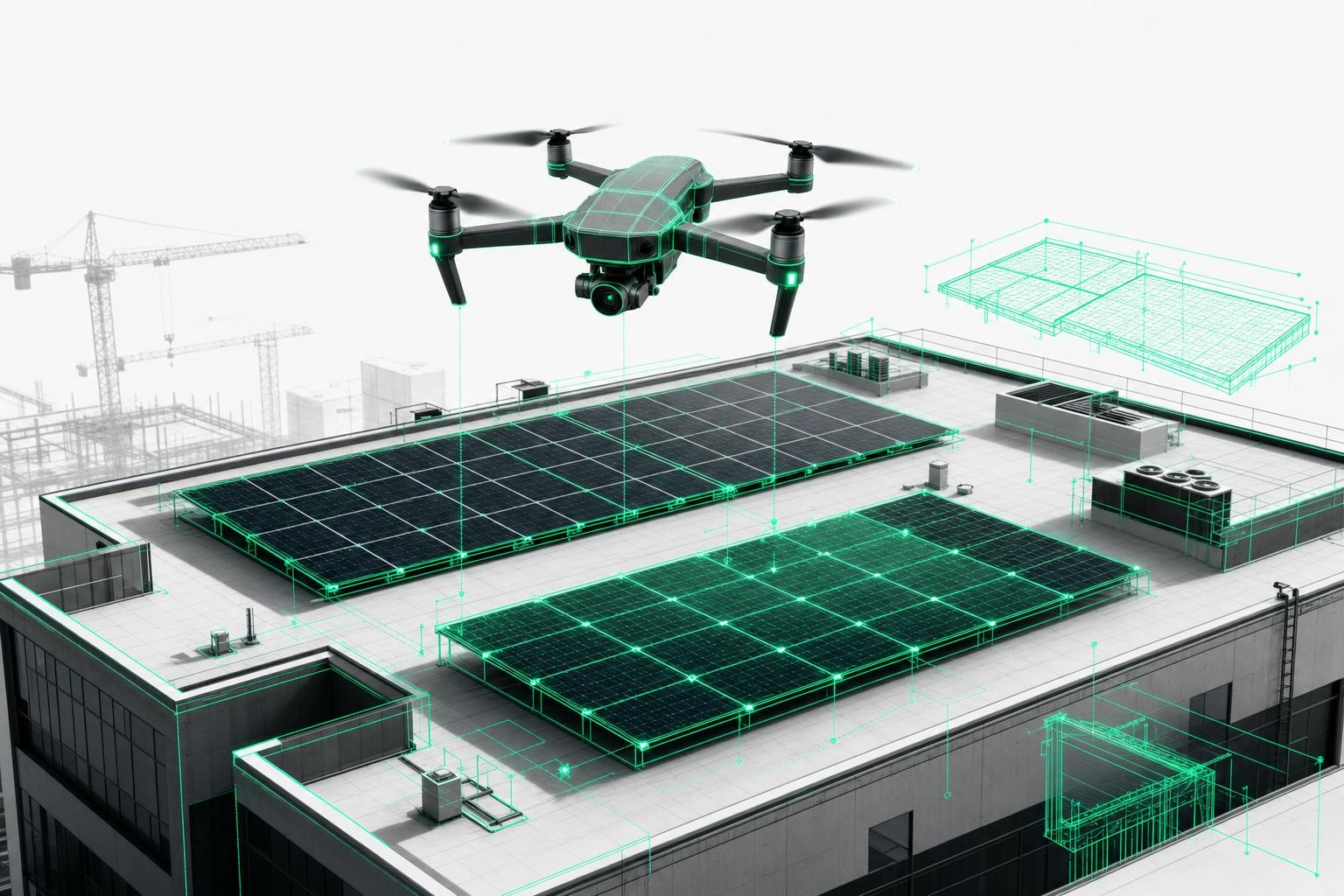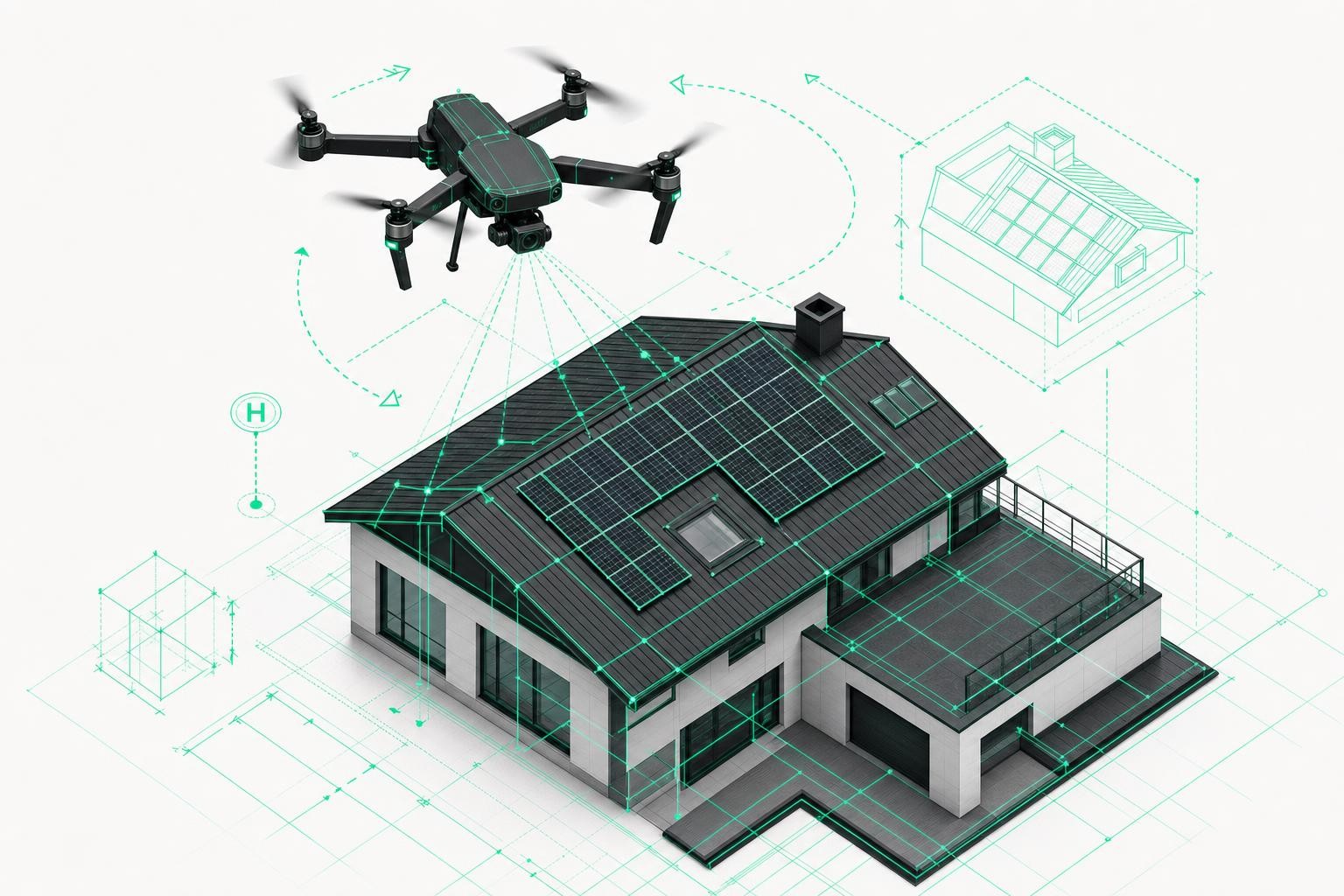

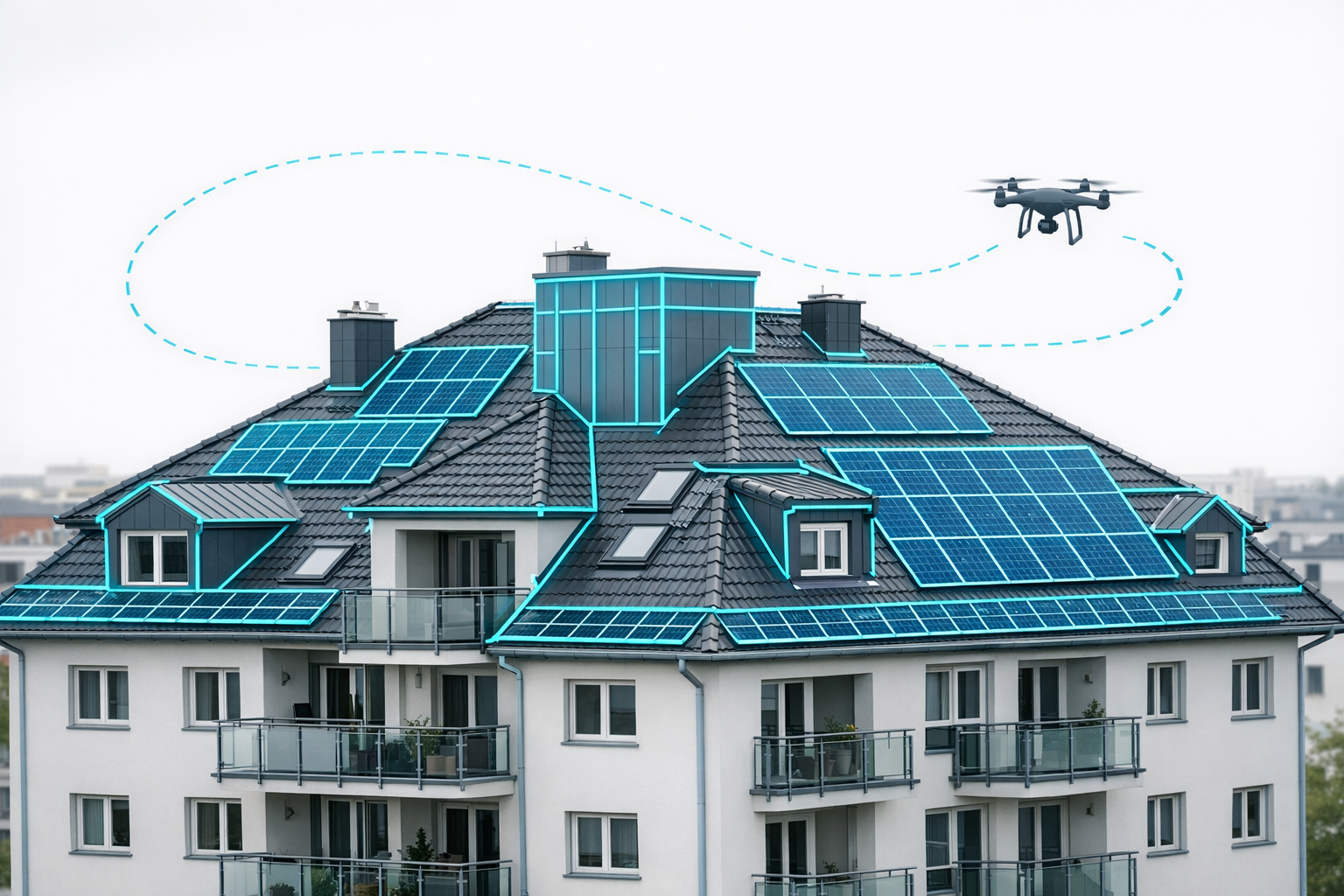
Imagine this: an apartment building with 12 units, a hipped roof, three chimneys, an elevator shaft and a stepped top storey. The owner wants to offer Energy Sharing from June 2026 - and expects a solid, reliable quote from you. If you're still calculating with a tape measure and satellite images, you won't stand a chance. And this is exactly the kind of scenario that will soon become the norm.
From 1 June 2026, the new Section 42c of the German Energy Industry Act (EnWG) comes into force and, for the first time, enables so-called Energy Sharing - the joint use of locally generated solar power via the public grid. For multi-family houses (MFH), this means that rooftop PV systems are no longer only interesting for individual owners, but for entire homeowner communities, HOAs and neighbourhoods.
The challenge: MFH roofs are far more complex than single-family homes. If you want to implement energy-sharing projects efficiently and profitably under the new energy sharing regulation, you need a planning basis that can handle this complexity. That foundation is a 3D drone survey.
Energy Sharing on MFH Roofs: What Changes from June 2026
With the Act to Amend Energy Industry Law, adopted on 18 December 2025, the legislator created an independent legal framework for Energy Sharing in Germany through Section 42c EnWG. From June 2026, households will be allowed to share or sell locally generated renewable electricity - for example from photovoltaic systems - within energy communities.
For apartment buildings, this is a real game changer:
- Tenants and owners benefit together from one shared rooftop PV system
- Simplified obligations apply to systems up to 100 kW on multi-party buildings (Section 42c (7) EnWG)
- The technical requirement is a smart metering system (smart meter gateway) that records consumption and generation in 15-minute intervals
- From 7 kWp system size upwards, the smart meter obligation already applies anyway.
At the same time, mandatory solar roofs in several federal states add extra pressure: From early 2026 in North Rhine-Westphalia (NRW), the solar obligation will also apply to major roof refurbishments (complete renewal of the roof covering) on all residential and non-residential buildings. In Baden-Württemberg, photovoltaic systems have been required for roof refurbishments on existing buildings since 1 January 2023.
The result: solar installers who master MFH projects now secure the largest growth segment in the industry - especially when it comes to solar panels for apartment buildings.
Solar roof obligation 2026: In NRW, as of January 1, 2026, the solar roof obligation also applies to extensive roof renovations of existing buildings - including multi-family houses. In Baden-Württemberg it has applied to roof renovations since 2023. That means: If you renovate an apartment-building roof today, you must plan PV at the same time in many states - and you need precise data for that.
Why MFH Roofs Are Particularly Challenging
A single-family home with a gable roof is a routine project. A five-storey apartment building from the 1970s? A completely different league - in every respect.
Complex Roof Geometries
MFH roofs often combine several roof types: hipped roofs, flat roofs, stepped top storeys with different slopes and height profiles. Dormers, skylights and firewalls restrict the usable PV area and require precise module layout planning. Complex roofs with shading and multiple roof sections create considerable extra work and can hardly be captured accurately with standard methods.
Many Penetrations and Rooftop Structures
Chimneys, vent pipes, elevator shafts, lift machine rooms, antenna systems, lightning protection - on an MFH these obstacles quickly add up to a dozen or more. Each of these structures creates shadows, defines clearance areas and must be factored into your module layout. With a tape measure and a rough sketch, this simply isn't reproducible in a reliable way.
Shading Analysis on Multi-Storey Buildings
Neighbouring buildings and trees can cause significant yield losses, especially at low sun angles in winter. For a four- or five-storey MFH in a dense urban setting, an accurate shading simulation isn't optional - it is the basis for a reliable yield calculation and serious solar system planning.
Structural Load and Safety
Older existing buildings from the 1950s to the 1980s are often not designed for the additional weight of modern PV systems. Before the new roofing and modules go up, a structural engineer needs to check whether the roof structure can carry the extra load of around 20 kg per m². You need accurate area measurements for this - and you need them before you even commission the engineer.
Height and Safety Risks
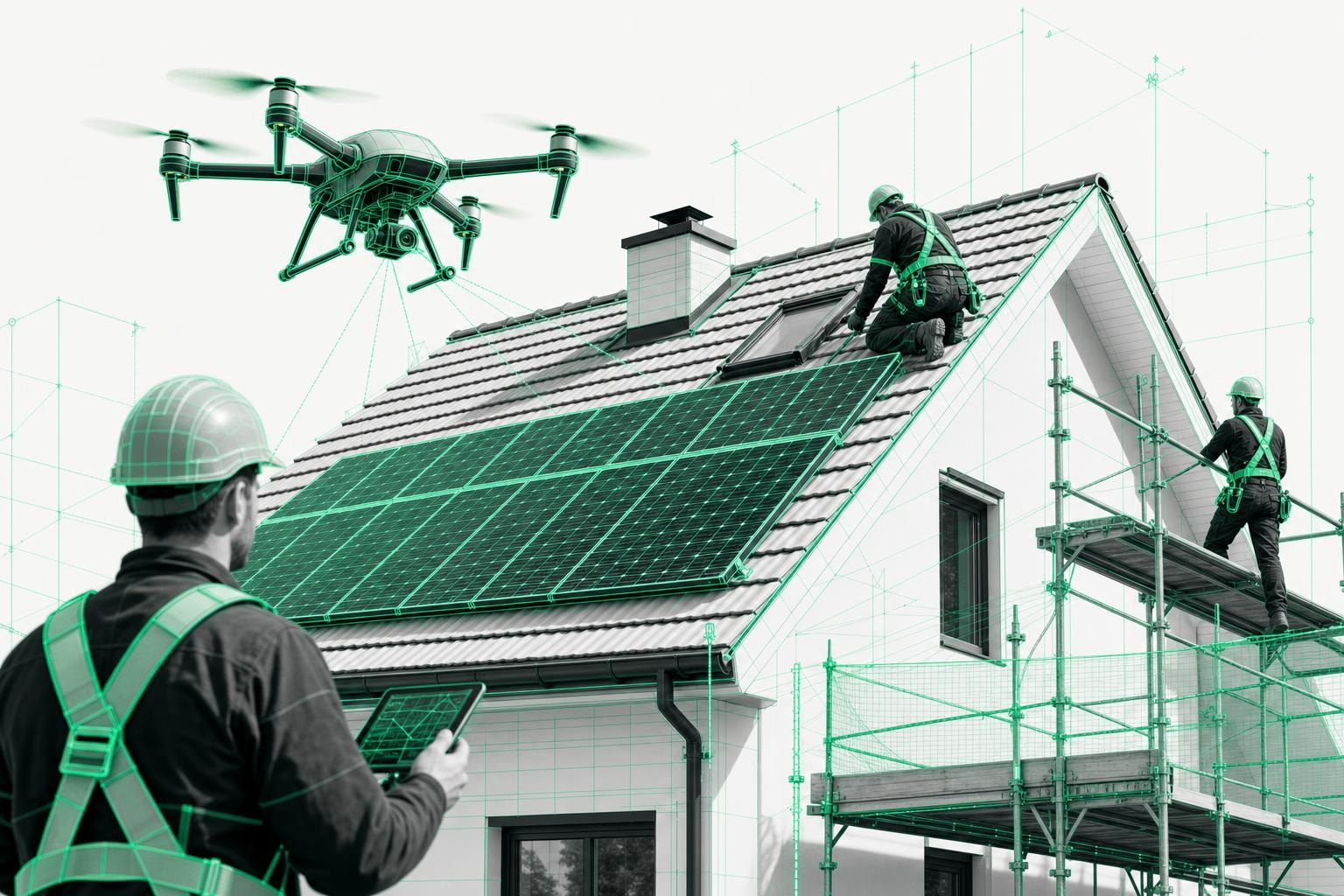
A four- or five-storey apartment building is not a roof you just "hop onto". A traditional site survey would require scaffolding or at least a secure access solution - a huge time and cost factor that drives up your pre-sales phase long before a single module has been ordered.
How Drone Surveys Simplify MFH Planning
Drone-based surveys don't just theoretically solve these challenges - they are what make MFH projects truly plannable in the first place.
One flight captures everything: Instead of time-consuming individual measurements on the roof, a drone flight of about 20-30 minutes captures the entire building. The Airteam Fusion Plattform automatically processes the images into a precise 3D model - with accuracy of up to 99.9% and a measurement tolerance of just 1-3 cm at a flight altitude of 40 m.
3D model instead of sketches: The finished 3D building model includes all roof pitches, surfaces, dormers, chimneys and penetrations. You can derive your module layout directly and precisely from it - even on complex hipped roofs or stepped storeys. Where you used to rely on estimates, the model now gives you hard facts.
Shading simulation directly from the model: The 3D model reflects the real building geometry including all rooftop structures. You can run your shading simulation in solar design software like PV*SOL directly on top of this model. The result is far more accurate than any estimate - and robust when you present it to customers and grid operators.
No need to climb the roof: This is a major advantage, especially for MFH with four or more storeys. No scaffolding, no fall protection, no risk for your team - and no hidden cost block during the quotation phase.
Seamless export to planning tools: The digital measurements can be exported in more than 15 formats and are directly compatible with PV*SOL, Eturnity, PVcase, SolarEdge Designer, AutoCAD and many other tools. Our detailed guide explains how the direct integration with PV*SOL works and how you can streamline your solar system planning workflow.
| Criterion | Manual measurement (MFH) | Drone measurement with Airteam |
|---|---|---|
| Time required | 3-5 hours on the roof | ~30 min drone flight + 24h analysis |
| Safety | Scaffolding or ladder work from the 4th floor and above | 100% from the ground - no climbing needed |
| Accuracy | ±5-15 cm (manual, error-prone) | 1-3 cm tolerance, DIN-certified (99.9%) |
| Shading analysis | Estimation, time-consuming when neighboring buildings are present | Directly simulable from the 3D model |
| Complex geometries | Error-prone for dormers, hips, and roof structures | Automatic detection of all components |
| Data export | Manual transfer to planning software | Over 15 formats, directly into PV*SOL, Eturnity & Co. |
| Repeatability | Another ascent required | Digital 3D model permanently available |
Real-World Example: Energy-Sharing Planning for an MFH with 12 Units
What does this look like in practice? Let's take a realistic scenario:
The building: An apartment block built in 1968 in NRW, five storeys, 12 residential units. The roof is scheduled for refurbishment in spring 2026 - and because the mandatory solar roof obligation in NRW applies to existing buildings from January 2026 in the case of major roof refurbishments, a PV system has to be planned at the same time. The building owner is interested in an energy-sharing model under Section 42c EnWG.
Step by step with Airteam:
A short flight of about 20-30 minutes captures the entire MFH from multiple perspectives. No scaffolding, no roof ascent — everything safely from the ground.
The Airteam Fusion platform processes the drone images fully automatically into a precise 3D building model. All surfaces, slopes, structures and penetrations are captured in a DIN-compliant manner — within 24 hours.
The 3D model is directly imported into PV planning software such as PV*SOL or Eturnity. Shading from dormers, chimneys, elevator shafts and neighboring buildings is simulated precisely.
Based on the exact geometry data, the yield calculation is performed for each sub-area. The result: an optimized PV design with the maximum number of modules and minimal losses.
The final proposal includes centimeter-precise area specifications, a robust yield forecast, and the technical basis for the Energy Sharing model according to §42c EnWG. Professional, fast, and convincing.
The result: The final quote is ready within two working days after the drone flight. It includes a robust 3D model, a detailed module layout with shading analysis, a realistic yield calculation - and forms the technical basis for the energy-sharing concept. Instead of 3-5 hours on the roof with scaffolding, the entire measurement process from the ground takes only around 30 minutes.
To get an interactive estimate for your own project, you can use our calculator:
Profitability: Why Drone Surveys Pay Off Especially Fast on MFH
The time savings from drone surveys are especially large on multi-family houses because the effort for a conventional survey increases disproportionately with building size and complexity.
Time Comparison: Traditional vs. Drone
| Task | Traditional survey (MFH) | Drone survey with Airteam |
|---|---|---|
| Preparation & travel | 30-60 min | 30-60 min |
| On-site measuring time | 3-5 hours | ~30 minutes |
| Safety effort (scaffolding/protection) | high, additional costs | not required at all |
| Data processing | 1-2 h manual transfer | automatic, 24 h delivery time |
| Export to planning tools | manual, error-prone | direct, 15+ formats |
| Total effort | 5-8 hours | ~1 hour active work + 24 h processing time |
More projects, better proposals: If you can survey an MFH in a fraction of the time, you have more capacity for additional jobs. And if you go into the first meeting with a professional 3D model and a reliable shading analysis, you significantly increase your conversion rate - especially with demanding clients such as HOAs or property managers.
Less rework and recalculation: Planning errors due to inaccurate surveys are among the most common causes of expensive rework and extra orders in PV projects. DIN-certified drone data with 1-3 cm tolerance reduce this risk to almost zero. That protects your margin - and your reputation.
Competitive advantage: MFH projects for Energy Sharing are complex. If you can plan them professionally and quickly, you stand out from the competition. With a 3D model from a drone survey, you don't just convince your customers - you also create a reliable basis for the entire process chain from solar system planning through installation to maintenance.
Conclusion: MFH Projects Are Your New Growth Opportunity - With the Right Tool
Energy Sharing, mandatory solar roofs and rising demand for roof refurbishments: in the coming years, apartment buildings will become one of the most important growth segments for solar installers focusing on solar panels for apartment buildings. The technical complexity of these projects is very real - but it's manageable. With drone surveys and the Airteam Fusion Plattform, you have the tool that makes MFH projects truly efficient to plan.
Your key benefits at a glance:
- Complete roof capture in ~30 minutes, safely from the ground
- DIN-certified 3D models with 1-3 cm tolerance within 24 hours
- Direct shading analysis based on the 3D model
- Seamless export into leading solar design software
- Reliable basis for quotes on energy-sharing projects under Section 42c EnWG
- Proven results with solar installers across Germany
Our success stories show how solar installers already use the Airteam Fusion Plattform for PV planning to streamline their solar system planning workflow and win more complex MFH projects. Get started now and test Airteam free for 14 days.
Can I capture all relevant measurements for a multi-family house with a single drone flight?
Yes. A single drone flight of about 20–30 minutes is sufficient to fully capture all relevant roof surfaces, slopes, structures, penetrations and building heights. The Airteam Fusion platform automatically generates a DIN-compliant 3D model from it - without anyone having to step onto the roof.
Which planning software is compatible with Airteam data?
The Airteam Fusion platform exports data in over 15 formats. For PV planning, the most relevant are: PV*SOL (LPM and planarized data), Eturnity, SolarEdge Designer, PVcase, AutoCAD (DXF/DWG), and many more. Post-processing of the data is typically not required.
Do I need a drone license for the drone-based measurement?
For most commercial drone operations in trades, the EU competency A1/A3 (online test) is sufficient. For larger or urban deployments, the A2 certificate is recommended. If you do not want to fly the drone yourself, you can alternatively book an Airteam pilot - the flight will then be carried out by a certified professional pilot.
What does a drone-based measurement cost for a multi-family house?
Airteam offers flexible pricing models: flat rates for regular users, as well as individual projects and credits for larger objects or additional planning data. Compared to the costs of a manual measurement including scaffolding or safety measures, the drone-based measurement already pays off on the first project.
Is a Smart Meter mandatory for Energy Sharing?
Yes. For Energy Sharing under §42c EnWG, a quarter-hour measurement of all involved metering points is required — i.e., a smart metering system (Smart Meter Gateway). From 7 kWp system capacity, the smart-meter obligation already applies anyway.