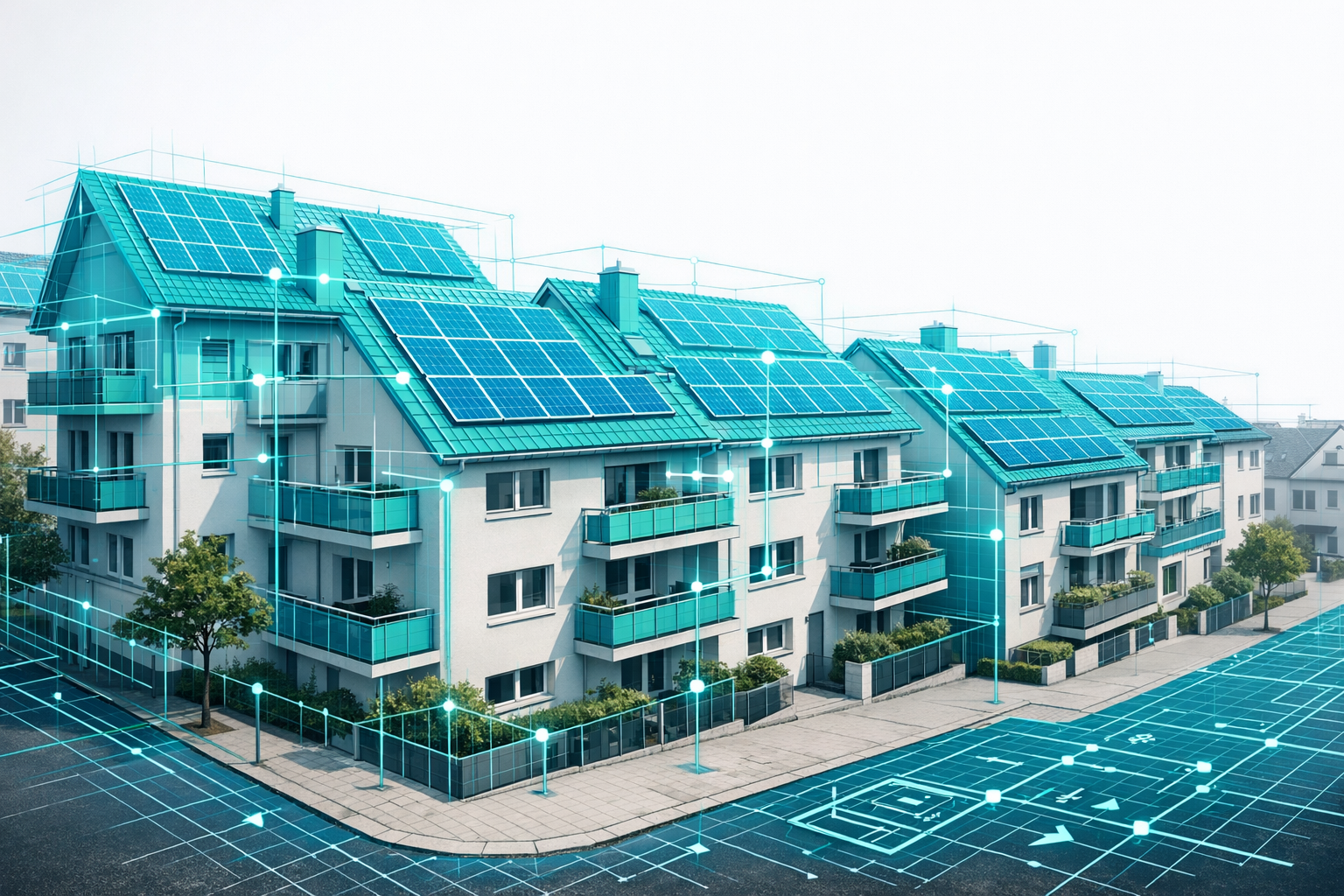
Imagine your customer is generating more solar power on the roof of their apartment building than the tenants actually consume - and the surplus has so far been fed into the grid for just a few cents. From 1 June 2026, that changes fundamentally: Section 42c of the German Energy Industry Act (EnWG) makes so-called energy sharing legally possible in Germany for the first time. Final consumers within the balancing area of a distribution system operator will be allowed to share electricity from renewable energies via the public grid.
For solar installers and PV planners this means: new project types, larger systems, more complex roof geometries - and therefore higher demands on planning accuracy. This article explains what energy sharing actually is, how it differs from existing tenant electricity models and collective building energy supply, and which technical requirements you need to know.
What is energy sharing - and what changes from June 2026?
Energy sharing describes the joint use of electricity from renewable energy sources, for example from PV systems, by several consumers - including across multiple buildings via the public distribution grid.
What used to be legally complicated or practically impossible will become reality from June 2026: PV system operators will no longer be limited to self-consumption or simple feed-in. They will be able to share solar power directly with neighbours, tenants in other buildings or commercial businesses - real solar power sharing within a defined area.
The legal basis is the new Section 42c EnWG, which was adopted on 18 December 2025 as part of the amendment to the Energy Industry Act and implements the requirements of the EU Internal Electricity Market Directive (Article 15a) into German law. In English communication this is often referred to as Section 42c Energy Industry Act or the photovoltaic law 2026 for energy sharing.
The most important points at a glance:
- From 1 June 2026: energy sharing is permitted within the balancing area of a distribution system operator
- From 1 June 2028: extension to directly adjacent balancing areas within the same control area
- Eligible participants: private individuals, SMEs, municipalities and citizen energy communities
- Condition: the operation of the PV system must not be predominantly commercial in nature
- Obligation: distribution system operators must make energy sharing technically and organisationally possible within their area
Energy sharing vs. tenant electricity and collective building energy supply
Many solar installers are familiar with tenant electricity models or the German concept of Gemeinschaftliche Gebäudeversorgung (collective building energy supply, GGV). Energy sharing, however, is an independent concept - with crucial differences.
| Feature | Renters' electricity / GGV | Energy Sharing (§42c EnWG) |
|---|---|---|
| Scope | Single building (one roof, one building) | Entire balancing area of a distribution system operator |
| Network usage | None (internal to the building) | Public distribution network permitted |
| Participants | Only tenants of the building | Private households, SMEs, municipalities - across buildings |
| Billing obligation | Renters' electricity operators, traditional contracts | Simplified, partial exemption from supplier obligations |
| Metering technology | Conventional meter permitted | Smart meters with 15-minute settlement mandatory |
| Plant size (simplified) | Exemption up to 30 kW for households | Simplified obligations up to 30 kW (HH) / 100 kW (MFH) |
| Effective from | Existing | June 1, 2026 (within a DSO area) |
The decisive advantage of energy sharing: it is not limited to a single building. Unlike classic tenant electricity models, electricity in energy sharing setups can be distributed via the public grid to participants in the neighbourhood - residents of different buildings or even an entire district can be part of the same energy community.
For solar installers, this means: projects on multi-family houses (MFH) become more attractive, because the generated power can reach a much larger group of consumers. At the same time, the demands on system size, planning and documentation increase.
The smart meter obligation: the technical foundation for energy sharing
Energy sharing only works with the right metering technology. The prerequisite for billing in an energy sharing model is an intelligent metering system (smart meter) with 15-minute balancing - without this digital infrastructure, it is not possible to allocate shared electricity correctly. In other words: mandatory smart meters are the technical backbone of every energy sharing project.
This fits with the obligation that already applies: since 2025, PV systems from 7 kWp of installed capacity are subject to a smart meter obligation - new systems of this size must use an intelligent metering system; otherwise they will be permanently limited to 60% of their rated output.
What this means in practice:
- New PV systems from 7 kWp (commissioned from March 2025 onwards) need smart meters and a control unit
- Existing systems from 7 kWp must be retrofitted by 1 January 2029 at the latest
- Smaller systems under 7 kWp are exempt from the obligation - and therefore not eligible for energy sharing
For solar installers this creates a clear value proposition: if you want to offer energy sharing to your customers, you should design systems from 7 kWp upwards and plan smart meters right from the start. The smart meter is not only the technical prerequisite for energy sharing, but also the key to direct marketing, dynamic tariffs and other revenue streams that will gain importance from 2026 onwards.
Solar roof obligations 2026: the demand booster
In parallel with the new energy sharing rules, several federal states are tightening their mandatory solar roof regulations - especially for roof refurbishments on existing buildings. For solar installers, this directly drives demand.
Solar roof obligation during renovations - when you as a solar installer must take action:
- NRW: From January 1, 2026, a PV requirement applies to comprehensive roof renovations (complete renewal of the roof covering) for all residential and non-residential buildings. At least 30% of the suitable roof area must be covered.
- Baden-Württemberg: Since January 1, 2023, the solar requirement applies to all basic roof renovations (60% of the suitable area).
- Schleswig-Holstein: Since March 29, 2025, a solar obligation applies to the construction of new residential and non-residential buildings as well as the renovation of more than 10% of the roof area for commercial use.
For all of these projects, an accurate roof measurement is a prerequisite for compliant PV planning.
In North Rhine-Westphalia (NRW), from 1 January 2026, a PV obligation applies to residential and non-residential buildings when the entire roof skin of an existing building is renewed - at least 30% of the suitable roof area must be covered with PV modules.
If you involve customers in refurbishment projects - either as a subcontractor to a roofing company or as a dedicated PV planner - you will have to expect a mandatory PV installation far more often. Combined with the potential of energy sharing, a single system becomes part of a local energy network instead of just an isolated project.
What this means in concrete terms for solar installers: new project types, new requirements
Energy sharing changes the type of projects you plan and implement as a solar installer. Traditional single-family home projects were manageable: one roof, one system, one connection. The new rules bring the following changes:
Larger systems on multi-family houses
To supply multiple parties with energy - including across buildings - larger systems are required. Energy sharing allows simplified obligations for systems up to 30 kW for household customers and up to 100 kW for multi-party buildings. This makes exactly the category attractive that was previously often too complex for smaller solar businesses.
More complex roof geometries on existing buildings
Multi-family houses and older buildings often have nested roofs, dormers, chimney structures, skylights and shading from neighbouring buildings. Without precise planning this leads to incorrect module counts, inefficient orientations or subsequent corrections - in the worst case to projects that are not economically viable.
Greater planning diligence due to legal requirements
If you integrate customers into an energy sharing model, you are responsible for the technical foundations. Errors in area calculation or shading analysis lead to incorrect yield forecasts - and therefore to disappointment across the entire energy community.
Why precise 3D roof measurement is now indispensable
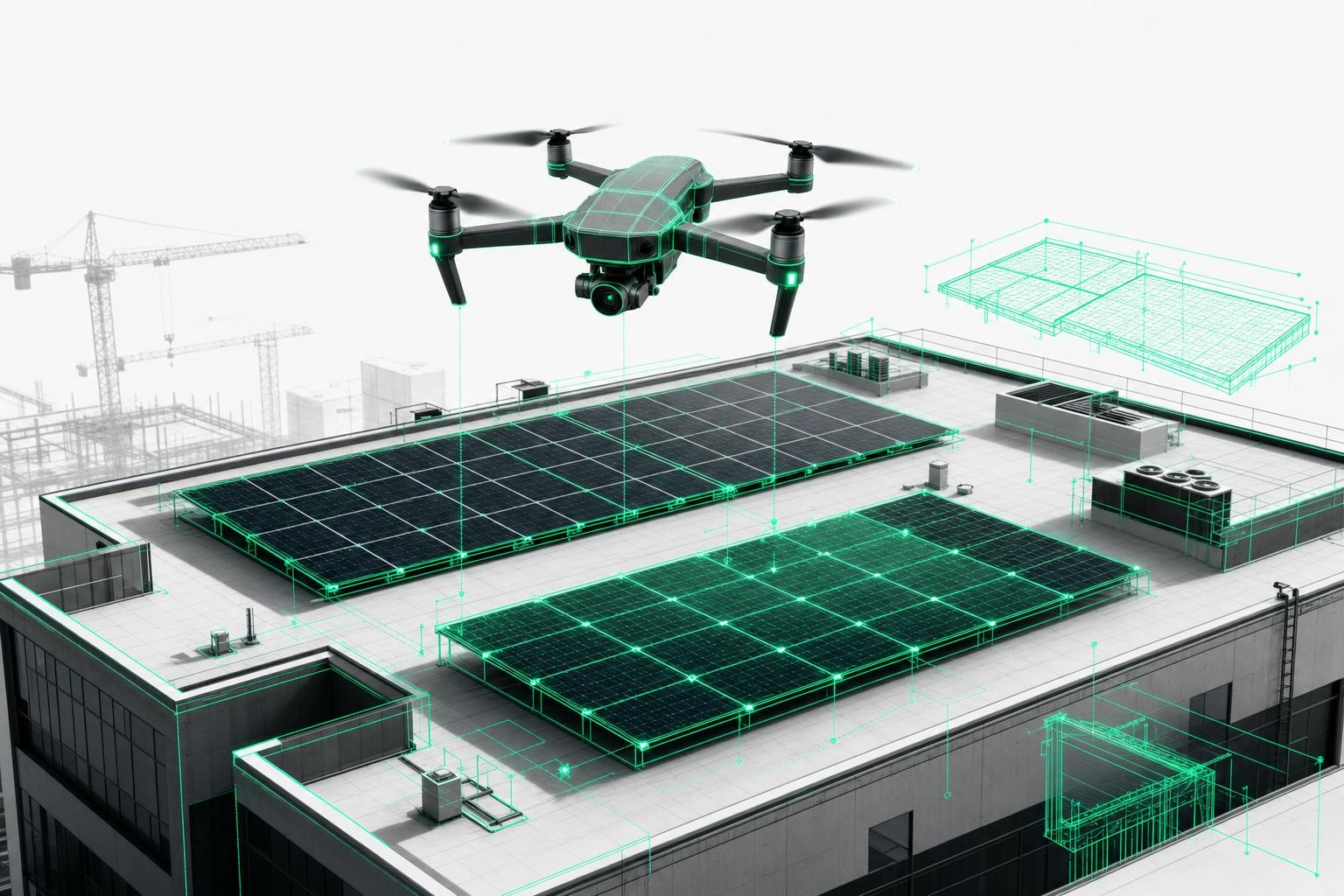
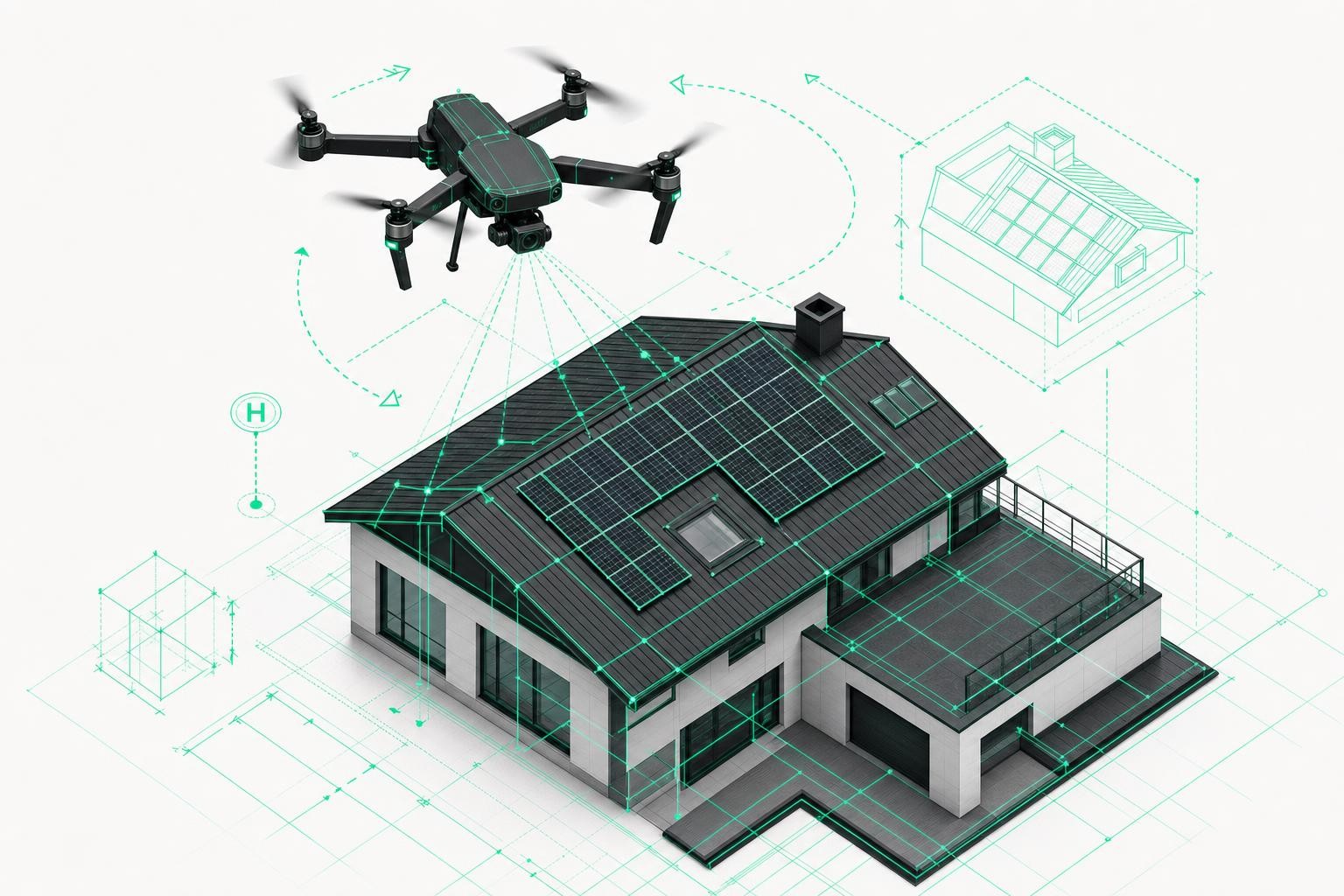
This is exactly where the Airteam Fusion platform comes in. With AI-powered drone surveying you create a DIN-certified 3D model from a single drone flight - ideal for the new generation of energy sharing projects under the photovoltaic law 2026.
What Airteam delivers for multi-family and refurbishment projects:
- Centimetre-accurate roof areas: Airteam achieves an accuracy of up to 99.9% with a 1-3 cm tolerance at a flight altitude of 40 m - DIN-compliant and therefore legally robust for quotes and permits
- Complete building capture: the AI automatically detects all relevant components - roof areas, pitches, dormers, chimneys, stacks, roof windows and obstacles
- Shading analysis: especially for multi-family houses in dense urban environments, analysing shading sources is crucial for an accurate yield forecast
- Export to all common formats: data can be imported directly into PV planning software such as PV*SOL, Eturnity or SolarEdge Designer - no media breaks
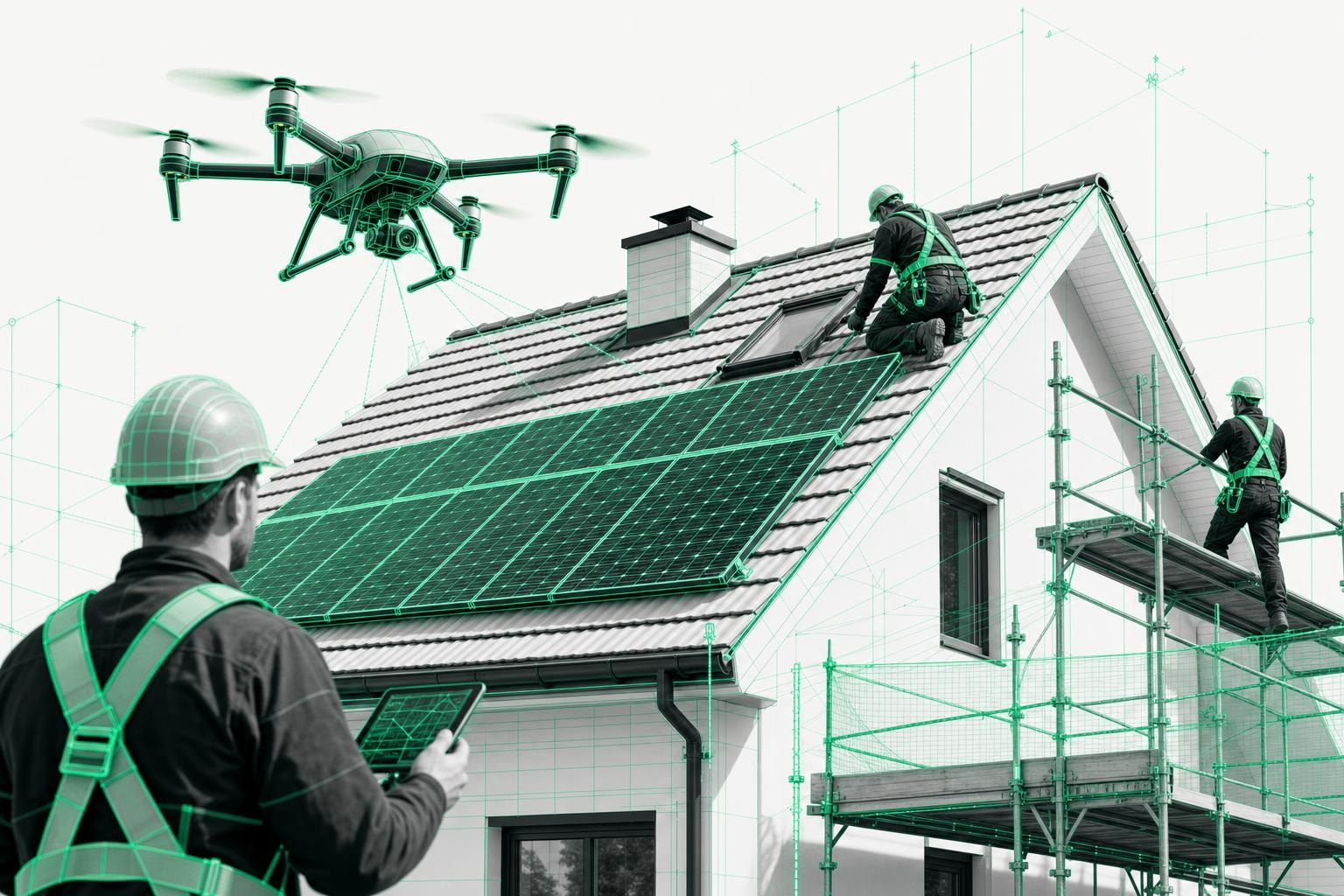
- No need to access the roof: the drone flight is carried out entirely from the ground - safe, fast and without risk for your team
How this works in practice is explained in the article 3D building surveying with drones for trade businesses with a step-by-step guide.
This is what the workflow looks like in practice:
- Drone flight over the building or building complex (including neighbouring roofs when planning energy sharing)
- Upload the images to the Airteam Fusion platform
- Automatic 3D model generation by AI - completed within a few hours
- Export the planning data into your PV software
- Accurate quote creation based on real measurement data - not rough estimates
The comparison between drone-based surveying and conventional roof measurement shows how big the difference is in practice. What used to take hours, Airteam completes in just a few minutes - with higher precision and no safety risk.
Success stories such as Solit Energie AG or 1Komma5° Rosenheim show how solar companies are making their PV planning significantly faster and more accurate with Airteam - even on complex existing buildings.
What you should do now
Energy sharing is not a distant topic - the starting signal is 1 June 2026, and the first projects are already being planned. As a solar installer, you can position yourself now:
Short term:
- Inform yourself about the solar roof obligations in your federal state (in particular NRW, Baden-Württemberg and Schleswig-Holstein)
- Check existing customers with PV systems: do they already have a smart meter? Are they suitable for energy sharing within their balancing area?
- Expand your offering for multi-family house projects - and create a solid planning basis with 3D drone surveying
Medium term:
- Develop an information package for property managers and homeowners' associations on the opportunities of energy sharing and modern tenant electricity models
- Use precise 3D measurements as the basis for professional visualisations and convincing offers
- Strengthen your competitive advantage through digital, certified planning - compared to competitors who still rely on conventional methods
Conclusion: new law, new opportunities - and new planning requirements
Section 42c EnWG creates, from June 2026, a legal basis for energy sharing in Germany for the first time - the sharing of renewable electricity using the public grid. For solar installers this means: more project volume, larger systems and more attractive business models.
At the same time, the requirements increase: multi-family houses, existing roofs and refurbishment projects with solar roof obligations demand precise planning, correct area calculations and reliable shading analysis. Anyone who relies on old methods here risks errors, rework and dissatisfied customers.
With AI-powered 3D drone measurement from Airteam you create the technical foundation for every energy sharing project - fast, safe, DIN-compliant and integrated directly into your planning software.
What is Energy Sharing and from when does it apply?
Energy Sharing refers to the communal use of electricity from renewable energy sources - also via the public distribution grid. From June 1, 2026, distribution system operators in Germany are obliged to support Energy Sharing within their balancing area. The legal basis is §42c EnWG.
What differentiates Energy Sharing from the tenant electricity model?
In the tenant electricity model, electricity is used only within a building - without the public grid. Energy Sharing, by contrast, allows the distribution of electricity through the distribution grid to neighboring households, SMEs, or municipalities, also across buildings.
Do customers need a smart meter for Energy Sharing?
Yes. An intelligent metering system (Smart Meter Gateway) with 15-minute settlement is a technical mandatory prerequisite for billing in Energy Sharing. Without a Smart Meter, correct allocation and billing of the shared electricity is not possible.
Which installations can participate in Energy Sharing?
Participants can be operators of solar or wind installations that are natural persons, SMEs, citizen energy communities, or legal entities under public law. The plant operation must not be predominantly commercial in nature. For households up to 30 kW and multi-family buildings up to 100 kW, there are simplified obligations.
How does Airteam help with planning Energy-Sharing projects?
Airteam provides DIN-certified 3D measurements of multi-family buildings and existing buildings via drone - including shading analysis, roof area calculation, and export to all common PV planning formats such as PV*SOL or Eturnity. This saves time in proposal preparation and minimizes planning errors.