By the end of May 2026, Germany was obliged to transpose the revised EU Building Directive (EPBD) into national law. What may sound like bureaucracy at first will fundamentally reshape the PV market: more mandatory installations, higher planning requirements and new documentation duties. If you are not working digitally, you will lose market share over the coming years.
As a solar installer or PV planner, you should know exactly what the EPBD 2026 means, which deadlines apply and how you can position your business correctly now.
What is the EPBD - and why is 2026 so important?
The EPBD (Energy Performance of Buildings Directive) is the revised EU directive on building energy efficiency. Its goal: The European building stock is to become climate-neutral by 2050 - a sector which, according to the EPBD analysis, accounts for around 36 percent of energy-related greenhouse gas emissions and around 40 percent of energy consumption in the EU[1].
Germany had to transpose the requirements of EPBD 2024 into national law by 29 May 2026 - most likely by amending the Building Energy Act (Gebäudeenergiegesetz, GEG), the Renewable Energy Act Germany and through adjustments to the state building codes[1]. For solar businesses this means: the legal landscape will not change at a single point in time, but step by step - with clear deadlines.
This EU building directive complements existing national rules on building energy efficiency and will tighten the framework for PV installations, solar incentives Germany 2026 and future refurbishment projects.
Concrete requirements: Solar mandate with a phased roadmap
The most relevant part of the EPBD for solar installers is the phased-in solar mandate on buildings. The directive requires that photovoltaic or solar thermal systems are installed on suitable roof areas - as long as this is technically, economically and functionally feasible.
| Building type | Deadline | Condition |
|---|---|---|
| New public buildings & Non-residential buildings > 250 m² | by 31.12.2026 | Technically & economically feasible |
| Existing public buildings > 2.000 m² | by the end of 2027 | Retrofit required during renovation |
| Existing non-residential buildings > 500 m² (comprehensive renovation) | by the end of 2027 | Measures requiring approval |
| Existing public buildings > 750 m² | by the end of 2028 | Retrofit required |
| New residential buildings & covered parking spaces | by the end of 2029 | Technically & economically feasible |
| Existing public buildings > 250 m² | by the end of 2030 | Retrofit required |
Important: Even federal states without their own solar panel mandate Germany will be obliged to introduce one at the latest under the EU requirements[2]. At the same time, several states are already tightening their existing rules: Nine federal states have introduced binding regulations for private residential buildings, and North Rhine-Westphalia will also require PV systems on existing buildings from 1 January 2026 when the roof is completely renewed.
For new residential buildings the EPBD also stipulates: From 2030, new builds may no longer cause any CO₂ emissions from fossil fuels; public new builds must comply with this zero-emission standard as early as 2028.
Energy sharing: A new business field from June 2026
In parallel with the EPBD, another law that directly affects the PV market will enter into force: Section 42c of the German Energy Industry Act (EnWG), which regulates energy sharing.
Energy Sharing from 1 June 2026 (§ 42c EnWG): PV system operators may distribute their self-generated solar power over the public grid directly to neighbors and fellow residents in the same distribution grid area. From June 2028 the model will be extended to neighboring balancing areas. Prerequisite: intelligent metering technology (Smart Meter) and an appropriate supply contract.
For solar installers, energy sharing opens up a completely new field of consulting and planning: From June 2026, PV system operators will be allowed to sell electricity directly to neighbours and co-residents in the same distribution grid area - at prices that can be significantly higher than the classic feed-in tariff[3].
Particularly attractive: multi-family buildings and neighbourhoods as new target groups for PV systems - in combination with the model of collective building supply (Section 42b EnWG). Together with the EU building directive and the Renewable Energy Act Germany, this creates additional incentives for local renewable energy concepts.
How the market is changing: More volume, more complexity
The EPBD and related laws are generating a new wave of demand - but not a simple one. Solar businesses must prepare for three structural shifts:
1. Larger and more complex projects
The focus is shifting away from single-family homes towards commercial properties, public buildings and multi-family houses. These roofs have more complex geometries, installations such as ventilation systems or skylights, and require more precise planning - including detailed shading analyses.
2. Higher requirements for documentation and proof
The EPBD will give energy performance certificates and renovation roadmaps greater importance. Owners will have to present their energy performance certificate proactively for major renovations[4]. For solar installers this means: measurement data, planning documents and performance evidence must be standard-compliant, traceable and ready to hand over.
3. Competitive pressure through digitalisation
Those who prepare quotes quickly, accurately and with convincing visuals will win more projects. Existing customers increasingly ask for digital documentation. Federal law is clearly moving towards standardised, digital processes in building energy efficiency - a trend confirmed by the EPBD 2026 update overview from the German Building Forum[5].
Why precise 3D measurements are becoming a key competitive edge
This is where the strategic opportunity lies for solar businesses that adopt digital planning data early. The biggest bottlenecks in multi-family and refurbishment projects do not occur on site - they arise in the planning phase:
- Inaccurate roof areas lead to planning errors in the number of modules, inverter sizing and grid feed-in capacity
- Missing shading analyses of dormers, installations and neighbouring buildings cost yield and erode trust
- Incompatible data formats delay the transfer to planning software such as PV*SOL, Eturnity or SolarEdge
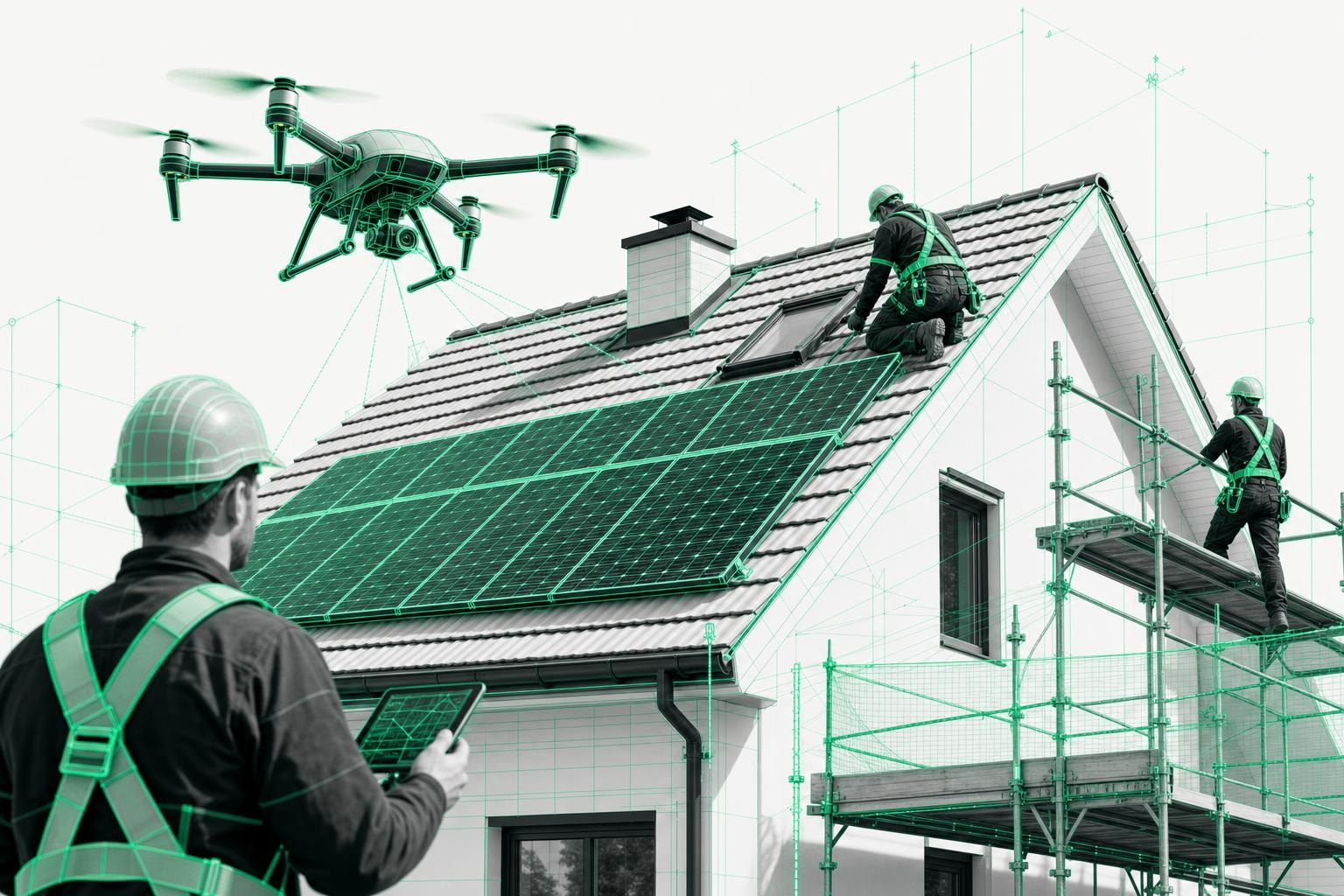
The Airteam Fusion Plattform eliminates exactly these bottlenecks: a single drone flight delivers DIN-certified 3D building models with up to 99.9% accuracy and 1-3 cm tolerance in less than 24 hours - entirely from the ground, without anyone having to set foot on the roof.
The data can be exported in more than 15 formats, including PV*SOL, Eturnity, SketchUp and AutoCAD. In practice this means: no media breaks, no re-entering of data, no transfer errors.
How this works on real projects is shown in the Airteam success stories from solar installers such as Energieinsel, 1Komma5° Rosenheim or Svea Solar - companies that are already planning faster and more professionally than their competitors thanks to digital roof measurements.
What is special about existing roofs and multi-family buildings?
Existing roofs are particularly challenging to plan: irregular geometries, dormers, roof windows, valleys and eaves that are not visible in a simple floor plan. For energy sharing and tenant electricity models on multi-family buildings, exact area calculations in line with DIN standards are crucial - both for profitability calculations and to prove eligibility for subsidies and other solar incentives Germany 2026.
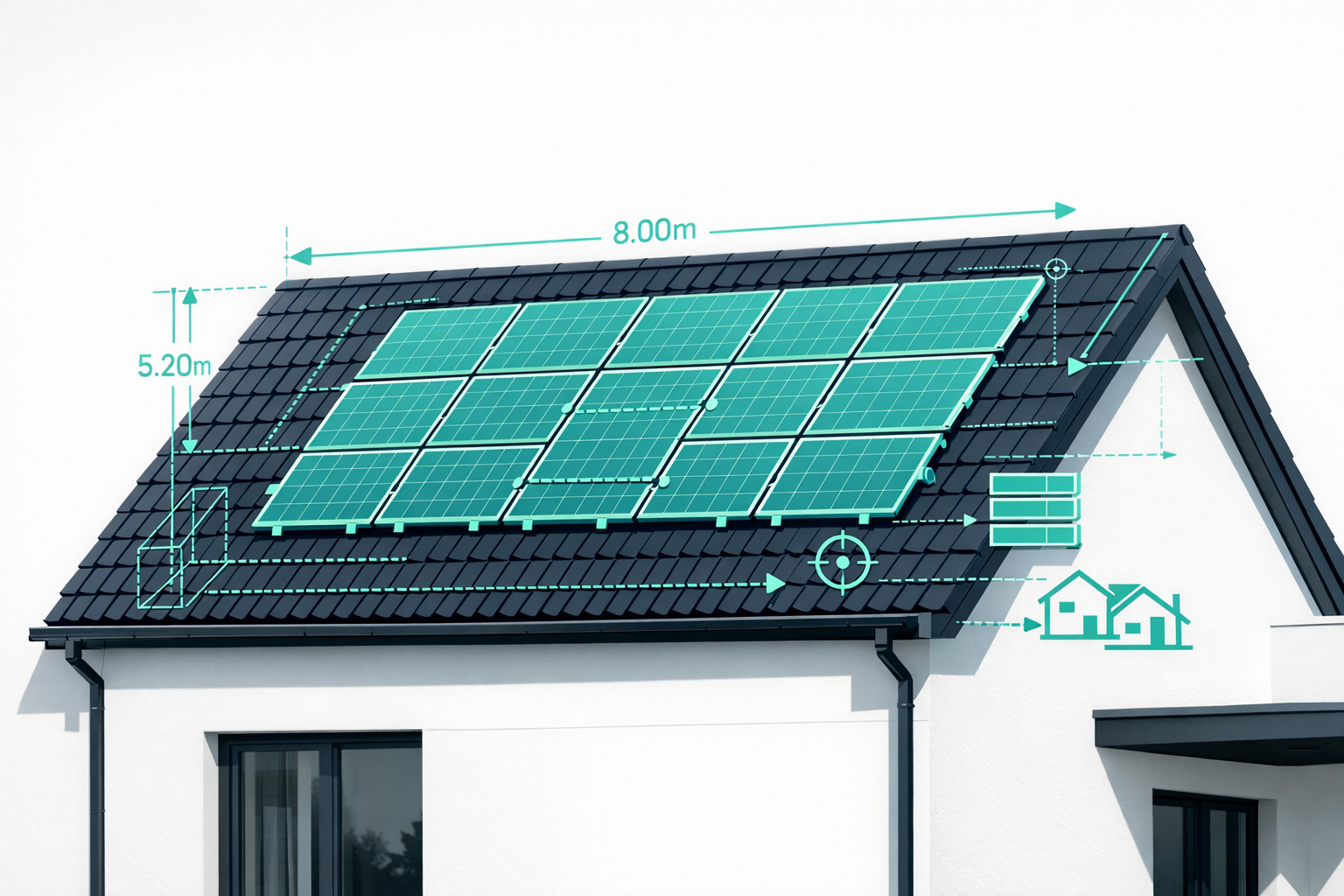
The Airteam Fusion Plattform automatically detects all relevant building elements and generates a complete, dimensionally accurate 3D model - which you can export into all common planning and calculation formats.
This is especially valuable when the solar mandate applies in the context of a roof refurbishment[2]: in that case, one set of digital measurements becomes the basis for both the roof renovation design and the PV system layout - two processes, one drone flight.
Outlook: What happens after 2026?
The EPBD is not a one-off event, but a transformation process with clearly defined milestones:
- 2027: Existing public buildings > 2,000 m² and non-residential buildings > 500 m² must be upgraded with PV when they are renovated
- 2028: Zero-emission standard for new public buildings; energy sharing permitted across wider areas
- 2029: Solar mandate for new residential buildings
- 2030: Solar mandate on all public buildings > 250 m²; residential buildings should use 16% less primary energy
For solar installers this means: order volumes will grow structurally. The question is not whether more PV systems will be installed - but who will plan and install them. Companies with digital planning processes, fast measurements and DIN-compliant documentation will be the most sought-after partners.
Conclusion: Regulatory tailwind - for those who are ready
The EU building directive EPBD 2026 is not a threat, but a growth driver for solar businesses. However, the new levels of complexity, documentation and speed significantly raise the bar for planning.
If you switch to digital 3D roof measurements now, you will not only save time - you will position yourself as a professional, future-ready partner for property owners, housing associations and municipalities.
You can find more details on how to handle PV projects digitally and efficiently from start to finish in this article: From quote to maintenance: The underestimated added value of 3D roof measurement for solar installers.
Must Germany have fully implemented the EPBD by May 2026?
Yes, the majority of the new provisions of the revised EU Building Directive (EPBD 2024) had to be transposed into national law by May 29, 2026. The concrete design—especially for tradespeople, solar installers, and property owners—will subsequently be defined by the amendment to the Building Energy Act (GEG) and the state building codes.
Does the solar obligation apply to existing residential buildings yet?
No, there is no blanket retrofit obligation for existing residential buildings. However, for roof renovations at the state level (e.g., NRW, Schleswig-Holstein, Baden-Württemberg) a solar requirement may apply when more extensive work is carried out. At the EU level, a solar obligation applies to new residential buildings from the end of 2029.
What is Energy Sharing and why is it relevant for solar installers?
Energy Sharing (regulated in § 42c EnWG) refers to the communal use of locally generated renewable electricity via the public grid. From June 2026, PV system operators will be able to sell their excess electricity directly to neighbors or tenants in the same distribution network area — a new business field with higher revenues than the traditional feed-in tariff.
Why are precise 3D measurements essential for planning under the EPBD?
The EPBD requires comprehensive documentation, proofs of energy efficiency, and compliant planning data for renovations and new buildings. Especially for multi-family houses and commercial properties with complex roof geometries, centimeter-accurate 3D models are the basis for reliable shading analysis, correct area calculations and legally compliant project documentation.
Which federal states have already implemented a stricter solar roof requirement?
Among the states with their own solar obligation regulations are, among others, Baden-Württemberg, NRW (from 1 January 2026 for a complete roof replacement also for existing buildings), Schleswig-Holstein, Berlin, and Bavaria. In total, nine states have already introduced binding rules for private residential buildings.